
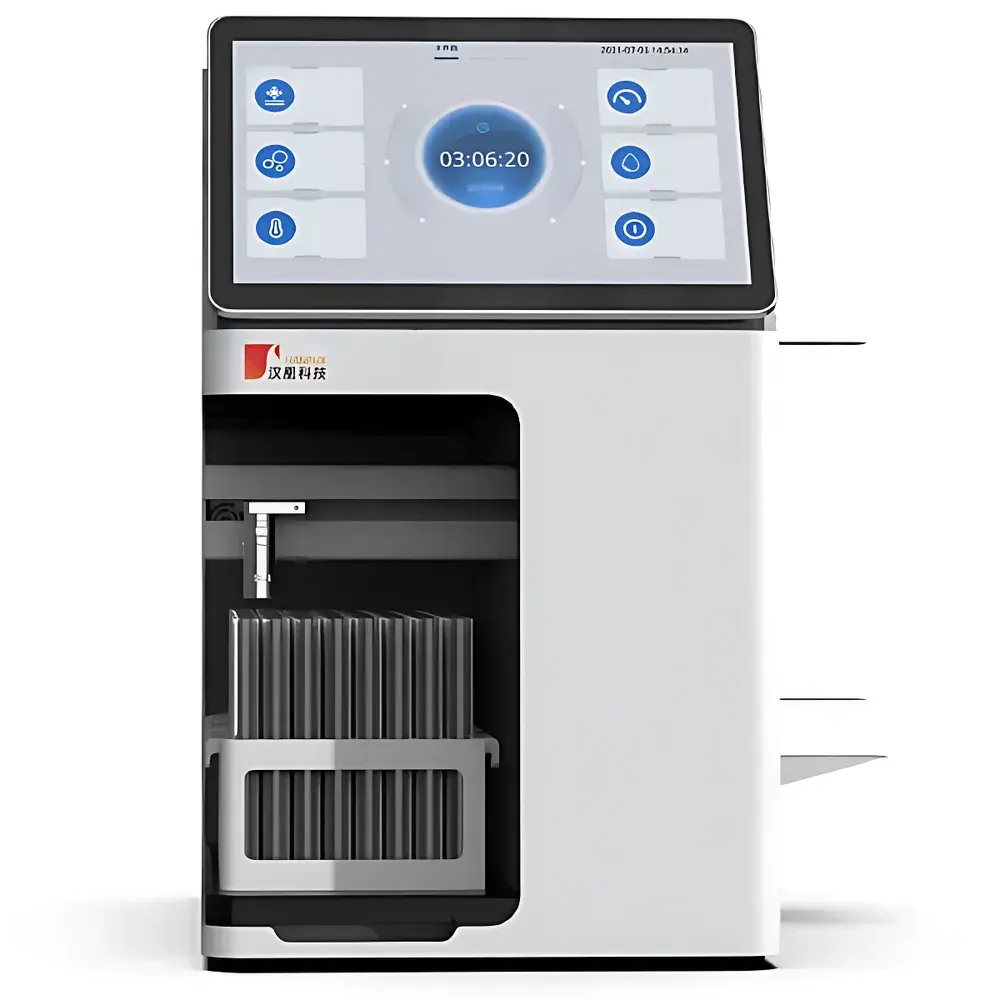
Hanbon Intepure-F 200 Medium-Pressure Preparative Liquid Chromatography System
| Brand | Hanbon |
|---|---|
| Origin | Jiangsu, China |
| Manufacturer Type | OEM Manufacturer |
| Product Category | Domestic |
| Model | Intepure-F 200 |
| Application Level | Laboratory-Scale |
| Instrument Type | Medium-to-Low Pressure Preparative HPLC System |
| Flow Rate Range | 1–200 mL/min |
| Flow Accuracy | ±2% |
| Flow Precision (RSD) | ±2% |
| Maximum Operating Pressure | 200 psi |
| Wavelength Range | 200–400 nm or 200–800 nm |
| Wavelength Reproducibility | ±0.5 nm |
| Baseline Noise | ±5 × 10⁻⁵ AU (254 nm, Time Constant 0.75 s) |
| Data Acquisition Rate | 20 Hz |
Overview
The Hanbon Intepure-F 200 is a medium-pressure preparative liquid chromatography system engineered for reliable, scalable purification of organic compounds, natural products, peptides, and fermentation-derived molecules at the milligram-to-gram scale. It operates on classical liquid chromatography principles—utilizing high-efficiency column packing materials (e.g., silica, C18, amino, cyano phases) and gradient elution to achieve separation based on differential partitioning between mobile and stationary phases. Designed explicitly for laboratory environments where method development, iterative purification, and regulatory-compliant documentation are routine, the system integrates a dual-solvent gradient pump, diode-array detection (DAD), and intelligent fraction collection into a single compact platform. Its pressure rating of 200 psi supports both flash chromatography and semi-preparative applications without requiring ultra-high-pressure hardware—making it ideal for synthetic chemistry labs, natural product isolation workflows, and early-stage process development in pharmaceutical R&D.
Key Features
- Intuitive 15-inch capacitive touchscreen interface with real-time system status visualization—including pump pressure, flow rate, UV absorbance traces, and fraction collector positioning.
- High-precision dual-piston gradient pump with integrated solvent selection valves, delivering stable flow across the full 1–200 mL/min range with ≤±2% accuracy and reproducibility.
- Diode-array detector (DAD) with selectable wavelength ranges (200–400 nm or 200–800 nm), ±0.5 nm wavelength reproducibility, and low baseline noise (±5 × 10⁻⁵ AU at 254 nm), enabling real-time spectral confirmation of eluting peaks.
- Modular open-access fraction collector supporting multiple collection modes: full-collection, waste-collection, threshold-triggered collection (UV peak height/area), and user-defined time-based collection.
- Universal column compatibility—accepts standard commercial flash columns (13 mm to 30 mm i.d.) and accommodates both normal-phase and reversed-phase chemistries without hardware modification.
- Integrated safety architecture including solvent reservoir level sensing, waste container overflow detection, real-time pressure monitoring with automatic shutdown, and built-in purge air pump for post-run line flushing and solvent residue removal.
Sample Compatibility & Compliance
The Intepure-F 200 is validated for use with small-molecule organics, heterocycles, alkaloids, flavonoids, glycosides, linear and cyclic peptides, and polar metabolites. Its flow and pressure specifications align with ASTM D6985 (Standard Practice for Flash Chromatography) and ISO 17025 requirements for method-controlled instrumentation. The system’s software architecture supports audit trail generation, role-based user access control (administrator, operator, reviewer), electronic signature capability, and timestamped event logging—meeting core expectations of FDA 21 CFR Part 11 for electronic records and signatures. All data files are stored in vendor-neutral formats (e.g., .csv, .pdf reports, .jdx spectral exports), facilitating integration into LIMS or ELN platforms under GLP/GMP-aligned quality systems.
Software & Data Management
The embedded ChromaControl™ software provides a structured, workflow-driven interface with clearly segmented functional zones: method editor, run monitor, fraction manager, and report generator. It includes TLC-based gradient recommendation algorithms that estimate initial solvent strength from Rf values—accelerating method scouting. Real-time chromatogram overlays, peak integration with customizable baselines, and automated peak-to-tube mapping enhance traceability. All method parameters, instrument events, and user actions are recorded in an immutable audit log. Data export supports CSV (peak tables), PDF (certified reports), and proprietary binary formats compatible with third-party analysis tools. Software updates are delivered via secure HTTPS with SHA-256 integrity verification.
Applications
- Purification of synthetic intermediates and final APIs during medicinal chemistry campaigns.
- Isolation of bioactive constituents from plant extracts, microbial broths, or marine sources.
- Desalting and buffer exchange of peptide fractions prior to MS or NMR analysis.
- Scale-up support for route scouting—bridging analytical HPLC methods to gram-scale purification.
- Quality control of column-packed materials and solvent system validation per USP and ICH Q5A guidelines.
FAQ
What column dimensions and chemistries are supported?
The system accepts all standard flash columns with internal diameters from 13 mm to 30 mm, including silica, C18, NH₂, CN, and Diol phases—both pre-packed and user-packed cartridges.
Can the DAD acquire full-spectrum data during fraction collection?
Yes—the detector continuously scans across the selected wavelength range (200–400 nm or 200–800 nm) at 20 Hz and stores full spectra for each data point, enabling retrospective peak identification and purity assessment.
Is the software compliant with 21 CFR Part 11?
Yes—audit trails, electronic signatures, user permission tiers, and data immutability features are implemented per current FDA guidance for computerized systems used in regulated environments.
How does the system handle solvent switching between runs?
The integrated air purge pump automatically flushes residual solvents from the flow path after each run, minimizing cross-contamination and reducing equilibration time for subsequent methods.
What is the maximum sample loading capacity per injection?
Loading capacity depends on column dimensions and stationary phase, but typical operation ranges from 1 mg to >5 g per run using 25–30 mm i.d. columns with appropriate flow and gradient optimization.




