

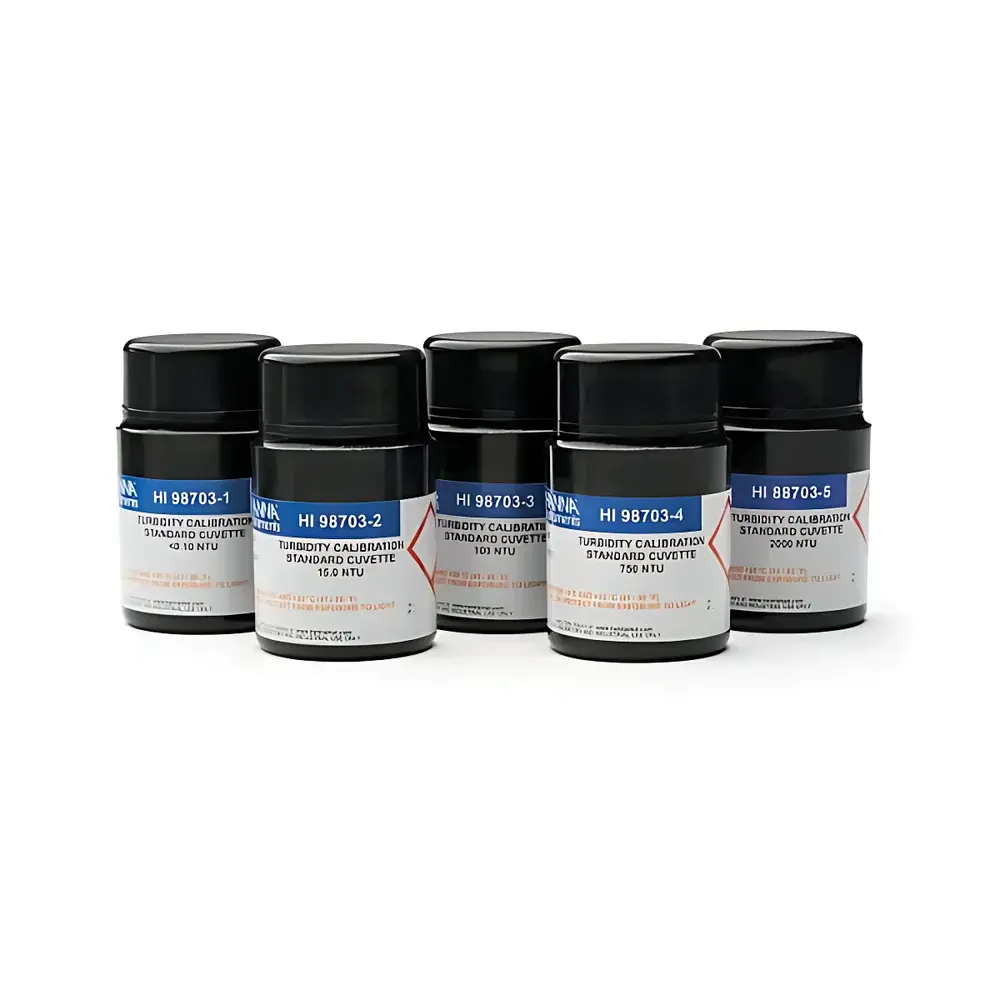
Hanna HI88703-11 EPA-Compliant Turbidity Calibration Standard Set
| Brand | Hanna Instruments |
|---|---|
| Origin | Italy |
| Model | HI88703-11 |
| Calibration Standards | ≤0.1, 15, 100, 750, and 2000 NTU @ 25°C |
| Temperature Range for Use & Storage | 18–25°C (64.5–77°F) |
| Accuracy | ±0.01 NTU for ≤0.1 NTU standard |
| Certifications | EPA Method 180.1 compliant |
| Packaging | Sealed glass cuvettes with lot-specific Certificate of Analysis (CoA) |
| Compliance | Designed for use with HI88703 Portable Turbidimeter per US EPA 40 CFR Part 136 and ASTM D6508 |
Overview
The Hanna HI88703-11 EPA-Compliant Turbidity Calibration Standard Set is a rigorously manufactured reference material suite engineered specifically for routine verification and calibration of the HI88703 Portable Turbidimeter in accordance with U.S. Environmental Protection Agency (EPA) Method 180.1 and ASTM D6508. Unlike generic turbidity standards, this set employs Formazin-based suspensions prepared under ISO/IEC 17025-accredited manufacturing conditions in Hanna’s Italian production facility. Each standard is traceable to National Institute of Standards and Technology (NIST) Standard Reference Material (SRM) 2102, ensuring metrological integrity across environmental monitoring, wastewater treatment, drinking water compliance, and regulatory laboratory workflows. The five-point calibration range—≤0.1, 15, 100, 750, and 2000 NTU—is optimized to span the full operational envelope of EPA-compliant turbidimeters, supporting both low-range precision (e.g., source water clarity assessment) and high-range robustness (e.g., raw influent characterization). All standards are supplied in individually sealed, optically matched glass cuvettes to eliminate inter-cuvette variability and prevent photodegradation or evaporation-induced concentration drift.
Key Features
- EPA Method 180.1 and ASTM D6508 validation—certified for regulatory reporting in municipal and industrial water testing labs
- Lot-specific Certificate of Analysis (CoA) included, documenting traceability to NIST SRM 2102, preparation date, expiration date, and measured values at 25°C
- Five-tier calibration matrix covering critical regulatory thresholds: sub-0.1 NTU (for ultra-pure water), 15 NTU (typical surface water limit), 100 NTU (turbid influent screening), 750 NTU (high-solids process streams), and 2000 NTU (maximum instrument linearity verification)
- Optimized thermal stability: calibrated and certified at 25°C; validated performance within 18–25°C ambient range per EPA temperature control requirements
- Hermetically sealed borosilicate glass cuvettes with integrated optical path length consistency (10 mm pathlength), eliminating user-induced errors from cleaning artifacts or scratches
- No reconstitution or dilution required—ready-to-use upon opening, minimizing operator variability and contamination risk
Sample Compatibility & Compliance
This calibration set is exclusively validated for use with the Hanna HI88703 Portable Turbidimeter operating in EPA mode. It meets the stringent criteria defined in 40 CFR Part 136 for method-defined instruments and supports GLP/GMP audit readiness through documented lot traceability and CoA retention. The standards comply with ISO 7027:2016 for nephelometric measurement geometry and are stable for ≥12 months when stored unopened at 18–25°C in darkness. Once opened, cuvettes must be used immediately and discarded—no recapping or reuse permitted per EPA guidance to prevent microbial growth or particle aggregation that compromises calibration fidelity. The set satisfies FDA 21 CFR Part 11 data integrity expectations when paired with HI88703’s built-in calibration logging and timestamped audit trail.
Software & Data Management
When used with the HI88703 instrument, the HI88703-11 standards enable automated multi-point calibration routines that generate internal reference curves with slope, intercept, and R² validation metrics. All calibration events—including date/time stamp, operator ID (if configured), cuvette ID, and measured vs. nominal NTU deviation—are stored in non-volatile memory and exportable via USB or Bluetooth to LIMS-compatible CSV files. The instrument firmware enforces lockout of measurement mode until successful calibration verification, ensuring data integrity before sample analysis. Audit logs retain full chain-of-custody metadata required for EPA-certified laboratories undergoing third-party accreditation (e.g., NELAC, TNI, or state DOH audits).
Applications
- Verification of turbidity analyzer performance prior to EPA-regulated discharge monitoring (NPDES permits)
- Calibration of portable field meters used in watershed assessments and stormwater runoff studies
- Quality control of drinking water filtration efficiency at treatment plants (per EPA Ground Water Rule and Surface Water Treatment Rule)
- Validation of inline turbidity sensors in pharmaceutical water systems (USP , EP 2.2.27)
- Proficiency testing and inter-laboratory comparison programs requiring traceable Formazin standards
- Training and competency assessment for laboratory technicians performing EPA-approved methods
FAQ
Is the HI88703-11 set compatible with non-Hanna turbidimeters?
No—this set is metrologically optimized for the optical geometry, detector response curve, and firmware calibration algorithms of the HI88703. Cross-platform use may introduce systematic bias exceeding EPA tolerance limits.
What is the shelf life, and how is expiration determined?
Unopened, the set remains valid for 12 months from manufacture date printed on the CoA. Expiration is based on accelerated stability testing per ISO Guide 35, not arbitrary time-based devaluation.
Can I reuse a cuvette after opening?
Absolutely not. EPA Method 180.1 prohibits reuse due to irreversible particle settling, surface adsorption, and potential biofilm formation—even within minutes of exposure.
Why is temperature control (18–25°C) specified for use?
Turbidity measurements are temperature-sensitive; Formazin suspension viscosity and light scattering cross-section vary measurably outside this range, violating EPA’s requirement for standardized measurement conditions.
Does the CoA include uncertainty budgets?
Yes—the Certificate of Analysis reports expanded uncertainty (k=2) for each standard, derived from NIST-traceable gravimetric preparation, spectrophotometric verification, and inter-laboratory comparison data.





