
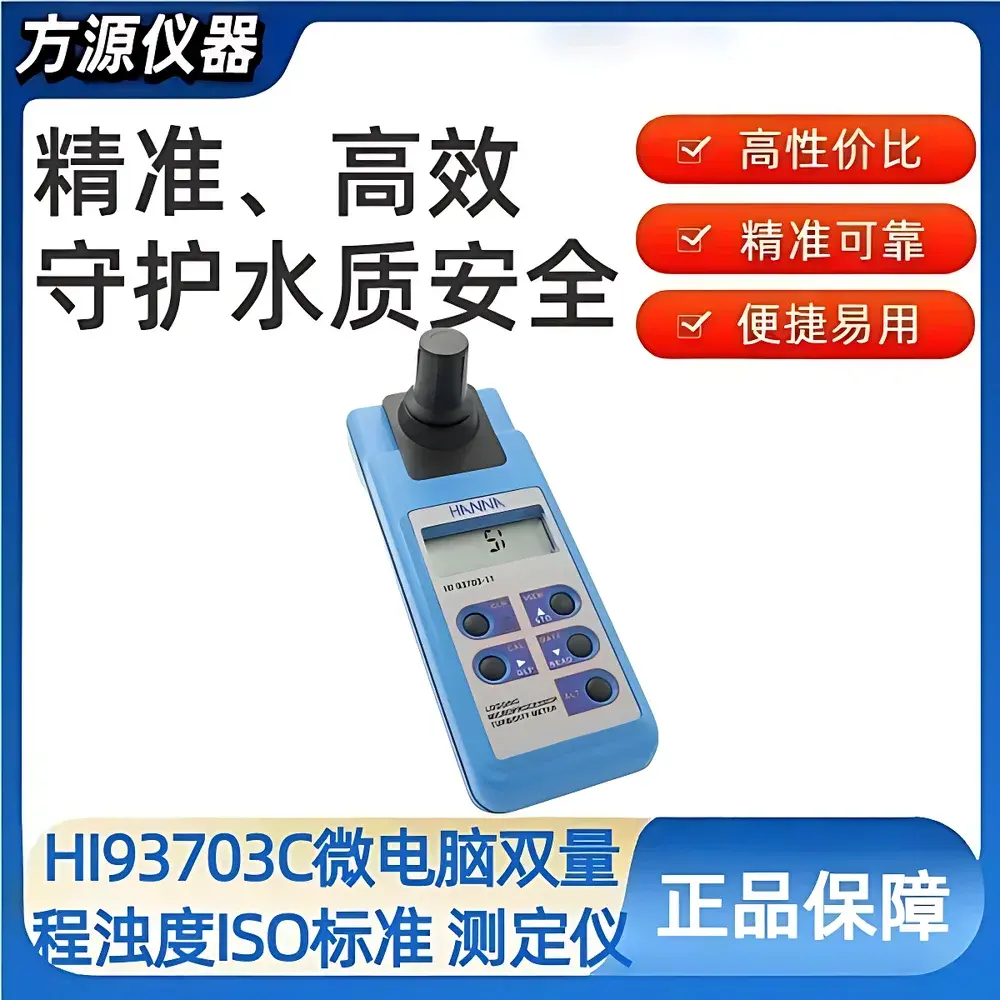
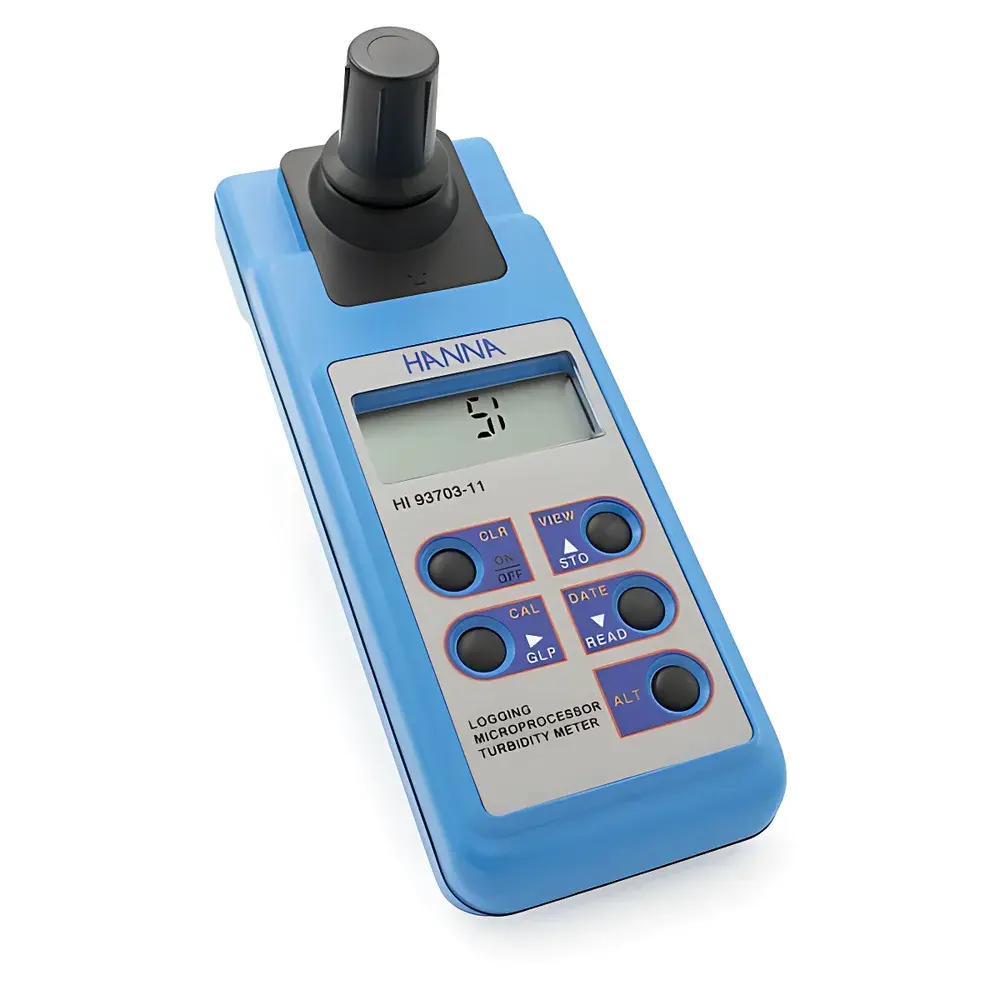
Hanna HI93703C Portable ISO-Compliant Turbidimeter with Dual-Range Measurement
| Brand | Hanna Instruments |
|---|---|
| Origin | Italy |
| Model | HI93703C |
| Instrument Type | Portable |
| Parameter Type | Single-parameter |
| Measurement Range | 0.00 to 1000 FTU |
| Resolution | 0.01 FTU (0.00–50.00 FTU), 1 FTU (50–1000 FTU) |
| Accuracy | ±5% of reading or ±0.5 FTU (whichever is greater) at 25°C/77°F |
| Measurement Principle | Nephelometric turbidity measurement per ISO 7027 |
| Calibration | Manual 3-point calibration (0, 10, 500 FTU) |
| Data Storage | 199 measurement records |
| Interface | RS232 |
| GLP Compliance | Yes (automatic calibration timestamping, calibration history logging) |
| Power | 4 × 1.5 V AA batteries |
| Operating Environment | 0 to 50°C (32 to 122°F), max 95% RH non-condensing |
| Dimensions | 220 × 82 × 66 mm |
| Weight | 510 g |
Overview
The Hanna HI93703C is a portable, microprocessor-based turbidimeter engineered for precise, field- and lab-ready nephelometric turbidity measurement in accordance with ISO 7027:1999. It employs a stable tungsten light source and a custom-designed photodetector positioned at a 90° angle to the incident beam—ensuring high sensitivity to scattered light intensity, the fundamental physical basis of formazin turbidity units (FTU). Unlike transmission-based methods, this geometry minimizes interference from color, absorbance, or particle settling, delivering robust repeatability across diverse water matrices. The instrument features automatic dual-range switching between 0.00–50.00 FTU (0.01 FTU resolution) and 50–1000 FTU (1 FTU resolution), enabling seamless transition from low-turbidity drinking water compliance testing to high-turbidity wastewater or process stream monitoring—without manual range selection or recalibration.
Key Features
- ISO 7027-compliant optical design with 90° nephelometric detection geometry and calibrated tungsten lamp source
- Dual-range measurement architecture: high-resolution mode (0.01 FTU) for sub-50 FTU applications; coarse-resolution mode (1 FTU) for rapid high-range screening
- Hanna-exclusive CAL CHECK™ performance verification system using traceable, temperature-stabilized formazin standards (0, 10, 500 FTU @ 25°C)
- GLP-compliant data management: automatic timestamping of calibrations, storage of calibration values, dates, and operator IDs (where enabled via software)
- Three-point manual calibration with factory-predefined reference points (0, 10, 500 FTU) aligned to ISO 7027 reference materials
- RS232 serial interface for direct connection to PCs or LIMS; supports ASCII data export for audit-trail documentation
- Low-power operation with auto-shutdown after 5 minutes of inactivity; battery life exceeds 200 hours under typical use
- Ergonomic, IP65-rated housing with integrated carrying case (HI710139) for transport and field deployment
Sample Compatibility & Compliance
The HI93703C is validated for aqueous samples meeting ISO 7027 requirements—including potable water, surface water, effluent, and clarified process streams. Its optical path is optimized for standard 25-mm round glass cuvettes (HI731313), minimizing wall-scatter artifacts and ensuring consistent beam geometry. The instrument complies with international regulatory frameworks requiring documented measurement traceability: calibration records satisfy ISO/IEC 17025 clause 7.7 (measurement traceability), while GLP logging supports FDA 21 CFR Part 11–aligned audit readiness when paired with compliant data acquisition software. All supplied calibration standards (HI93703-4) are certified against NIST-traceable formazin reference materials and include batch-specific certificate of analysis with uncertainty statements.
Software & Data Management
Data capture is managed via built-in memory storing up to 199 measurement records, each tagged with date/time stamp, sample ID (user-entered), and measurement range. The RS232 port enables direct transfer to spreadsheet or LIMS environments using standard terminal emulation (e.g., Tera Term, PuTTY) or Hanna’s optional HI92000 Windows software—supporting automated report generation, calibration trend analysis, and electronic signature workflows compatible with GMP/GLP environments. All stored data include metadata on calibration status, last calibration date, and operator-defined identifiers, fulfilling ALCOA+ principles (Attributable, Legible, Contemporaneous, Original, Accurate, Complete, Consistent, Enduring, Available).
Applications
- Drinking water quality control per EPA Method 180.1 and WHO Guidelines for Drinking-water Quality
- Wastewater treatment plant effluent monitoring per ISO 7027 and national discharge regulations
- Pharmaceutical water systems (PW, WFI) where turbidity ≤ 0.1 FTU is required per USP
- Food & beverage process water validation and rinse water clarity assessment
- Environmental field surveys requiring rugged, battery-powered turbidity verification
- Academic and teaching labs performing standardized nephelometry experiments per ASTM D6508
FAQ
What does FTU stand for, and how is it related to NTU or FNU?
FTU (Formazin Turbidity Unit) is the primary unit defined in ISO 7027 for instruments using formazin standards and 90° detection. NTU (Nephelometric Turbidity Unit) is the equivalent term used in EPA and ASTM methods; FNU (Formazin Nephelometric Unit) is identical to FTU but emphasizes the nephelometric principle. All three are numerically interchangeable when measurement conditions align.
Does the HI93703C meet regulatory requirements for drinking water compliance?
Yes—the instrument satisfies ISO 7027:1999 and is routinely deployed in accredited labs for compliance with EU Directive 98/83/EC and U.S. EPA 40 CFR Part 141. Its accuracy specification (±5% or ±0.5 FTU) meets the performance criteria for Class 1 turbidimeters under ISO 7027 Annex A.
Can the HI93703C be used with non-Hanna cuvettes?
Only HI731313 matched glass cuvettes are recommended. Their optical path length, surface finish, and refractive index are factory-matched to the instrument’s optical alignment. Substitution with generic cuvettes introduces systematic error due to scatter variability and thermal expansion mismatch.
Is calibration traceable to national standards?
Calibration standards (HI93703-4) are manufactured under ISO 9001 and certified against NIST SRM 2134a. Each vial includes a certificate listing expanded uncertainty (k=2) and traceability chain to NIST.
How often should CAL CHECK™ verification be performed?
Per ISO/IEC 17025 and internal QA protocols, CAL CHECK™ should be executed before each analytical session and after any environmental shock (e.g., temperature shift >5°C, mechanical impact). Daily verification is recommended for regulated environments.




