
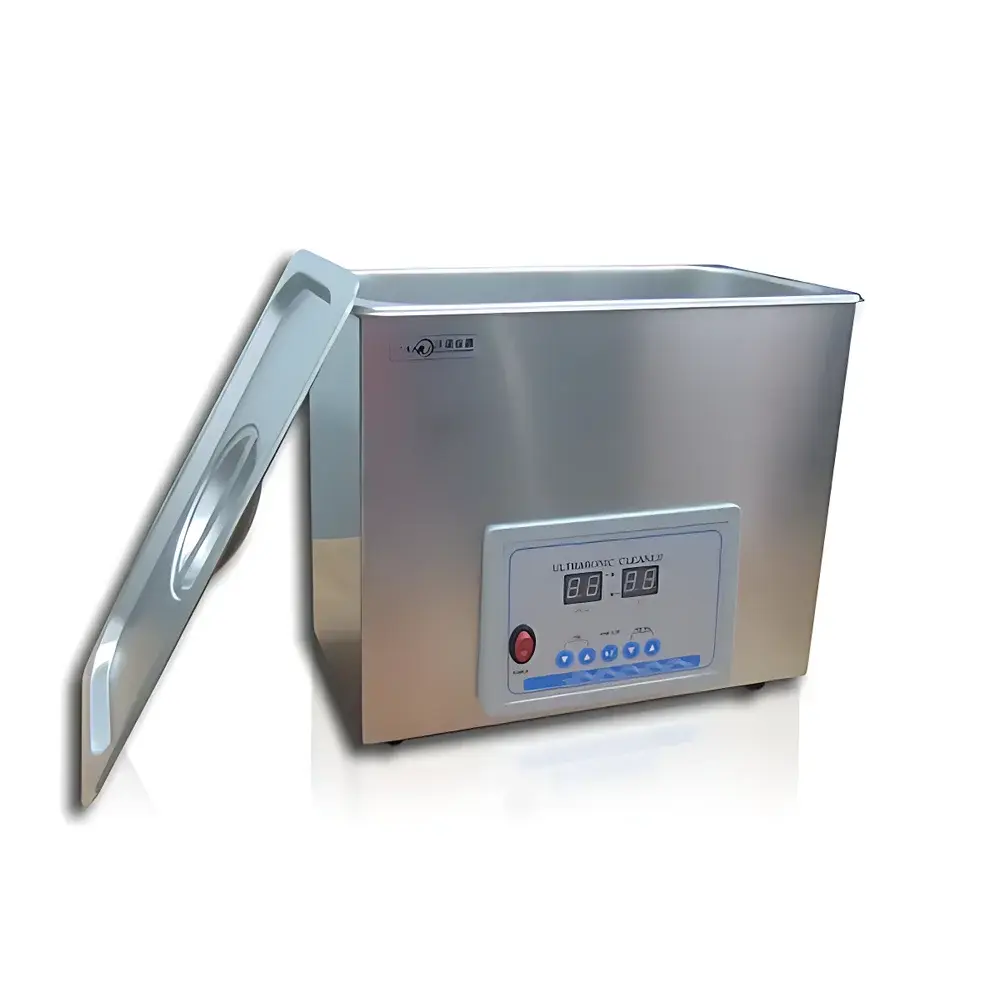
Hannuo HN3-120A Heated Ultrasonic Cleaner
| Brand | Hannuo |
|---|---|
| Origin | Shanghai, China |
| Model | HN3-120A |
| Capacity | 3 L |
| Ultrasonic Frequency | 40 kHz |
| Ultrasonic Power | 120 W |
| Power Adjustment | Fixed |
| Temperature Control Range | RT–80 °C |
| Timer Range | 1–99 min |
| Sound-Dampening Lid | Included |
| Drain Valve | Manual |
| Construction | Stainless Steel Tank & Housing |
| Control System | Microprocessor-Based Digital Display with Auto-Sweep Frequency |
Overview
The Hannuo HN3-120A Heated Ultrasonic Cleaner is a benchtop laboratory-grade ultrasonic cleaning system engineered for precision, repeatability, and operational safety in demanding analytical, quality control, and R&D environments. It operates on the principle of high-frequency acoustic cavitation—generating controlled micro-bubbles in liquid media that collapse violently upon contact with submerged surfaces, producing localized shockwaves and micro-jets capable of dislodging particulate contaminants, organic residues, biofilms, and tightly adhered debris from complex geometries. Integrated resistive heating (RT–80 °C) enhances solvent activity and accelerates dissolution kinetics—particularly beneficial for viscous or temperature-sensitive soils such as waxes, greases, polymers, and proteinaceous residues. Designed to ISO 9001-compliant manufacturing standards and validated for consistent performance across batch-to-batch cleaning cycles, the HN3-120A serves as a foundational tool in GLP-aligned laboratories where traceability, process stability, and equipment qualification are critical.
Key Features
- Microprocessor-controlled digital interface with real-time display of elapsed time and current bath temperature
- Programmable timer (1–99 minutes) with automatic shutdown and audible end-of-cycle alert
- Integrated auto-sweep frequency function (centered at 40 kHz) to maintain uniform energy distribution and prevent standing-wave dead zones
- Stainless steel tank (304 grade) and reinforced housing for corrosion resistance and long-term structural integrity
- Dedicated sound-dampening lid to reduce ambient noise levels to ≤55 dB(A) during operation
- Heating element with PID-based thermal regulation ensuring ±2 °C accuracy across the full 20–80 °C range
- Cumulative operating hour counter (up to 99,999 hours) for preventive maintenance scheduling and audit-ready usage logs
- Single-chip firmware architecture supporting stable, low-drift operation without external software dependencies
Sample Compatibility & Compliance
The HN3-120A accommodates a broad spectrum of sample types and container formats—including glassware (vials, beakers, pipettes), metal components (surgical instruments, calibration standards), polymer substrates (microfluidic chips, sensor housings), and delicate optics (lens assemblies, fiber optic connectors). Its 230 × 140 × 100 mm tank volume supports immersion of standard labware up to 100 mm in height. The unit complies with IEC 61000-6-3 (EMC emissions) and IEC 61000-6-2 (immunity), and meets UL/CSA Class II electrical safety requirements. While not certified for sterile processing per ISO 17664 or AAMI ST79, it is routinely deployed in pre-sterilization cleaning workflows compliant with ISO 15883-1 and ASTM F3127 for reusable medical device reprocessing validation.
Software & Data Management
The HN3-120A operates as a standalone instrument with no proprietary software dependency. All operational parameters—including setpoint temperature, timer duration, and cumulative runtime—are stored in non-volatile memory and persist through power cycling. The digital display provides immediate visual confirmation of active parameters without requiring host PC connectivity. For laboratories implementing 21 CFR Part 11 compliance, optional third-party data loggers (e.g., Omega OM-DAQPRO-5300) may be interfaced via analog output (0–5 V) to record temperature and cycle status. Audit trails can be generated manually via printed log sheets aligned with internal SOPs for equipment use documentation.
Applications
- Pretreatment of HPLC vials, GC autosampler inserts, and electrophoresis trays prior to analysis
- Removal of polishing compounds and oxide layers from metal calibration artifacts and reference standards
- Decontamination of reusable pipette tips, filter holders, and centrifuge rotors in molecular biology labs
- Ultrasonic-assisted extraction of plant metabolites, soil-bound pesticides, or pharmaceutical actives
- Disaggregation of nanoparticle agglomerates and homogenization of colloidal suspensions
- Pre-cleaning of optical components and MEMS devices prior to coating or metrology
- Supporting ASTM D2240 (Shore hardness test specimen preparation) and ISO 16232 (road vehicle component cleanliness testing)
FAQ
Is the HN3-120A suitable for cleaning delicate optics or semiconductor wafers?
Yes—when operated with low-surface-tension, residue-free solvents (e.g., electronic-grade isopropanol or deionized water) and optimized dwell times (typically 2–5 min at 40 °C), it achieves sub-micron particle removal without surface abrasion.
Does the unit support continuous operation beyond 99 minutes?
No—the maximum single-cycle timer is 99 minutes; however, sequential cycles may be initiated manually after cooldown to avoid thermal stress on transducers.
Can the heating function be disabled independently of ultrasonication?
Yes—temperature control is decoupled from ultrasonic activation; users may run cold ultrasonic cleaning or heated static soak modes as required.
What maintenance is required for long-term reliability?
Monthly inspection of tank integrity, quarterly descaling (if using hard water), and annual verification of temperature accuracy using NIST-traceable thermometers are recommended.
Is the stainless steel tank passivated per ASTM A967?
Yes—tanks undergo nitric acid passivation post-fabrication to ensure optimal corrosion resistance in aqueous and mild alkaline cleaning solutions.



