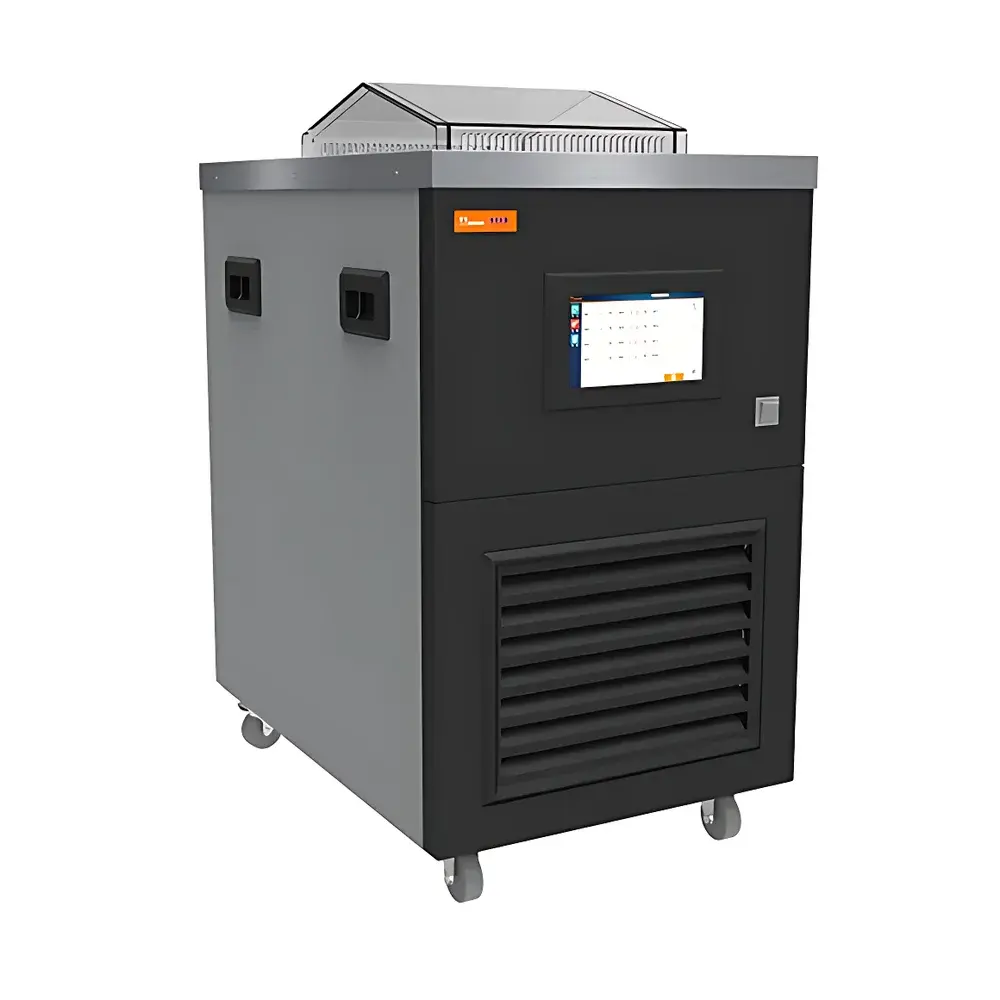
Hanon FCL35-20 Beer Shelf-Life Accelerated Stability Tester
| Brand | Hanon |
|---|---|
| Origin | Shandong, China |
| Model | FCL35-20 |
| Instrument Type | Beer-Specific Accelerated Stability Testing System |
| Application | Laboratory-Based Shelf-Life Prediction |
| Temperature Range | 0–60 °C |
| Temperature Control Accuracy | ±0.05 °C |
| Display Resolution | ±0.01 °C |
| Bath Capacity | 35 L |
| Bath Opening Dimensions | 350 × 270 × 300 mm |
| Sample Capacity | 12 Bottles (adjustable basket) |
| Refrigeration Power | 1.05 kW (at 20 °C), 0.68 kW (at 0 °C), 0.35 kW (at −20 °C) |
| Heating Power | 2 kW |
| Pump Pressure Range | 0–0.8 bar |
| Pump Flow Rate | 0–20 L/min |
| Power Supply | 220 V AC ±10%, 50 Hz |
| Ambient Operating Temperature | 5–40 °C |
| Dimensions (L×W×H) | 640 × 440 × 740 mm |
| Weight | 50 kg |
| Touchscreen | 7-inch Color LCD with Capacitive Touch |
| Connectivity | Dual-band 2.4/5 GHz Wi-Fi Module |
| Compliance | Designed for ASTM E2041, ISO 11348, and internal brewery QC protocols requiring accelerated aging under controlled thermal cycling |
Overview
The Hanon FCL35-20 Beer Shelf-Life Accelerated Stability Tester is an engineered laboratory platform designed to simulate and accelerate the physical and colloidal instability mechanisms that govern beer shelf life—primarily chill haze formation, protein-polyphenol aggregation, and oxidative precipitation. Unlike generic thermal cyclers, the FCL35-20 implements precisely programmable multi-stage thermal profiles—including rapid ramping, precise hold durations, and repeatable cooling/heating transitions—to replicate real-world storage conditions over compressed timeframes. Its core principle relies on controlled thermal stress induction followed by objective turbidity assessment (typically via external spectrophotometric measurement at 760 nm or 800 nm), enabling quantitative correlation between accelerated cycle count and predicted real-time stability (e.g., 1 cycle ≈ 1–3 months ambient storage, depending on formulation). The system operates within a sealed, corrosion-resistant stainless-steel bath environment, ensuring reproducible heat transfer kinetics across heterogeneous bottle geometries and fill volumes.
Key Features
- Programmable thermal cycling architecture supporting up to 999 user-defined methods—each configurable with initial equilibration temperature, target hold temperatures, dwell durations, ramp rates, and total cycle count.
- Integrated liquid-level sensing with automatic power cutoff and audible/visual alarm upon bath fluid depletion—critical for unattended overnight operation and long-term stability studies.
- Dual-stage thermal protection: independent deviation monitoring triggers alarm and shutdown if measured bath temperature deviates >5 °C from setpoint, safeguarding sample integrity and instrument longevity.
- High-efficiency Peltier-assisted heating and refrigeration modules enable ≤15 min ramp from 20 °C to 60 °C and ≤22 min to −20 °C, minimizing thermal inertia artifacts during transition phases.
- ±0.05 °C temperature uniformity across the full 35 L bath volume (validated per ASTM E2041 Annex A), with real-time resolution of ±0.01 °C displayed on the 7-inch capacitive touchscreen interface.
- Dual-band Wi-Fi (2.4/5 GHz) enables secure remote access via Hanon’s dedicated mobile application—supporting live parameter streaming, event logging, push notifications for alarms, and synchronized control of multiple FCL35-20 units within a single lab network.
- Modular stainless-steel sample basket accommodating standard 330 mL, 500 mL, and 650 mL bottles; custom basket configurations available for non-standard container formats (e.g., crowns, swing-top, PET).
- Optically transparent tempered glass bath cover permits continuous visual inspection of sample clarity, sediment formation, and foam stability without interrupting thermal cycles.
- Tool-free removable air-intake grille simplifies routine maintenance of condenser and fan assemblies—reducing downtime in high-throughput QC environments.
- Industrial-grade casters with locking brakes facilitate repositioning across lab floors while maintaining mechanical stability during active thermal cycling.
Sample Compatibility & Compliance
The FCL35-20 is validated for use with all commercially packaged beer types—including lagers, ales, stouts, sour beers, and non-alcoholic variants—across alcohol contents from 0–12% v/v and pH ranges of 3.8–4.8. Its bath geometry and flow dynamics ensure uniform convective heat transfer regardless of bottle material (glass, aluminum, PET) or closure type (crown cap, twist-off, cork). The system meets foundational requirements for GLP-compliant stability testing as defined in ISO/IEC 17025:2017 Clause 7.2.2 (equipment verification) and supports audit-ready data traceability when paired with compliant third-party turbidity analyzers. While not FDA 21 CFR Part 11–certified out-of-the-box, its Wi-Fi logging module exports timestamped CSV files containing setpoint history, actual temperature readings, cycle counters, and alarm events—enabling integration into validated LIMS or ELN platforms meeting 21 CFR Part 11 electronic record requirements.
Software & Data Management
The embedded firmware supports local method storage, cycle progress tracking, and real-time graphing of temperature vs. time. All operational logs—including start/stop timestamps, thermal deviations, alarm triggers, and user login events—are stored internally for ≥12 months. Through the Hanon Connect mobile app (iOS/Android), users can initiate, pause, or abort cycles remotely; download raw log files; configure email/SMS alerts for critical events; and synchronize method libraries across instruments. Exported data conforms to ASTM E1447–22 standards for analytical instrument output formatting, facilitating direct import into statistical analysis tools (e.g., JMP, Minitab) for Arrhenius modeling, Weibull distribution fitting, or shelf-life extrapolation.
Applications
- Predictive shelf-life estimation for new beer formulations prior to commercial launch.
- Comparative stability screening of hop varieties, adjuncts, or fining agents (e.g., silica gel, PVPP).
- Validation of pasteurization efficacy and cold-filtered packaging line performance.
- Root-cause analysis of haze recurrence in production batches exhibiting premature turbidity.
- Supporting regulatory submissions requiring documented thermal stress response data (e.g., EU Regulation No 1169/2011 labeling claims).
- Teaching laboratories demonstrating colloidal stability principles in food science curricula.
FAQ
What turbidity measurement method does the FCL35-20 use?
The FCL35-20 is a thermal cycling platform only—it does not perform turbidity measurements internally. Users integrate it with standardized spectrophotometers (e.g., Hach DR3900, Thermo Scientific Genesys 180) following ISO 7070 or ASBC Method Beer-32.
Can the system operate continuously for 30+ days?
Yes—provided bath fluid level is maintained, ambient temperature remains within 5–40 °C, and scheduled maintenance (e.g., filter cleaning every 200 hours) is performed. Internal diagnostics monitor compressor duty cycle and thermal load in real time.
Is calibration traceable to national standards?
Temperature sensors are factory-calibrated against NIST-traceable references; certificate of conformance is supplied. Users may perform field verification using a calibrated PT100 probe per ASTM E74–21 Section 8.
Does the instrument support external trigger signals?
Yes—the rear I/O panel includes TTL-compatible dry-contact inputs for synchronization with external turbidity analyzers or PLC-based lab automation systems.
What maintenance intervals are recommended?
Air intake filters: weekly inspection, monthly cleaning. Bath fluid: replace every 6 months or after 1,000 operating hours. Refrigerant integrity check: annually by authorized service technician.