
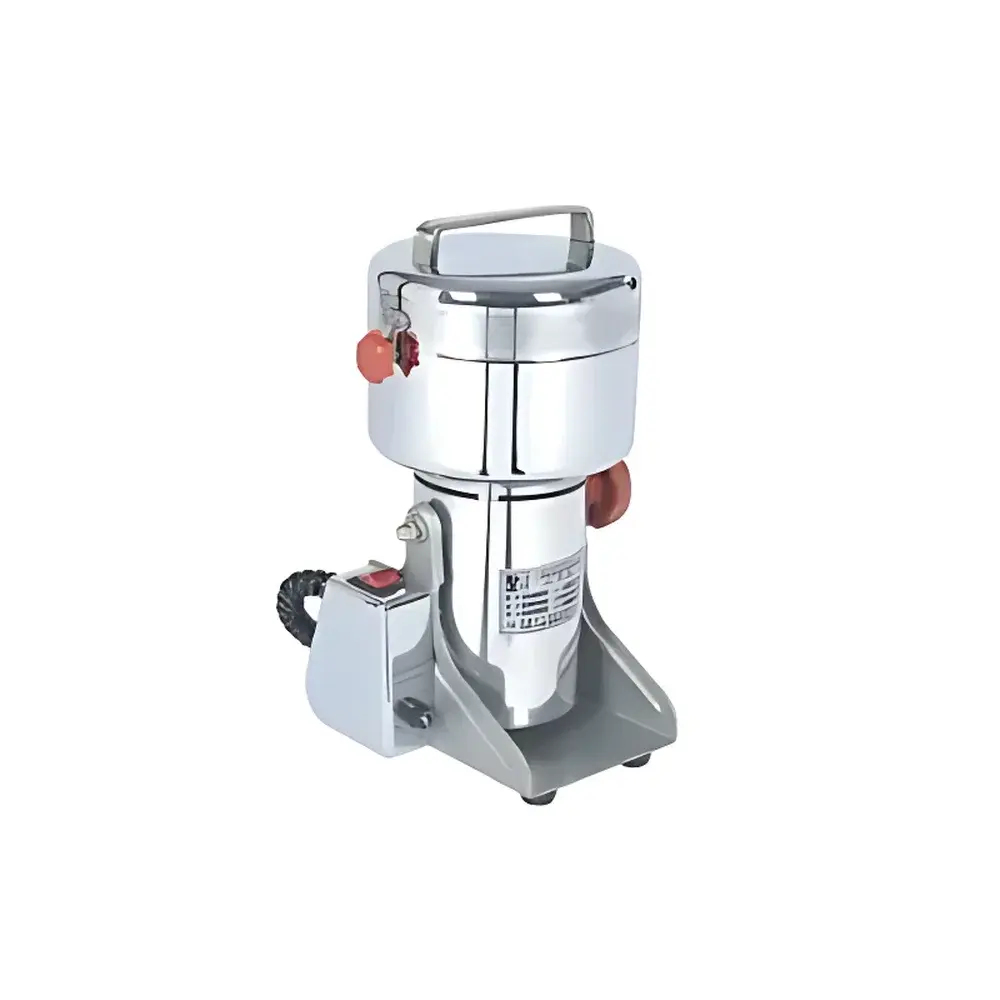
Hanuo DFY-200A High-Speed Oscillating Solid Sample Grinder
| Brand | Hanuo |
|---|---|
| Origin | Shanghai, China |
| Model | DFY-200A |
| Motor Speed | 25,000 rpm |
| Power | 900 W |
| Batch Capacity | 200 g |
| Output Particle Size | ≤200 mesh (74 µm) |
| Input Max. Particle Size | ≤5 mm |
| Grinding Chamber Dimensions | 134 × 97 mm |
| Overall Dimensions | 20 × 22 × 28 cm |
| Construction | Stainless Steel Grinding Bowl & Blades |
| Application | Hard, brittle, fibrous, and moderately tough solid samples |
Overview
The Hanuo DFY-200A High-Speed Oscillating Solid Sample Grinder is a compact, high-efficiency laboratory grinding instrument engineered for rapid size reduction of dry, solid biological, herbal, mineral, and pharmaceutical materials. Operating on the principle of high-frequency oscillatory impact—where a stainless-steel grinding blade rotates at 25,000 rpm within a fixed stainless-steel bowl—the device generates intense shearing, impact, and friction forces to achieve uniform particle size distribution in seconds. Unlike rotary cutters or planetary ball mills, the oscillating design minimizes heat buildup and sample oxidation, preserving thermolabile compounds and structural integrity during processing. Its 900 W brush motor delivers consistent torque across variable load conditions, supporting reproducible preparation of samples destined for elemental analysis (e.g., ICP-OES), HPLC, XRD, or pharmacopeial testing. The DFY-200A is designed for benchtop use in QC laboratories, botanical research facilities, and regulatory-compliant formulation development environments.
Key Features
- Stainless-steel grinding chamber and blade assembly ensure corrosion resistance, non-contamination, and compliance with USP General Chapter <1118> for equipment material suitability in pharmaceutical sample prep.
- Oscillating high-speed rotor architecture enables rapid comminution (3–120 s typical cycle time) without external cooling, reducing risk of volatile loss or thermal degradation.
- Precision-machined bowl geometry (134 × 97 mm) and optimized blade clearance guarantee homogeneous energy transfer and minimal residual sample retention (<0.5% carryover).
- Fixed-speed operation at 25,000 rpm eliminates speed variability, ensuring inter-batch repeatability critical for GLP and ISO/IEC 17025-accredited workflows.
- Compact footprint (20 × 22 × 28 cm) and low acoustic emission (<72 dB(A)) support integration into shared lab spaces and laminar flow hoods.
- Interlocked safety lid with automatic motor cutoff prevents operation during access—meeting IEC 61000-6-2 EMC and IEC 60335-1 mechanical safety requirements.
Sample Compatibility & Compliance
The DFY-200A is validated for hard, brittle, and moderately fibrous solids including dried plant tissues (e.g., Astragalus membranaceus, Panax notoginseng), animal-derived materials (e.g., seahorse, pearl powder), resins (e.g., frankincense), and mineral herbs (e.g., gypsum, calcite). It accepts feed particles up to 5 mm in maximum dimension and consistently reduces them to ≤200 mesh (D90 ≤ 74 µm) under standard operating conditions. The grinder is unsuitable for wet, oily, sticky, or highly elastic samples (e.g., fresh roots, gums, polymers). All contact surfaces comply with FDA 21 CFR Part 117 (food contact) and ISO 8573-1 Class 4 air purity standards when used with optional HEPA-filtered exhaust adapters. Documentation includes CE Declaration of Conformity, RoHS compliance certificate, and material traceability reports for SS304 components.
Software & Data Management
The DFY-200A operates as a standalone electromechanical device with no embedded microprocessor or digital interface. However, its deterministic performance profile (fixed speed, timed operation via mechanical timer) supports full auditability under regulated environments. Users may integrate it into electronic lab notebook (ELN) workflows by logging batch ID, sample weight, grind duration, and sieve verification results manually or via barcode-scanned SOPs. For GMP/GLP applications, the unit is compatible with third-party time-stamped video monitoring systems and can be included in equipment qualification protocols (IQ/OQ/PQ) per ASTM E2500 and Annex 11 guidance. Calibration records for timer accuracy (±0.5 s tolerance) and torque verification are recommended annually.
Applications
- Preparation of homogenized reference materials for quantitative elemental analysis (ICP-MS, AAS) in herbal quality control labs.
- Routine size reduction of pharmacopoeial crude drugs prior to dissolution testing (USP <711>) or content uniformity assays.
- Generation of fine powders for X-ray diffraction phase identification and crystallinity assessment.
- Supporting AOAC 990.10 and ISO 17072-1 compliant sample prep for heavy metal screening in traditional medicine products.
- High-throughput pretreatment of botanical specimens in ethnopharmacological research requiring morphologically intact yet finely divided tissue.
FAQ
What types of samples are incompatible with the DFY-200A?
Wet, viscous, oily, or highly elastic materials—including fresh plant matter, gums, waxes, and synthetic polymers—will cause clogging, blade slippage, or inconsistent particle distribution.
Is the grinding chamber autoclavable?
No. While constructed from SS304, the sealed motor housing and timer mechanism are not rated for steam sterilization. Cleaning is performed via ethanol wipe-down and ultrasonic bath (non-corrosive detergent only).
Can the DFY-200A achieve sub-10 µm particle sizes?
Not reliably. Its oscillating impact mechanism is optimized for 30–200 mesh (600–74 µm); achieving finer distributions requires downstream milling (e.g., cryogenic ball milling) or jet milling.
Does Hanuo provide validation documentation for GMP use?
Yes—upon request, Hanuo supplies Equipment Specification Documents (ESD), Factory Acceptance Test (FAT) reports, and Material Certificates (EN 10204 3.1) for all DFY-series units shipped to regulated markets.
How often should the grinding blade be replaced?
Under normal use (≤50 batches/week of herbal materials), blade replacement is recommended every 12–18 months or after visible edge wear exceeding 0.1 mm depth, verified via optical profilometry.



