
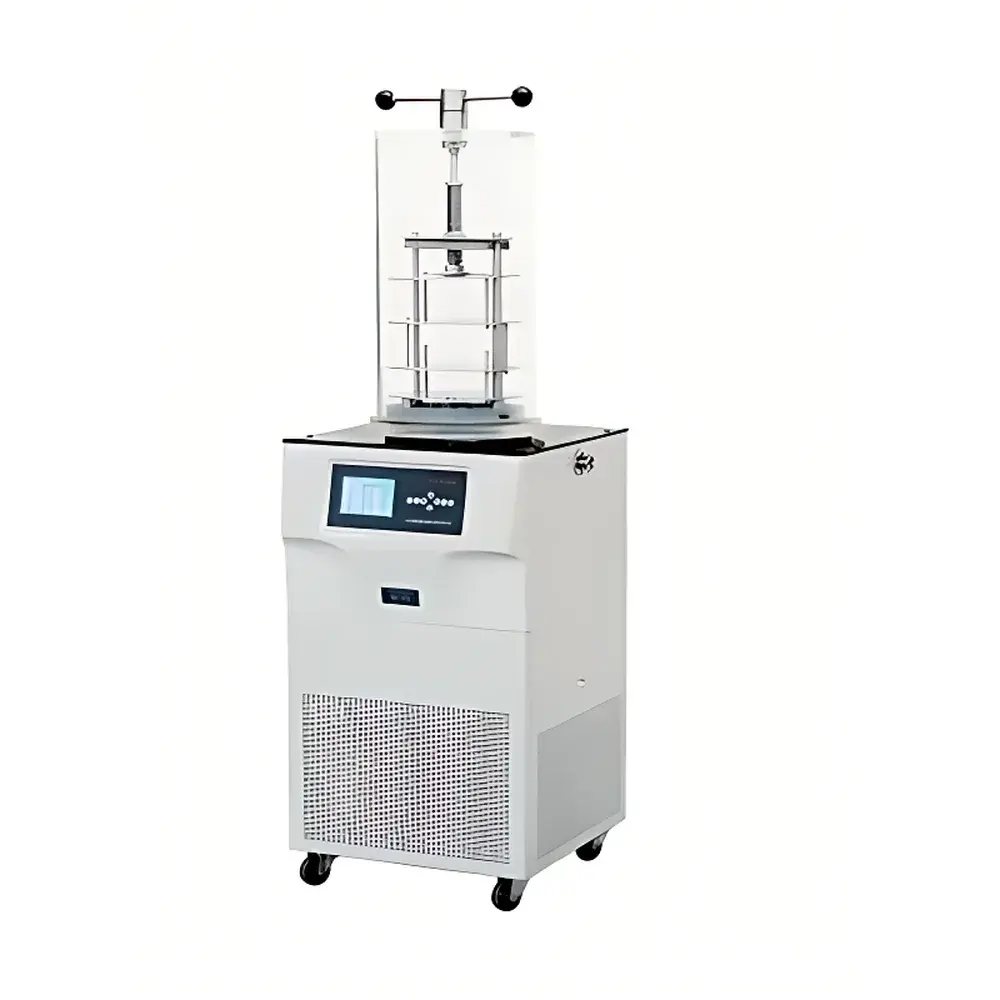
Hanuo FD-2B Pilot-Scale Freeze Dryer
| Brand | Hanuo |
|---|---|
| Origin | Shanghai, China |
| Model | FD-2B (Pilot-Scale, Shelf-Heating, Vacuum Freeze Dryer) |
| Type | Standard Shelf-Type Freeze Dryer |
| Application Scope | Pilot-Scale Processing |
| Lyophilization Area | 0.12 m² |
| Ultimate Vacuum | < 13 Pa |
| Condenser Temperature | < −70 °C |
| Ice Capacity | 6 kg/24 h |
| Overall Dimensions | W 540 × D 720 × H 960 mm |
| Power Supply | 220 V, 50 Hz, 1800 W |
| Condenser Chamber | Φ280 × 420 mm |
| Sample Tray | Φ225 mm, 3-layer |
| Tray Capacity | 1.2 L |
| Refrigeration System | Dual-Compressor Cascade Cooling |
| Control Interface | Large LCD Display with Programmable Freeze-Drying Cycle Memory |
| Standard Configuration | Vertical Main Unit, 2 L Domestic Vacuum Pump, Pressure-Seal Shelf-Heating Drying Chamber (3 Trays) |
Overview
The Hanuo FD-2B is a pilot-scale, shelf-heating vacuum freeze dryer engineered for reproducible lyophilization of thermolabile substances under controlled low-temperature and high-vacuum conditions. Based on the principle of sublimation—where ice transitions directly from solid to vapor phase without passing through liquid—the FD-2B enables gentle dehydration of sensitive biologics including monoclonal antibodies, recombinant proteins, live attenuated vaccines, diagnostic enzyme reagents, and sterile pharmaceutical intermediates. Its dual-compressor cascade refrigeration system achieves condenser temperatures below −70 °C, ensuring efficient water vapor capture during primary drying and minimizing thermal load on heat-sensitive samples. Designed as a floor-standing unit with casters for mobility, the FD-2B bridges the gap between laboratory-scale feasibility studies and small-batch cGMP-compatible process development—supporting scale-up pathway validation in accordance with ICH Q5C and USP .
Key Features
- Pilot-scale capacity with 0.12 m² shelf area and 1.2 L total tray loading volume (three Φ225 mm trays), suitable for batch sizes ranging from 500 mL to 2 L per cycle
- Shelf-integrated electric heating system enabling precise temperature control during secondary drying (desorption phase), critical for residual moisture reduction and stability optimization
- Dual-stage cascade refrigeration architecture delivering sustained condenser performance at ≤ −70 °C, validated for continuous 24-hour operation with 6 kg ice capture capacity
- Programmable LCD controller with non-volatile memory for up to 32 freeze-drying cycles; supports ramp-hold profiles, real-time parameter logging (shelf temp, chamber pressure, condenser temp), and curve export via USB
- Integrated pressure-seal lid mechanism compatible with vial stoppering under vacuum or inert gas backfill—enabling aseptic handling and container closure integrity testing preparation
- Robust stainless-steel construction (304 grade chamber and condenser), CE-compliant electrical safety design, and IP20-rated enclosure for standard laboratory environments
Sample Compatibility & Compliance
The FD-2B accommodates a wide range of sample formats—including serum vials (10–50 mL), glass Petri dishes, custom aluminum pans, and multi-well plates—provided they conform to maximum tray diameter (Φ225 mm) and height constraints (< 120 mm). It meets essential requirements for GLP-compliant documentation: all cycle parameters are timestamped and stored internally with audit-trail capability (user ID, start/stop time, deviations). While not pre-certified to FDA 21 CFR Part 11, its data export functionality supports integration into validated LIMS or ELN systems for electronic record retention. The system operates within ISO 22000 and ASTM F2476-20 environmental limits for laboratory freeze-drying equipment, and its vacuum performance aligns with ISO 13485 Annex C specifications for medical device sterilization process development.
Software & Data Management
The embedded controller provides full-cycle automation with adjustable setpoints for shelf temperature (−50 °C to +60 °C), chamber pressure (0.1–100 Pa), and condenser temperature monitoring. All operational data—including real-time curves for shelf temp, chamber pressure, and condenser temp—are logged at user-defined intervals (1–60 sec resolution) and saved to internal flash memory. Export is supported via USB 2.0 port in CSV format for post-processing in MATLAB, Python (pandas), or commercial statistical software (JMP, Minitab). Optional RS-485 Modbus RTU interface enables remote supervision and integration with building management systems (BMS) or central SCADA platforms in regulated facilities.
Applications
- Process development of lyophilized drug products under QbD frameworks, including design space exploration for shelf temperature ramps and hold times
- Stability-indicating studies per ICH Q1A(R3), supporting accelerated and long-term storage condition assessments
- Pre-formulation screening of cryoprotectants (e.g., sucrose, trehalose) and bulking agents using controlled nucleation and annealing protocols
- Biobanking of primary cell lines, microbial cultures, and tissue homogenates requiring ultra-low residual moisture (< 1.5% w/w)
- Food science research involving probiotic preservation, botanical extract stabilization, and functional ingredient encapsulation
- Academic and contract research organization (CRO) workflows requiring GxP-aligned documentation and traceable parameter recording
FAQ
What is the maximum allowable sample volume per cycle?
Up to 1.2 L distributed across three Φ225 mm trays; optimal loading density is 5–10 mm depth for uniform drying.
Does the FD-2B support automatic pressure rise test (PRT) or leak rate verification?
No built-in PRT function; however, chamber pressure decay can be manually monitored via the LCD interface over 30–60 minute intervals for qualitative leak assessment.
Can the system be connected to an external vacuum pump?
Yes—the rear-mounted vacuum port accepts standard KF-25 or ISO-KF flange adapters; compatibility with oil-free scroll pumps (e.g., Edwards nXDS) is confirmed for cleanroom applications.
Is the heating shelf calibrated traceable to NIST standards?
Factory calibration certificates are provided; users may perform field verification using Class A PT100 probes inserted into designated shelf sensor ports.
What maintenance intervals are recommended for the dual-compressor system?
Compressor oil inspection every 1,000 operating hours; condenser coil cleaning every 3 months in high-humidity environments; vacuum pump oil replacement every 500 hours or per manufacturer’s specification.



