
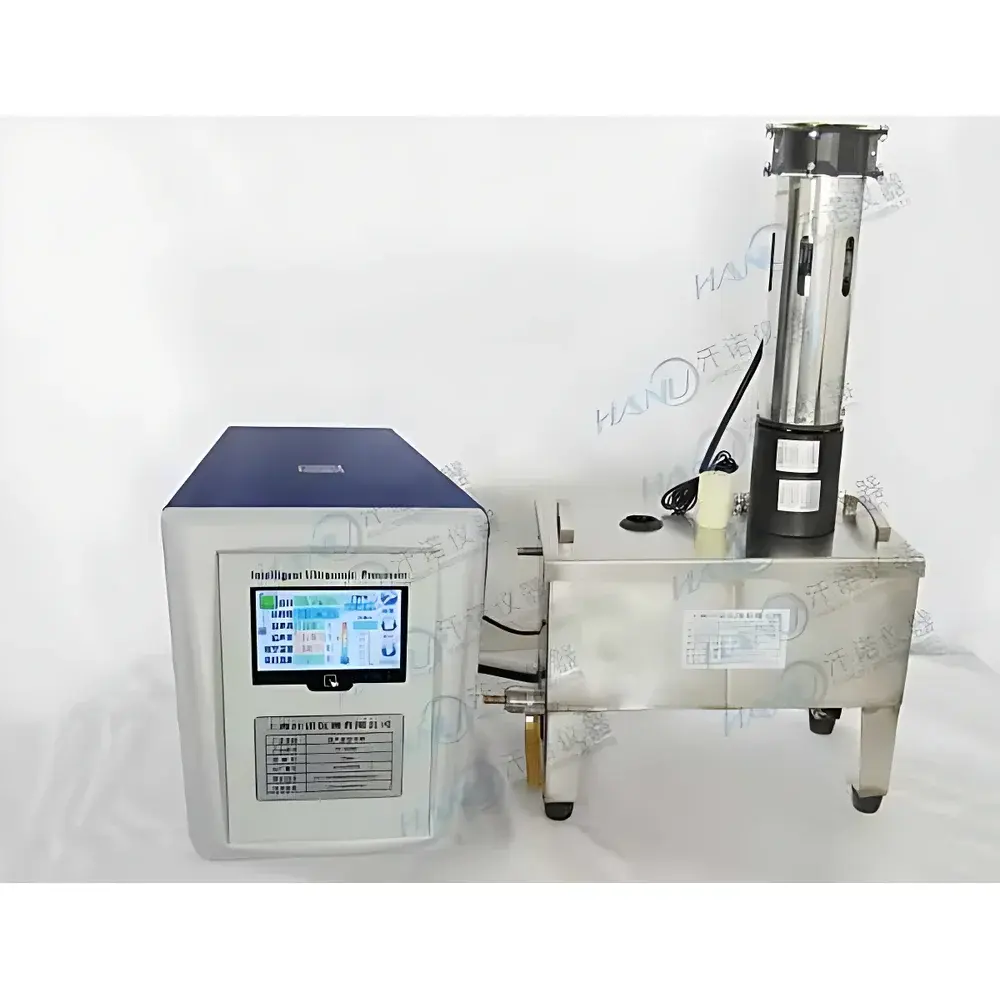
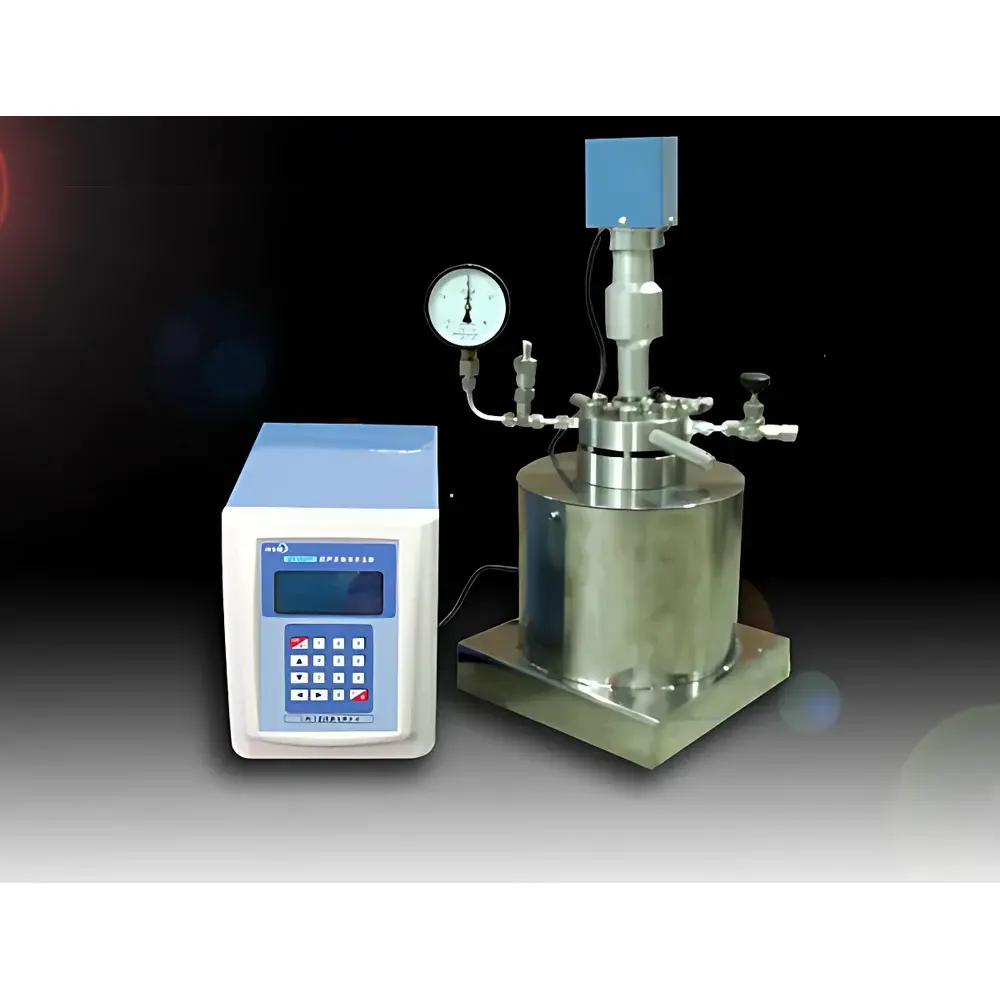
Hanuo HANUO-6000 Industrial Continuous-Flow Ultrasonic Disperser
| Brand | Hanuo |
|---|---|
| Origin | Shanghai, China |
| Manufacturer Type | Authorized Distributor |
| Country of Origin | China |
| Model | HANUO-6000 |
| Ultrasonic Power Output | 500–6000 W |
| Frequency | 20 kHz |
| Maximum Heating Power | 2000 W |
| Temperature Range | 0–100 °C |
| Process Volume | 500–5000 mL (expandable to 20 L / 50 L / 100 L with optional reactors) |
| Display | 4.3″ TFT touchscreen |
| Control Interface | Touchscreen-based centralized microprocessor control |
| Pulse Mode | Adjustable on/off interval from 0.1–99.9 s |
| Total Timer | 0–99 h 59 min 59 s |
| Temperature Monitoring & Feedback Control | Yes |
| Automatic Frequency Tracking | Yes |
| Safety Protections | Overtemperature, overload, and fault self-diagnosis with audible/visual alarm |
| Data Storage | 20 programmable protocols with password protection |
| Optional Accessories | Titanium alloy sonotrodes (Φ20, Φ25, Φ35, Φ40, Φ50 mm) |
Overview
The Hanuo HANUO-6000 Industrial Continuous-Flow Ultrasonic Disperser is an engineered solution for scalable, reproducible ultrasonic processing in laboratory and pilot-scale production environments. It operates on the principle of high-intensity acoustic cavitation—generated by a 20 kHz piezoelectric transducer system—to induce localized extreme conditions (up to ~5000 K and ~1000 atm) within liquids. These transient microenvironments drive physical and chemical effects including cell lysis, particle deagglomeration, emulsification, solvent extraction, and reaction acceleration. Unlike batch-mode ultrasonicators, the HANUO-6000 supports true continuous-flow operation via integrated pump-compatible reactor configurations, enabling consistent energy delivery across variable throughput rates. Its modular architecture accommodates volume scalability—from 500 mL benchtop trials to 100 L process validation—while maintaining acoustic field homogeneity through optimized horn-to-reactor coupling and active frequency tracking.
Key Features
- Adjustable ultrasonic power output (500–6000 W) with real-time digital feedback for precise energy dosing
- Intelligent 20 kHz frequency auto-tracking to maintain resonance stability under varying load conditions (e.g., viscosity shifts, temperature drift)
- Integrated PID temperature control (0–100 °C) with immersion probe monitoring and programmable heating/cooling profiles
- Programmable pulse mode (0.1–99.9 s on/off intervals) to manage thermal load and prevent sample degradation during extended treatments
- 4.3″ high-resolution TFT touchscreen interface supporting multi-parameter scripting, protocol recall, and user-level password protection
- Dual-safety architecture: hardware-based overtemperature cutoff + software-driven fault diagnostics (transducer impedance anomaly, power mismatch, coolant flow interruption)
- Modular reactor compatibility: interchangeable titanium sonotrodes (Φ20–Φ50 mm), double-jacketed borosilicate vessels (500–2000 mL), and 304 stainless steel jacketed tanks/reactors (with external chiller loop integration)
Sample Compatibility & Compliance
The HANUO-6000 processes diverse sample matrices—including aqueous suspensions, organic solvents, viscous polymer solutions, and heterogeneous biological slurries—without requiring chemical additives or phase-transfer catalysts. Its non-invasive, solvent-free mechanism aligns with green chemistry principles (ACS GCI Principles #2, #9). For regulated environments, the device supports audit-ready operation: all parameter changes, runtime logs, and temperature/power traces are timestamped and stored locally (20 protocol slots with encrypted access). While not certified as GMP-compliant out-of-the-box, its programmable logic, error logging, and protocol locking make it suitable for GLP-aligned workflows and pre-IND extractive process development per ICH Q5A and USP . All electrical components meet CE/IEC 61000-6-3 (EMC) and IEC 61010-1 (safety) standards.
Software & Data Management
Control firmware implements deterministic real-time scheduling for synchronized actuation of ultrasonic output, thermal regulation, and timing sequences. Each saved protocol includes full parameter metadata: target temperature setpoint, ramp rate, hold duration, power ramp profile, pulse duty cycle, and final cooldown sequence. Exportable CSV logs capture second-by-second values for temperature, applied wattage, and elapsed time—enabling post-run statistical process analysis (e.g., Cp/Cpk calculation for extraction yield consistency). No cloud dependency: data remains resident on-device unless manually exported via USB 2.0 port. Firmware updates are delivered via signed binary files to ensure integrity verification prior to installation.
Applications
- Cell disruption for intracellular protein recovery (E. coli, yeast, mammalian suspension cultures)
- Ultrasound-assisted extraction (UAE) of polyphenols, alkaloids, and terpenoids from botanical matrices (e.g., Artemisia annua, Camellia sinensis)
- Nanomaterial synthesis: exfoliation of graphene oxide, dispersion of carbon nanotubes, and stabilization of metal-organic frameworks (MOFs) in aqueous colloids
- Emulsion formation for pharmaceutical nanoemulsions (e.g., lipid-based drug delivery systems meeting USP droplet size criteria)
- Homogenization of vaccine adjuvant suspensions (alum, squalene-in-water) prior to sterile filtration
- Accelerated leaching of rare earth elements from spent Ni–MH battery cathodes under mild acidic conditions
FAQ
What is the maximum recommended flow rate for continuous-mode operation?
For optimal cavitation efficiency and thermal management, the system supports 0.5–5 L/min depending on reactor geometry and fluid properties; higher rates require auxiliary cooling and larger-diameter sonotrodes.
Can the HANUO-6000 be integrated into a PLC-controlled production line?
Yes—RS-485 Modbus RTU communication port enables bidirectional handshake with industrial controllers for start/stop commands, status reporting, and real-time parameter readback.
Is validation documentation available for IQ/OQ protocols?
Hanuo provides a vendor-specific User Requirement Specification (URS) template and factory test reports (including frequency sweep verification, power calibration certificates, and thermal uniformity mapping) to support customer-led qualification.
How does the system handle highly viscous samples (e.g., >10,000 cP)?
Viscosity above 2000 cP reduces cavitation intensity; we recommend pre-dilution, elevated temperature operation (≤80 °C), or use of the Φ50 mm high-amplitude sonotrode with forced circulation.
Are replacement parts subject to export controls?
Titanium sonotrodes and piezoceramic stacks are classified under EAR99; no license is required for shipment to most OECD countries, but end-use verification may apply for military or nuclear applications.



