
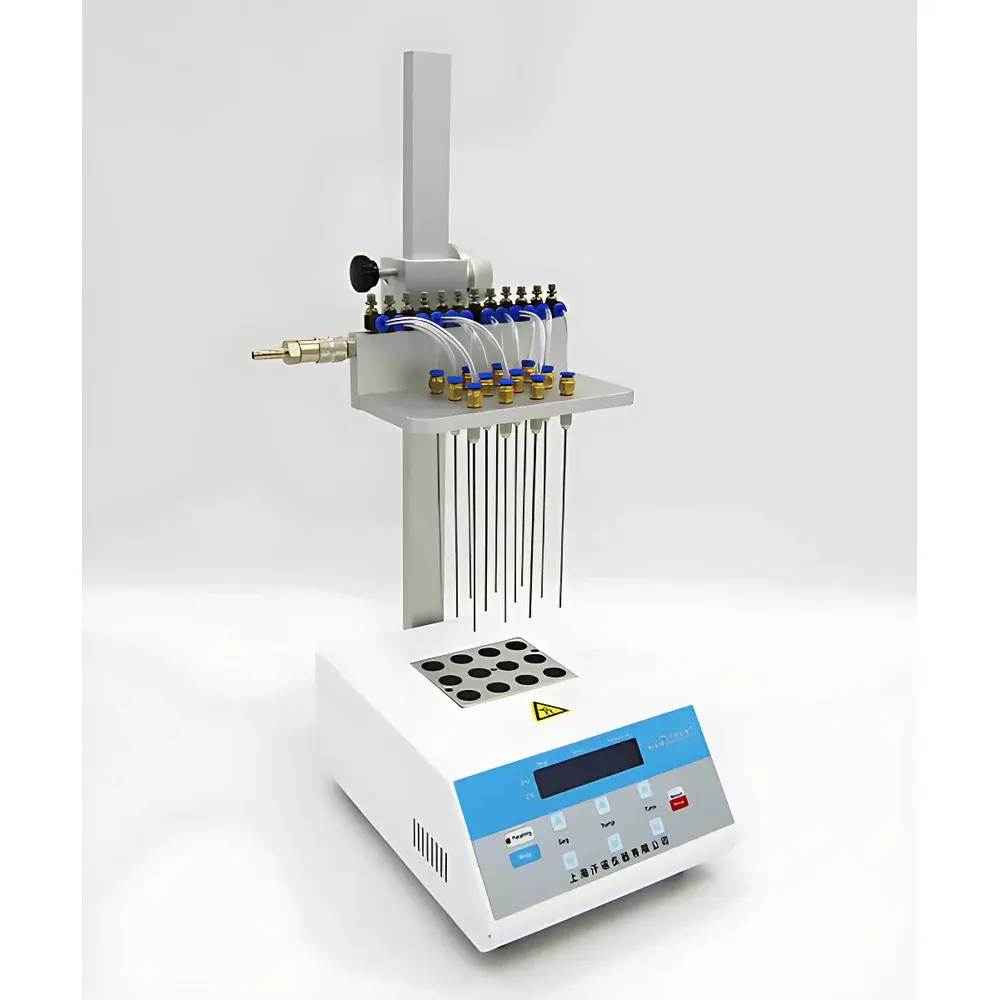
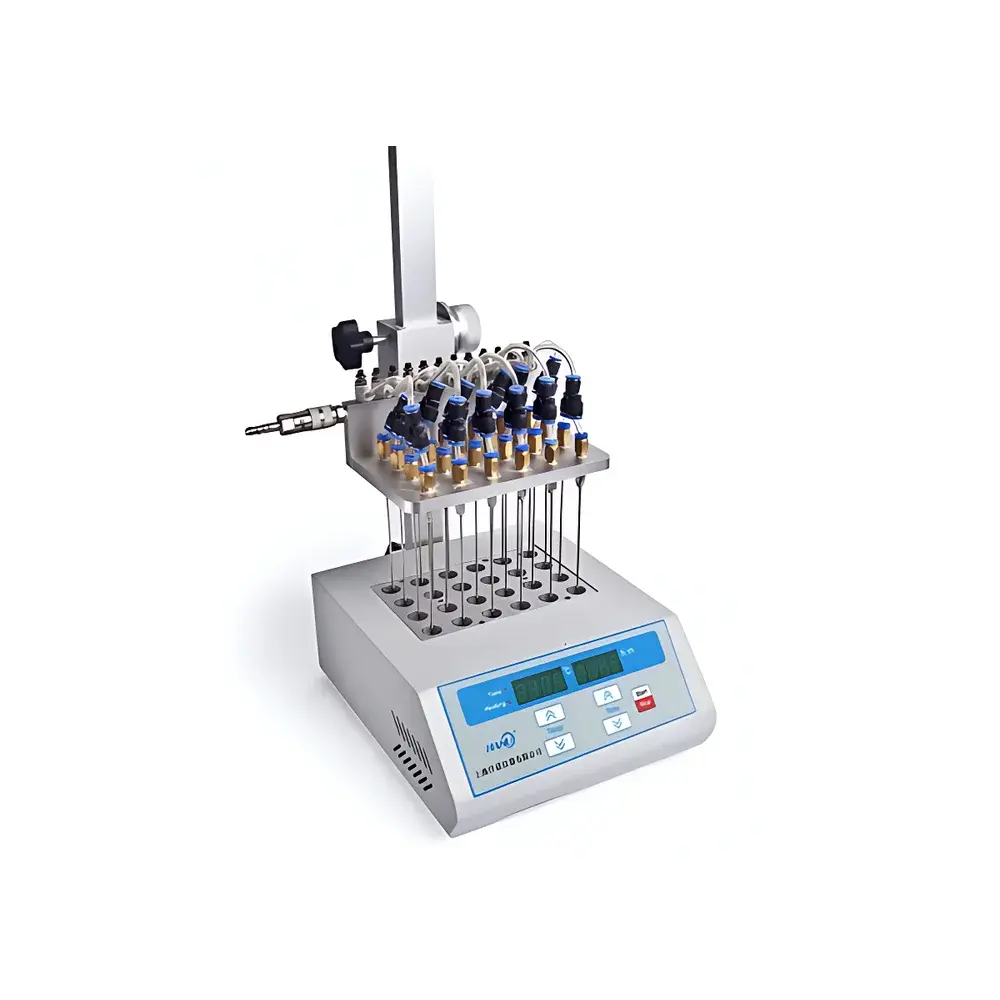
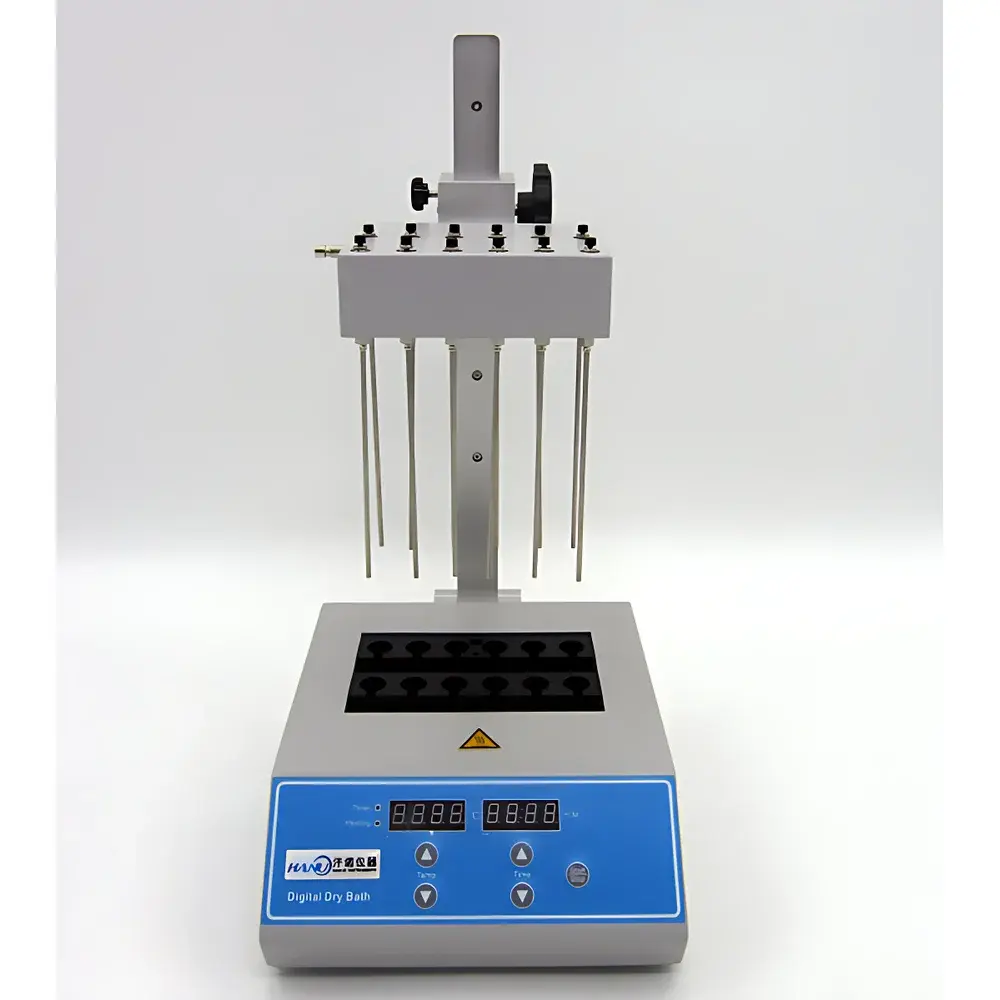
Hanuo HNDK200-1 Dry-Block Nitrogen Evaporator
| Brand | Hanuo |
|---|---|
| Origin | Shanghai, China |
| Model | HNDK200-1 |
| Heating Method | Dry-block heating |
| Temperature Range | Ambient +5°C to 150°C |
| Temperature Stability | ±0.5°C (at 100°C) |
| Temperature Accuracy | ±0.5°C (40–100°C), ±1.0°C (100–150°C) |
| Sample Capacity | 12 positions |
| Tube Diameter Compatibility | 12–16 mm |
| Nitrogen Flow Rate | 0–10 L/min |
| Maximum Nitrogen Pressure | ≤0.1 MPa |
| Heating Power | 150 W |
| Warm-up Time | ≤30 min (from 40°C to 150°C) |
| Timer Range | 0–99 h 59 min |
| Display | LED, 0.1°C resolution |
| Safety Features | Over-temperature protection, real-time temperature monitoring, automatic fault detection and audible alarm |
| Construction | Adjustable gas manifold with vertically movable gas needles (standard length: 150 mm), ventilated cabinet-compatible design |
Overview
The Hanuo HNDK200-1 Dry-Block Nitrogen Evaporator is an engineered solution for parallel sample concentration in analytical laboratories where reproducibility, inert atmosphere control, and thermal precision are critical. It operates on the principle of inert gas-assisted solvent evaporation: nitrogen (or compressed air, when oxygen sensitivity is not a concern) is delivered via precisely positioned stainless-steel needles directly above heated sample surfaces. This laminar gas flow disrupts the vapor boundary layer, significantly accelerating solvent removal while minimizing analyte oxidation, degradation, or foaming—particularly essential for thermolabile compounds such as steroids, pesticides, pharmaceutical metabolites, and clinical biomarkers. Unlike rotary evaporation—which is serial, vacuum-dependent, and unsuitable for multi-sample workflows—the HNDK200-1 enables simultaneous processing of up to 12 samples under consistent thermal and gaseous conditions. Its dry-block heating architecture eliminates oil bath maintenance, cross-contamination risk, and thermal lag, delivering rapid, uniform heat transfer across the aluminum heating module.
Key Features
- Dry-block heating system with 150 W power output and ambient-to-150°C range, achieving ≤30-minute ramp from 40°C to 150°C
- High-resolution LED display showing real-time temperature (0.1°C resolution) and countdown timer (0–99 h 59 min)
- Individually controllable 12-position gas manifold with on/off valves per channel—reducing nitrogen consumption during partial-use operation
- Vertically adjustable gas needle assembly (standard 150 mm length) compatible with 12–16 mm diameter test tubes, vials, and culture tubes
- Height-adjustable gas manifold accommodates varying solvent volumes; fully compatible with fume hood installation for handling volatile or toxic solvents (e.g., chloroform, hexane, acetonitrile)
- Integrated safety architecture: dual-limit over-temperature cutoff, continuous thermal monitoring, and audible alarm triggered by sensor failure or thermal runaway
- Modular aluminum heating block with optimized thermal mass for ±0.5°C stability at 100°C—validated per ASTM E2738 for laboratory heating device performance
Sample Compatibility & Compliance
The HNDK200-1 supports standard 12–16 mm round-bottom and flat-bottom tubes used in HPLC, GC, LC-MS, and ELISA workflows. Its inert nitrogen environment complies with USP , ICH Q5C, and ISO/IEC 17025 requirements for analyte integrity during sample preparation. When operated in GLP/GMP-regulated environments, the device’s fixed temperature setpoints, non-volatile timer, and absence of software-based controls simplify audit readiness—no 21 CFR Part 11 validation burden applies to its standalone hardware operation. All materials in contact with samples or gas streams meet USP Class VI biocompatibility standards; gas pathways are constructed from electropolished stainless steel and PTFE-sealed fittings to prevent leaching or adsorption.
Software & Data Management
The HNDK200-1 is a standalone hardware instrument with no embedded microprocessor-based software, network interface, or data logging capability. All operational parameters—including set temperature, elapsed time, and status indicators—are displayed locally via LED. This architecture ensures deterministic behavior, eliminates firmware update dependencies, and aligns with laboratories maintaining strict separation between sample preparation instrumentation and IT infrastructure. For traceability, users may record setpoints and run logs manually or integrate the unit into broader LIMS workflows via external environmental monitoring systems (e.g., calibrated thermocouple inputs connected to data loggers compliant with ISO 17025 clause 6.4.10).
Applications
- Routine concentration of extracts prior to GC-MS analysis of environmental contaminants (PAHs, PCBs, organochlorine pesticides)
- High-throughput sample cleanup in clinical toxicology labs processing urine or plasma for opioid, benzodiazepine, and stimulant screening
- Pre-concentration of derivatized amino acids and organic acids in metabolic phenotyping studies
- Removal of mobile phase solvents following solid-phase extraction (SPE) cartridges in food safety testing (e.g., mycotoxin analysis per AOAC 2005.08)
- Parallel drying of calibration standards and QC reference materials in regulated bioanalytical laboratories (FDA Bioanalytical Method Validation Guidance)
FAQ
Can this unit be used with compressed air instead of nitrogen?
Yes—provided the air supply is oil-free, particle-filtered (≤0.01 µm), and dew-point controlled (<−40°C) to prevent moisture condensation or hydrocarbon contamination.
Is the heating block interchangeable for different tube formats?
No—the HNDK200-1 uses a fixed 12-position aluminum block optimized for 12–16 mm diameters. Custom blocks are not available; alternative models (e.g., HNDK200-2) support 96-well plates.
What maintenance is required?
Annual verification of temperature accuracy using NIST-traceable calibrated thermometers is recommended. Gas needle tips should be inspected for clogging after use with viscous or salt-containing matrices.
Does it comply with CE or UL safety directives?
As a Class I electrical appliance manufactured to GB 4793.1–2018 (equivalent to IEC 61010-1), it meets fundamental safety requirements for laboratory equipment. CE marking is not affixed; regional conformity assessment must be performed by the importing entity.
Can it be mounted inside a laminar flow hood?
Yes—its compact footprint (240 × 180 × 320 mm) and zero-emission dry-block design allow safe integration into ISO Class 5 or better laminar flow enclosures without airflow disruption.



