
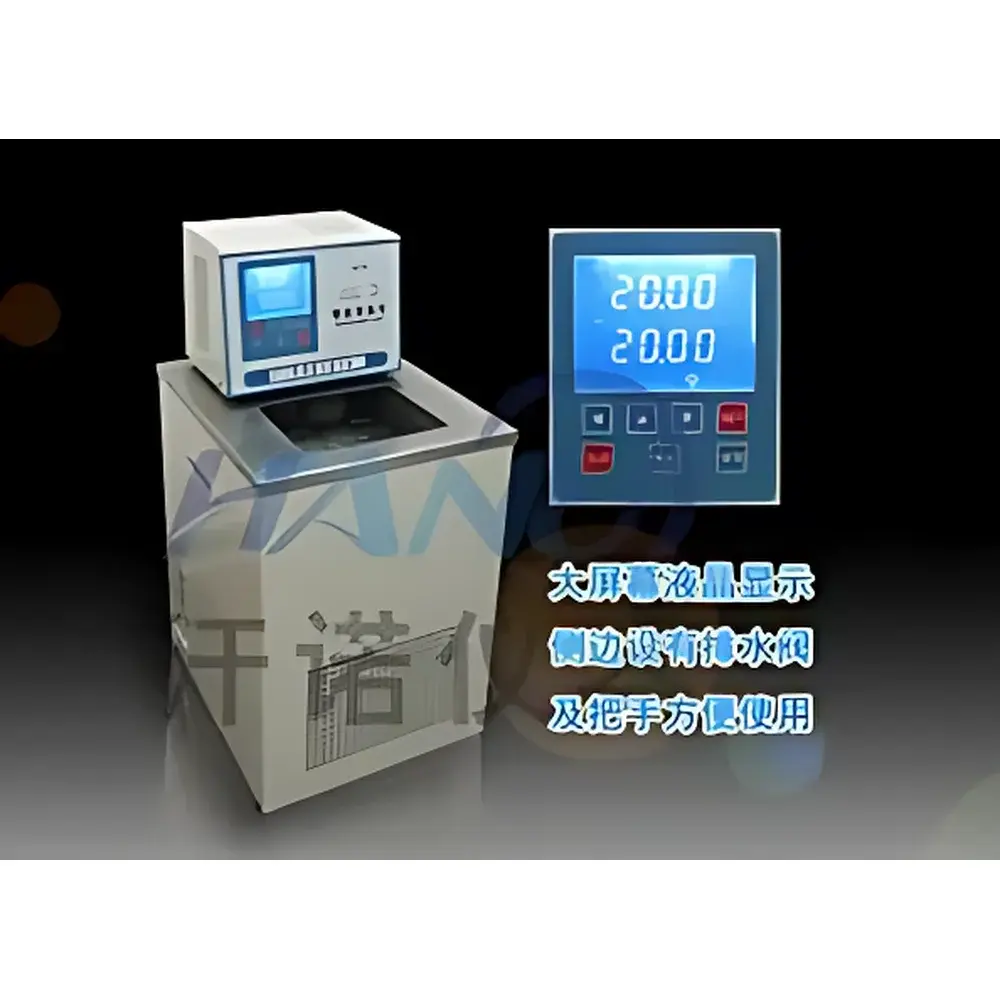
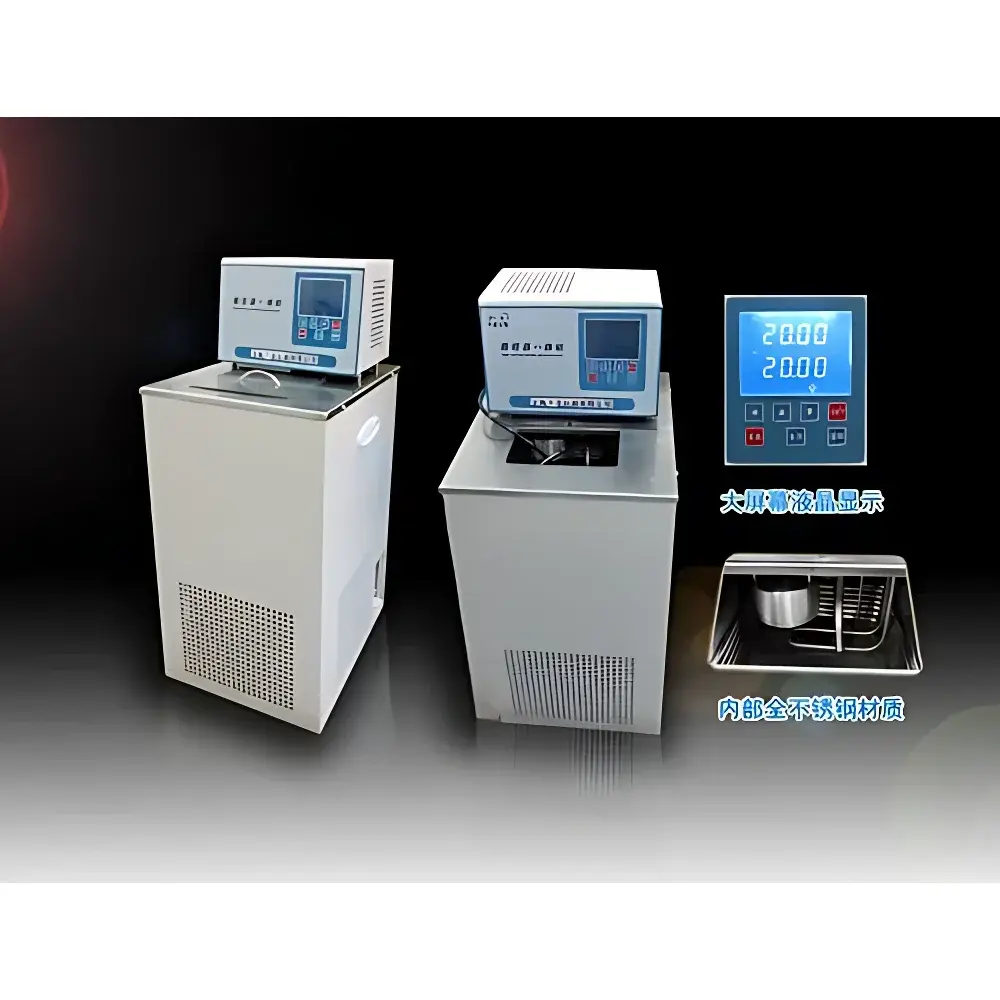
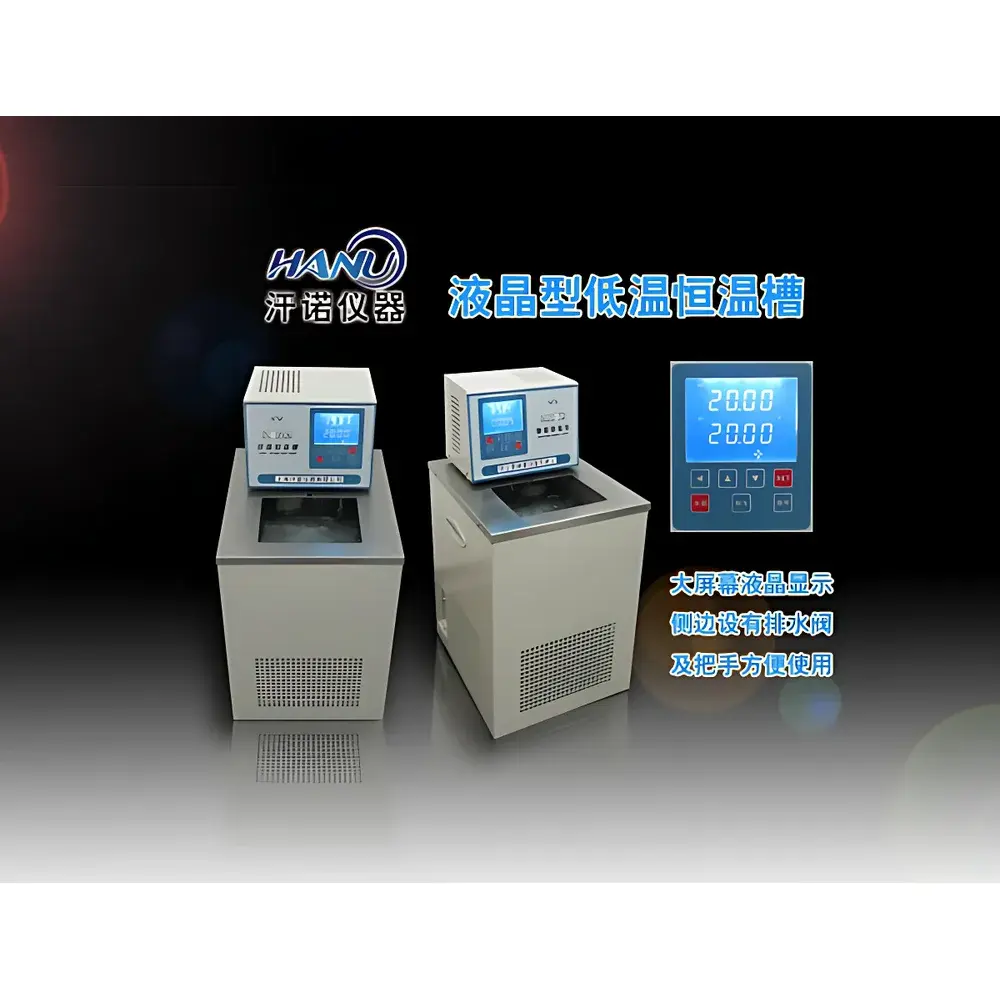
Hanuo HNGD-0300-5 Integrated High-Low Temperature Circulating Chiller
| Brand | Hanuo |
|---|---|
| Origin | Shanghai, China |
| Model | HNGD-0300-5 |
| Temperature Range | −40 °C to +300 °C |
| Temperature Stability | ±0.1 °C |
| Display Resolution | 0.1 °C |
| Bath Volume | 5 L |
| Circulation Flow Rate | 15 L/min |
| Maximum Head | 3.5 m |
| Internal Bath Material | Stainless Steel (304) |
| Control System | Microprocessor-based PID with Offset Correction |
| Safety Protections | Compressor Overheat/Overcurrent, Temperature Overshoot Cut-off & Alarm |
Overview
The Hanuo HNGD-0300-5 is an integrated high-low temperature circulating chiller engineered for precise thermal control in laboratory-scale chemical synthesis, material testing, and analytical instrumentation support. Operating across a broad thermal range of −40 °C to +300 °C, it employs a dual-stage refrigeration circuit combined with electric heating elements to achieve seamless transition between sub-ambient cooling and high-temperature operation without manual intervention. Its thermodynamic architecture is based on forced-convection liquid circulation, where a thermally stable bath fluid (e.g., silicone oil or specialized heat-transfer fluids) is conditioned and delivered via a dual-loop system—internal recirculation ensures uniform bath temperature distribution, while the external loop supplies conditioned fluid to external reactors, jacketed vessels, or analytical equipment such as spectrometers or calorimeters. Designed for continuous duty under demanding thermal loads, the unit meets fundamental engineering requirements for reproducibility, long-term drift stability, and operational safety in regulated research and quality control environments.
Key Features
- Wide operational range: −40 °C to +300 °C, enabling applications from cryogenic reaction quenching to high-temperature polymerization studies.
- High-precision microprocessor PID controller with user-adjustable temperature offset correction, ensuring traceable calibration alignment across instruments.
- Dual-circulation pump system: Internal loop maintains bath homogeneity; external loop delivers up to 15 L/min at 3.5 m head—sufficient for multi-point distribution to jacketed reactors or parallel instrument cooling.
- Stainless steel (AISI 304) bath chamber—corrosion-resistant, non-reactive, and compatible with common organic solvents and heat-transfer media.
- Comprehensive safety architecture: Real-time monitoring of compressor discharge temperature, current draw, and bath sensor feedback triggers automatic power cutoff and audible/visual alarm upon deviation beyond preset thresholds.
- Digital display with 0.1 °C resolution and intuitive keypad interface—designed for glove-compatible operation in controlled environments.
- Imported air-cooled hermetic scroll compressor for rapid cooldown response and extended service life under cyclic thermal loading.
Sample Compatibility & Compliance
The HNGD-0300-5 is compatible with standard laboratory heat-transfer fluids including silicone oils (e.g., Dow Corning 200 Fluid series), polyalphaolefins (PAOs), and glycol–water mixtures (for sub-zero operation down to −40 °C). Its stainless steel wetted parts meet ASTM A240 Type 304 requirements for corrosion resistance and surface passivation. While not certified to ISO/IEC 17025 or FDA 21 CFR Part 11 out-of-the-box, the device supports GLP/GMP-aligned workflows through its deterministic temperature control logic, audit-ready parameter logging (when interfaced with optional RS485/Modbus), and repeatable thermal performance verified per internal factory test protocols. It complies with IEC 61010-1:2010 for electrical safety in laboratory equipment and CE-marked for EMC (EN 61326-1) and low-voltage directives.
Software & Data Management
The HNGD-0300-5 features embedded firmware supporting analog (0–10 V / 4–20 mA) and digital (RS485 Modbus RTU) interfaces for integration into centralized lab automation systems. Optional PC software enables remote setpoint scheduling, real-time temperature graphing, and CSV export of time-stamped bath temperature logs—facilitating compliance with data integrity principles outlined in ALCOA+ (Attributable, Legible, Contemporaneous, Original, Accurate). The unit records critical event timestamps (e.g., overtemperature events, power interruptions) in non-volatile memory, supporting root-cause analysis during QA investigations. No proprietary cloud platform is required; all data remains locally stored unless explicitly exported via USB or serial link.
Applications
- Temperature-controlled chemical synthesis in jacketed glass reactors (e.g., Grignard reactions requiring −20 °C initiation followed by 80 °C reflux).
- Calibration and thermal validation of DSC, TGA, and rheometers requiring stable isothermal holds or linear ramp profiles.
- Cooling of high-power lasers, X-ray sources, and NMR probe preamplifiers where consistent heat dissipation is critical to signal stability.
- Material testing under thermal cycling conditions per ASTM D696 (Coefficient of Linear Expansion) or ISO 11359 (Dynamic Mechanical Analysis).
- Environmental stress screening of electronic components and packaging materials across extreme temperature boundaries.
FAQ
What heat-transfer fluids are recommended for operation at −40 °C?
Silicone oils with pour points ≤ −50 °C (e.g., DC 200 Fluid, 50 cSt) or low-viscosity PAOs (e.g., Synesstic 40) are validated for use. Ethylene glycol–water mixtures are not suitable below −20 °C due to increased viscosity and freezing risk.
Can the unit maintain ±0.05 °C stability across the full range?
Stability of ±0.1 °C is guaranteed per specification. Achieving ±0.05 °C requires optional calibration verification using a traceable NIST-certified PRT and may be attainable in narrow bands (e.g., 25–80 °C) with optimized fluid selection and reduced external thermal load.
Is external pump control supported?
Yes—the RS485 interface allows bidirectional communication for start/stop commands, flow rate modulation (via analog input), and fault status polling, enabling synchronization with reactor agitation or dosing sequences.
What maintenance intervals are recommended for the refrigeration system?
Compressor oil and filter-drier replacement every 24 months under continuous operation; annual inspection of condenser coil cleanliness and refrigerant charge verification using manifold gauge set and superheat measurement.
Does the unit comply with explosion-proof requirements for solvent-rich environments?
No—it is rated for general laboratory use (IP20 enclosure) and must be installed outside hazardous zones per NEC Class I, Division 2 or ATEX Zone 2 guidelines. For flammable solvent applications, consult Hanuo’s HNGD-Ex series variants with certified intrinsic safety design.



