
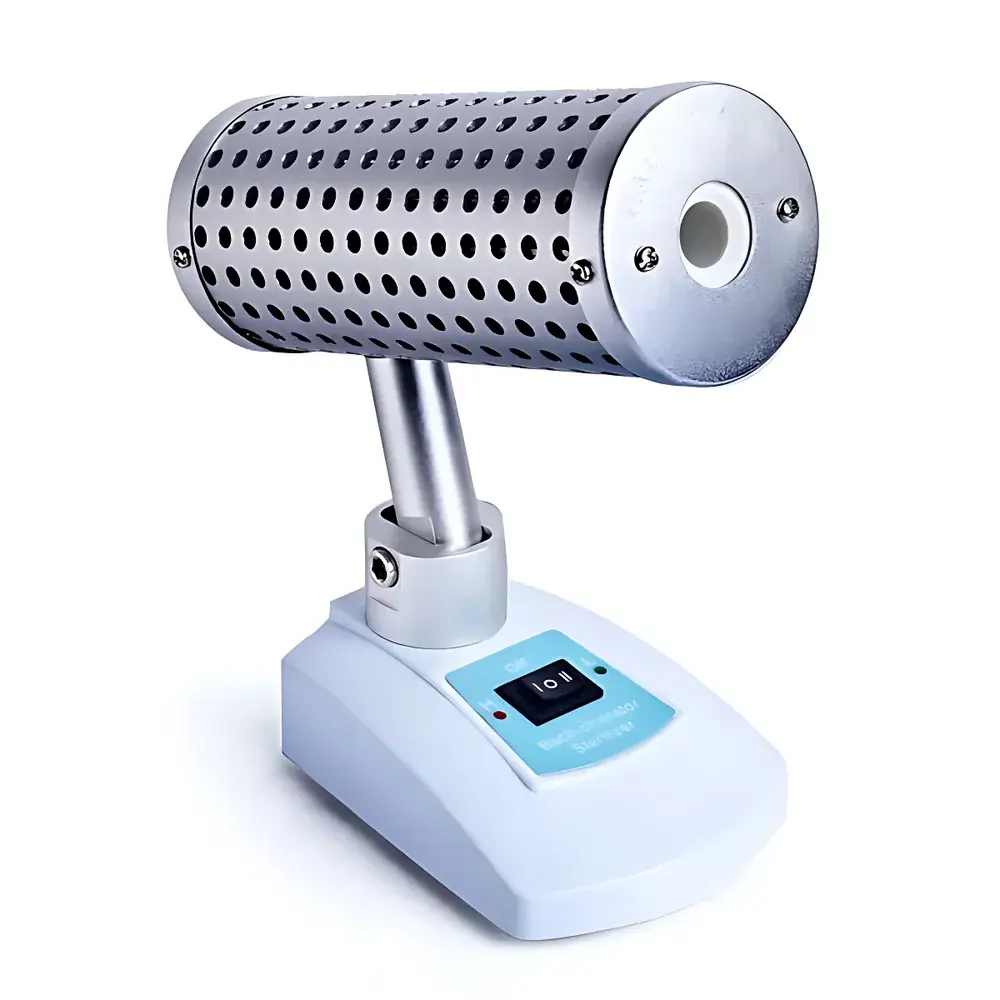
Hanuo HNM-800D Large-Aperture Infrared Microbial Sterilizer
| Brand | Hanuo |
|---|---|
| Origin | Shanghai, China |
| Model | HNM-800D |
| Instrument Type | Horizontal Benchtop Infrared Sterilizer |
| Maximum Operating Temperature | 825 °C ± 50 °C |
| Sterilization Chamber Diameter | 35 mm |
| External Dimensions | Not specified (compact benchtop unit) |
| Power Rating | 200 W |
| Net Weight | 1.5 kg |
| Input Voltage | AC 220 V ± 10 %, 50 Hz |
| Standby Temperature | 480 °C |
| Sterilization Time (typical) | 5–7 s |
| Compatible Tool Outer Diameter | ≤35 mm |
| Heating Zone Length | 100 mm |
| Operating Ambient Temperature | 10–50 °C |
| Relative Humidity Limit | ≤90 % RH |
| Altitude | Unrestricted |
Overview
The Hanuo HNM-800D Large-Aperture Infrared Microbial Sterilizer is a compact, electrically powered benchtop instrument engineered for rapid, flameless sterilization of microbiological tools—including inoculation loops, needles, forceps, and micro-spatulas—in biosafety cabinets, laminar flow hoods, anaerobic chambers, and mobile laboratory setups. Unlike steam-based autoclaves or open-flame devices, the HNM-800D employs high-intensity infrared radiation generated by a ceramic heating element to achieve precise, localized thermal disinfection. Its operational principle relies on radiant heat transfer: the infrared emitter rapidly elevates the surface temperature of metallic instruments inserted into the sterilization aperture to ≥800 °C, ensuring immediate microbial inactivation—including spores—via protein denaturation and nucleic acid degradation within 5–7 seconds. This method eliminates combustion hazards, volatile organic emissions, and airflow disruption—critical advantages in containment-sensitive environments governed by ISO 14644-1 Class 5 or higher cleanroom protocols.
Key Features
- Large-diameter sterilization aperture (35 mm ID) accommodates bulky or angled tools—including bent loops, wide-tip spreaders, and cryo-handled instruments—without repositioning.
- Ceramic infrared heating core with integrated thermal feedback control maintains stable operating temperature (825 °C ± 50 °C at center zone) and extends element service life by preventing thermal runaway.
- Adjustable tilt mechanism (±30°) enables ergonomic insertion angle optimization for seated or standing users, reducing repetitive strain during high-throughput workflows.
- Standby mode sustains 480 °C at the aperture entrance—minimizing warm-up delay between successive sterilizations while conserving energy and limiting ambient heat dissipation.
- Smooth, non-porous stainless steel and ceramic housing resists chemical corrosion from ethanol, bleach, or hydrogen peroxide decontamination agents; surface-cleanable per ISO 15223-1 labeling requirements.
- No pressure vessel, water supply, or exhaust ducting required—fully compliant with electrical safety standards IEC 61010-1 and EMC directive 2014/30/EU.
Sample Compatibility & Compliance
The HNM-800D is validated for sterilization of reusable metallic laboratory tools with maximum outer diameter ≤35 mm and total length ≤120 mm. It is routinely deployed in GLP-compliant microbiology labs, clinical diagnostic facilities, and pharmaceutical QC environments where flame-free operation is mandated (e.g., USP , EU GMP Annex 1). While not an autoclave substitute for porous loads or liquid media, it meets ASTM E1114-21 criteria for dry-heat microbial reduction when used per manufacturer instructions. Device design supports integration into ISO/IEC 17025-accredited workflows through traceable calibration records and documented temperature uniformity mapping across the sterilization zone.
Software & Data Management
The HNM-800D operates as a standalone hardware device with no embedded firmware or digital interface. Temperature regulation is achieved via analog PID circuitry with mechanical overtemperature cutoff (≥900 °C), eliminating software-related validation burdens under FDA 21 CFR Part 11. For audit readiness, laboratories may log usage parameters—including cycle count, operator ID, and environmental conditions—using external LIMS or paper-based SOP records aligned with ISO 9001:2015 clause 8.5.2. No firmware updates, cybersecurity patches, or data export functions are applicable.
Applications
- Routine sterilization of inoculation loops and needles prior to streaking, stab, or pour-plate techniques in bacteriology and mycology.
- Aseptic tool conditioning inside anaerobic glove boxes (O₂ < 10 ppm) where open flames are prohibited and nitrogen purge integrity must be preserved.
- Decontamination of micro-manipulators, biopsy forceps, and dental probes in point-of-care or field-deployable diagnostic units.
- Pre-sterilization of glass capillaries and metal microelectrodes in neurophysiology and single-cell isolation workflows.
- Supporting USP antimicrobial effectiveness testing by enabling rapid, repeatable tool sterilization between challenge organism transfers.
FAQ
Is the HNM-800D suitable for sterilizing plastic or coated instruments?
No. Only stainless steel, nickel-chromium, or tungsten-carbide tools rated for continuous exposure to >800 °C should be used. Polymers, silicone, or PTFE-coated items will melt or off-gas toxic compounds.
Does this unit require periodic calibration verification?
Yes. Users must verify center-zone temperature annually using a NIST-traceable infrared pyrometer (e.g., Fluke 62 Max+) per internal SOP, with records retained for regulatory inspection.
Can the HNM-800D be installed inside a biosafety cabinet without compromising airflow?
Yes—its zero-airflow-draw design and low radiant heat profile (surface temp <65 °C at 50 mm distance) meet NSF/ANSI 49 Section 7.3.2 requirements for auxiliary equipment placement.
What maintenance is required beyond routine cleaning?
Ceramic emitter surfaces should be inspected quarterly for carbon buildup; light residue may be removed with isopropyl alcohol and lint-free swabs—never abrasive cleaners or metal scrapers.
Is CE marking applicable to this device?
The HNM-800D complies with EU harmonized standards EN 61010-1:2010 and EN 61326-1:2013, and carries CE marking for laboratory use within the European Economic Area.



