
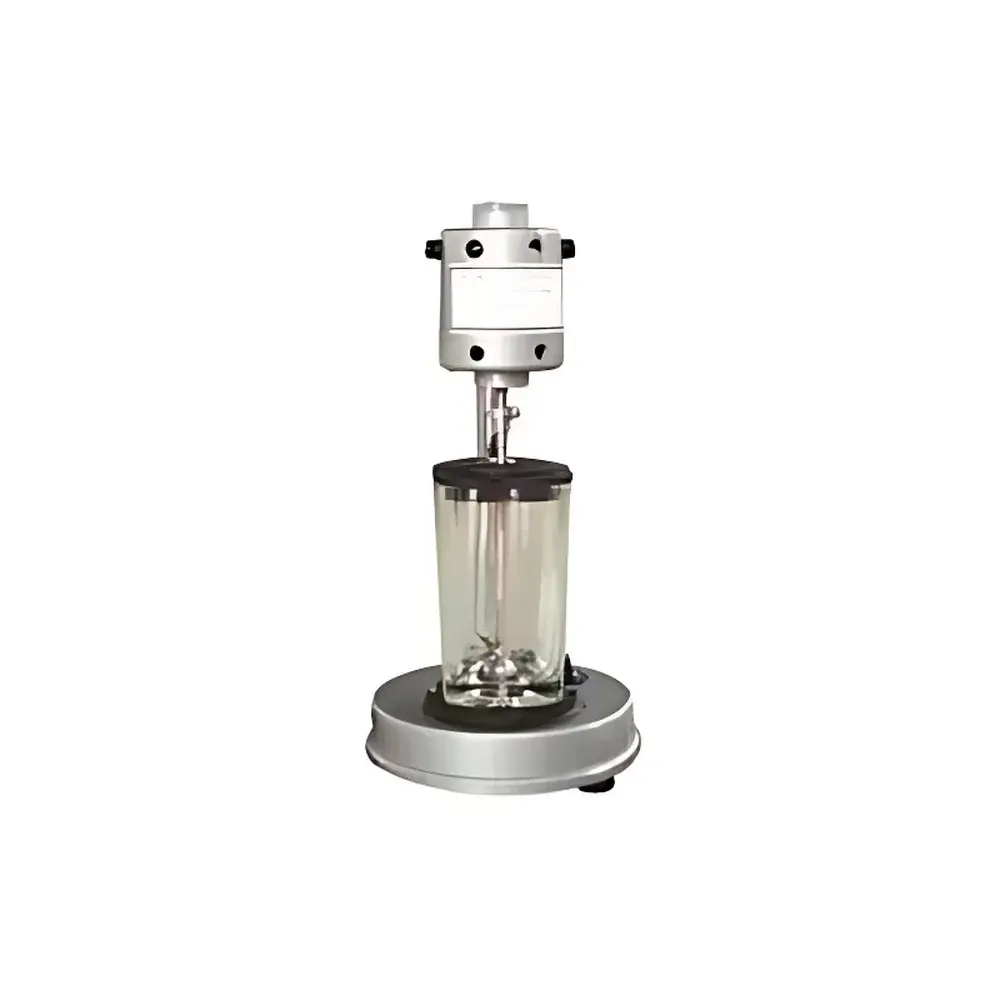
Hanuo JJ-2B High-Speed Tissue Homogenizer
| Brand | Hanuo |
|---|---|
| Origin | Shanghai, China |
| Model | JJ-2B |
| Output Power | 220 W |
| Maximum Sample Volume | 1000 mL |
| Speed Range | 0–12000 rpm (continuously variable) |
| Power Supply | 220 V, 50 Hz |
| Weight | 7.5 kg |
| Dimensions | 48 × 24 × 24 cm |
| Construction | 304 stainless steel body & tempered glass homogenizing cup |
| Drive Interface | Coupling-type shaft connection |
| Speed Control | Dual-range electronic speed regulator (high/low preset zones with fine analog adjustment) |
Overview
The Hanuo JJ-2B High-Speed Tissue Homogenizer is a benchtop mechanical homogenization system engineered for rapid, reproducible disruption of soft to semi-fibrous biological tissues, cell suspensions, and emulsifiable formulations. It operates on the principle of high-shear rotor-stator homogenization: a precision-machined stainless steel blade assembly rotates within a fixed tempered glass chamber, generating intense hydrodynamic forces—including cavitation, turbulent shear, and impact attrition—that simultaneously fracture cellular membranes, disperse aggregates, and homogenize heterogeneous mixtures. Designed for routine use in academic research laboratories, clinical pathology units, pharmaceutical QC labs, and food safety testing facilities, the JJ-2B delivers consistent particle size reduction and suspension uniformity without requiring cryogenic pretreatment or chemical lysis agents—making it suitable for downstream applications such as DNA/RNA extraction, protein solubilization, ELISA sample preparation, and microbiological media blending.
Key Features
- Tempered borosilicate glass homogenizing cup (1000 mL capacity) provides full visual monitoring of sample consistency, foam formation, and homogenization endpoint—critical for optimizing lysis efficiency and avoiding overheating or over-processing.
- 304 stainless steel housing ensures corrosion resistance, structural rigidity, and compliance with ISO 14644-1 Class 8 cleanroom-compatible surface finish standards for laboratory environments.
- Continuously variable speed control (0–12000 rpm) enables precise adaptation to sample viscosity, density, and thermal sensitivity; dual-range electronic regulation allows coarse initial acceleration followed by fine-tuned stabilization at target shear rates.
- Direct-coupled stainless steel drive shaft eliminates belt slippage or gear backlash, ensuring torque transmission integrity across the full operational range and supporting repeatable rotational inertia profiles per ASTM E2915-21 guidelines for mechanical homogenizer validation.
- Low-profile footprint (48 × 24 × 24 cm) and 7.5 kg mass facilitate integration into laminar flow hoods, biosafety cabinets, or shared instrumentation benches without compromising stability during high-speed operation.
Sample Compatibility & Compliance
The JJ-2B accommodates aqueous suspensions, buffered saline solutions, lipid-rich homogenates, and low-viscosity organic-aqueous mixtures. It is validated for use with mammalian tissues (liver, spleen, brain), plant leaf material, bacterial pellets, yeast cultures, and soft food matrices (e.g., fruit pulps, dairy emulsions). The device meets CE marking requirements for electrical safety (EN 61010-1:2010) and electromagnetic compatibility (EN 61326-1:2013). While not intrinsically certified for GLP or GMP production environments, its construction materials, traceable speed calibration, and absence of lubricants in contact zones support audit readiness under FDA 21 CFR Part 11-aligned documentation protocols when paired with validated SOPs.
Software & Data Management
The JJ-2B operates as a standalone analog-controlled instrument with no embedded firmware or digital interface. Speed settings are manually selected via front-panel potentiometer; no data logging, USB connectivity, or remote control capability is provided. Users are advised to record operational parameters—including set speed (rpm), duration (s), sample volume (mL), and ambient temperature (°C)—in laboratory notebooks or LIMS-integrated electronic lab notebooks (ELNs) to satisfy traceability requirements under ISO/IEC 17025:2017 clause 7.5.2. For automated workflows, external tachometers or optical RPM sensors may be deployed to verify rotational fidelity prior to each run.
Applications
- Pre-analytical sample preparation for nucleic acid isolation kits (e.g., QIAamp, TRIzol-based protocols)
- Routine homogenization of tissue biopsies prior to histopathological sectioning or immunohistochemistry staining
- Dispersion of nanoparticle suspensions in pharmaceutical formulation development
- Emulsification of flavor oils and stabilizer blends in food R&D laboratories
- Cell lysis optimization studies where enzymatic or detergent-based methods yield inconsistent recovery
- QC batch verification of suspension uniformity in liquid dosage form manufacturing
FAQ
Is the JJ-2B suitable for hard or fibrous tissues such as cartilage or muscle?
It is optimized for soft-to-moderate tissues; prolonged operation on highly fibrous or calcified samples may accelerate blade wear and reduce homogenization efficiency. Pre-chopping or cryo-pulverization is recommended for such materials.
Can the glass cup be autoclaved?
Yes—the tempered borosilicate cup is rated for steam sterilization at 121 °C for 20 minutes; however, repeated autoclaving cycles may affect long-term optical clarity and thermal shock resistance.
Does the unit include speed calibration certification?
No factory-issued calibration certificate is supplied; users should verify rotational speed using a handheld digital tachometer before first use and at defined intervals per internal quality assurance procedures.
What maintenance is required for sustained performance?
Blade sharpening or replacement every 50–100 hours of cumulative operation is advised; shaft coupling surfaces should be inspected for fretting wear quarterly, and all O-rings replaced annually to maintain seal integrity.
Is the JJ-2B compliant with USP <797> or <800> standards for hazardous drug compounding?
It is not designed for containment or negative-pressure operation; therefore, it does not meet USP <797>/<800> engineering controls requirements and must be used only in conjunction with appropriate primary engineering controls (e.g., CSTDs, isolators) when handling hazardous compounds.



