
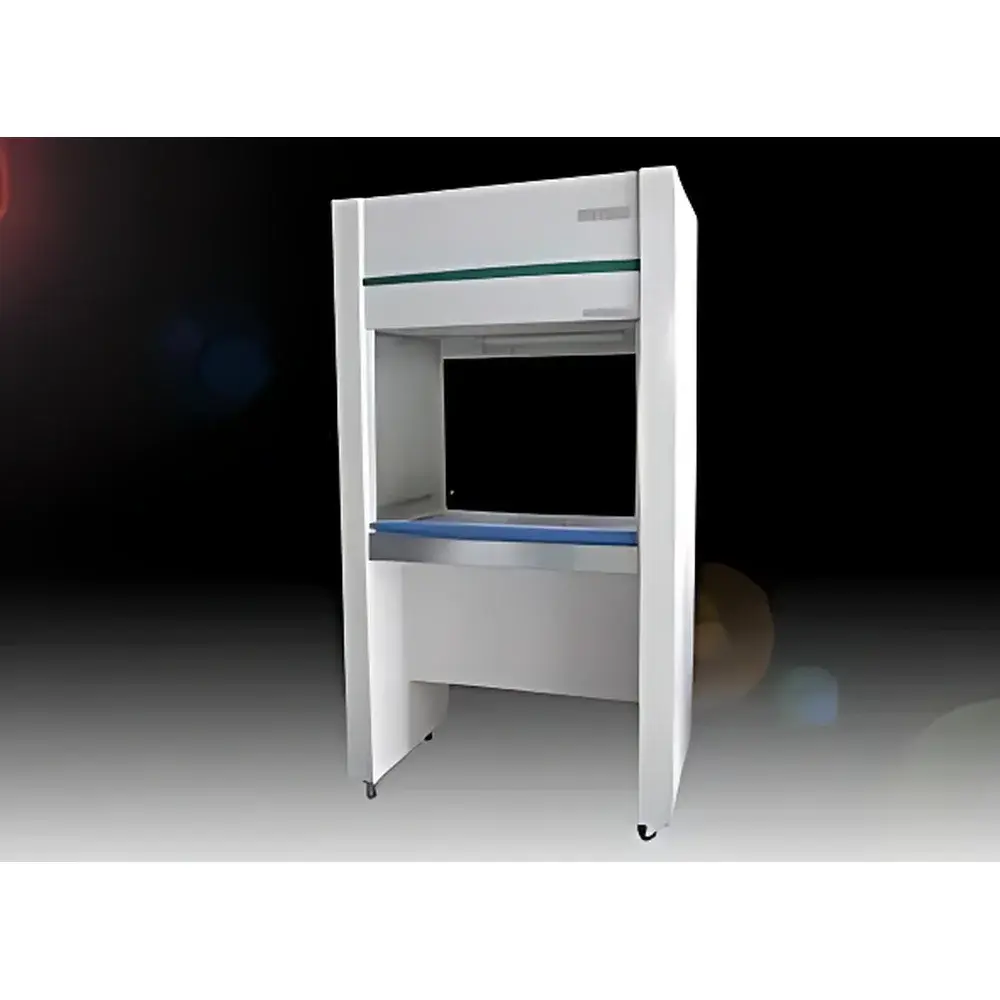
Hanuo SW-CJ-1D Vertical Flow Clean Bench
| Brand | Hanuo |
|---|---|
| Origin | Shanghai, China |
| Manufacturer Type | Authorized Distributor |
| Product Category | Domestic |
| Model | SW-CJ-1D |
| Instrument Type | Vertical Flow Clean Bench |
| Cleanliness Class | ISO Class 5 (equivalent to Fed. Std. 209E Class 100) @ ≥0.5 µm |
| Noise Level | ≤58 dB(A) |
| User Capacity | Single-user, front-access |
| Airflow Pattern | Vertical downflow |
| Average Air Velocity | 0.3–0.6 m/s (adjustable) |
| Illuminance | ≥300 lx |
| Vibration Half-Peak | ≤3 µm |
| Power Supply | AC 220 V / 50 Hz |
| Power Consumption | 0.13 kW |
| Work Area Dimensions (W×D×H) | 700 × 500 × 500 mm |
| Microbial Count | ≤0.5 CFU/plate·hour (90 mm Petri dish) |
Overview
The Hanuo SW-CJ-1D Vertical Flow Clean Bench is an ISO Class 5-certified laminar flow workstation engineered for localized particle and microbial control in non-sterile but contamination-sensitive laboratory environments. Unlike biological safety cabinets (BSCs), which protect both sample and operator via recirculated or exhausted air with HEPA filtration, the SW-CJ-1D employs a unidirectional vertical downflow of HEPA-filtered (≥99.99% @ 0.3 µm) ambient air across the work surface—providing consistent, low-turbulence airflow to maintain a particle-free zone for non-hazardous applications. It complies with the performance criteria outlined in ISO 14644-1 for cleanroom classification and aligns with U.S. Federal Standard 209E Class 100 requirements for airborne particulate concentration (≤3,520 particles/m³ ≥0.5 µm). Designed for routine aseptic handling—not containment—the unit supports tasks where sample integrity is critical but operator protection from biohazards is not required.
Key Features
- Vertical laminar airflow system with adjustable velocity (0.3–0.6 m/s) maintained via precision-matched blower and variable-frequency motor control.
- Front-mounted, semi-enclosed tempered glass sash with smooth vertical travel—minimizes turbulence ingress while permitting ergonomic access and visual monitoring.
- Infrared remote control interface with dedicated status indicators (e.g., UV lamp activation, airflow mode, alarm signals) positioned at the front fascia for intuitive operation without physical contact.
- Stainless steel (AISI 304) work surface and interior chamber walls—non-porous, corrosion-resistant, and compatible with standard laboratory disinfectants including 70% ethanol and sodium hypochlorite solutions.
- Dual 2 kW grounded power outlets integrated into the work area rear wall—designed to support concurrent use of pipette controllers, centrifuges, or small benchtop instruments without external extension cords.
- Integrated LED task lighting (≥300 lx at work surface) with uniform distribution and minimal heat emission—ensuring visual clarity without thermal interference to sensitive samples.
Sample Compatibility & Compliance
The SW-CJ-1D is validated for use with non-pathogenic cell cultures, microbiological media preparation, pharmaceutical weighing and compounding, optical component assembly, and microelectronics prototyping. Its ISO Class 5 environment meets baseline requirements for USP compounding (non-hazardous sterile preparations), ISO 13485 quality system validation, and GLP-compliant documentation workflows. While not certified under NSF/ANSI 49 or EN 12469 (as it lacks personnel or environmental protection features), its airflow stability, microbial recovery data (≤0.5 CFU/90 mm plate·hour), and vibration control (≤3 µm half-peak) satisfy internal validation protocols for Grade A environments per EU GMP Annex 1 when deployed within controlled background rooms (ISO Class 7 or better). Routine certification per ISO 14644-3 is recommended every 6 months.
Software & Data Management
The SW-CJ-1D operates as a standalone hardware platform with no embedded software or network connectivity. All operational parameters—including airflow velocity setpoint, UV exposure duration, and illumination state—are managed exclusively through the infrared remote control and front-panel status LEDs. For laboratories requiring audit-ready records, integration with external environmental monitoring systems (EMS) is supported via optional analog voltage output (0–10 VDC) for real-time airflow velocity logging. The unit includes a mechanical hour meter for maintenance tracking, and all calibration certificates (HEPA filter efficiency, airflow uniformity, illuminance mapping) are supplied with initial commissioning documentation—fully traceable to NIST-traceable standards.
Applications
- Aseptic transfer of mammalian or insect cell lines during routine subculturing and passaging.
- Preparation of culture media, buffers, and reagent dilutions in biotechnology and academic research labs.
- Weighing and dispensing of active pharmaceutical ingredients (APIs) for non-hazardous sterile compounding under USP .
- Assembly and inspection of precision optical components, MEMS devices, and semiconductor wafers where electrostatic discharge (ESD)-safe grounding is supplemented by particle exclusion.
- Handling of sensitive analytical standards in QC laboratories prior to HPLC or GC injection—reducing particulate-induced column fouling.
FAQ
Does the SW-CJ-1D provide protection against biological hazards?
No. It is a clean bench—not a biological safety cabinet—and does not protect the operator from aerosolized pathogens or hazardous chemicals.
What HEPA filter standard does it meet?
The unit uses a H14-class HEPA filter compliant with EN 1822-1, achieving ≥99.995% efficiency at the Most Penetrating Particle Size (MPPS) of 0.3 µm.
Can it be installed in a non-ISO classified room?
Yes, but background particle load will directly impact work surface cleanliness; optimal performance requires placement in at least an ISO Class 8 (Class 100,000) environment.
Is UV sterilization integrated?
Yes—a 254 nm germicidal UV lamp is included with timer-based activation (0–30 min) and interlocked sash safety cutoff.
What maintenance intervals are recommended?
HEPA filter replacement every 18–24 months (depending on usage and ambient dust load); pre-filter cleaning every 2 weeks; annual airflow uniformity and velocity verification per ISO 14644-3 Annex B.



