
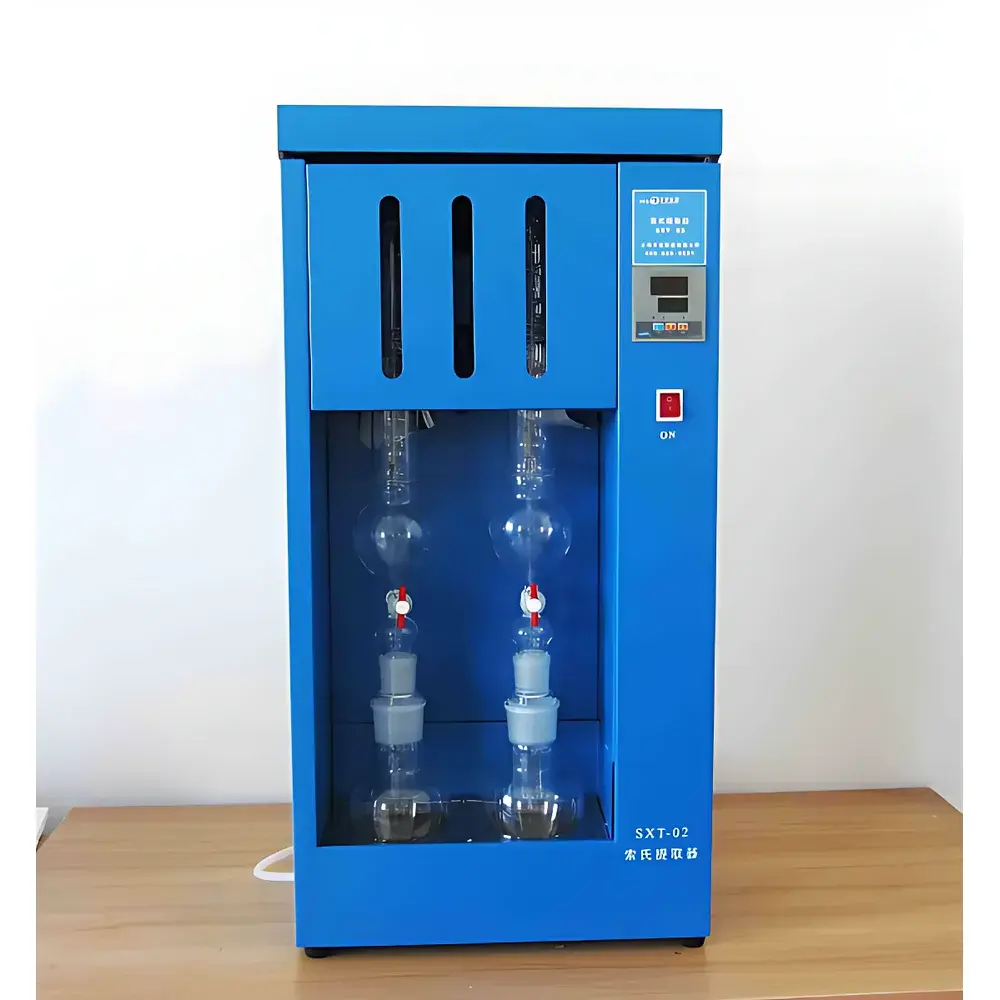
Hanuo SXT-02 Soxhlet Extractor
| Brand | Hanuo |
|---|---|
| Origin | Shanghai, China |
| Model | SXT-02 |
| Channels | 2 |
| Extraction Flask Volume | 500 mL per channel |
| Sample Capacity | 0.5–20 g per channel |
| Temperature Control Range | Ambient +5 °C to 100 °C |
| Heating Power | 300 W |
| Dimensions (W×D×H) | 750 × 360 × 550 mm |
| Weight | 16 kg |
| Power Supply | 220 V ±10 V, 50 Hz |
Overview
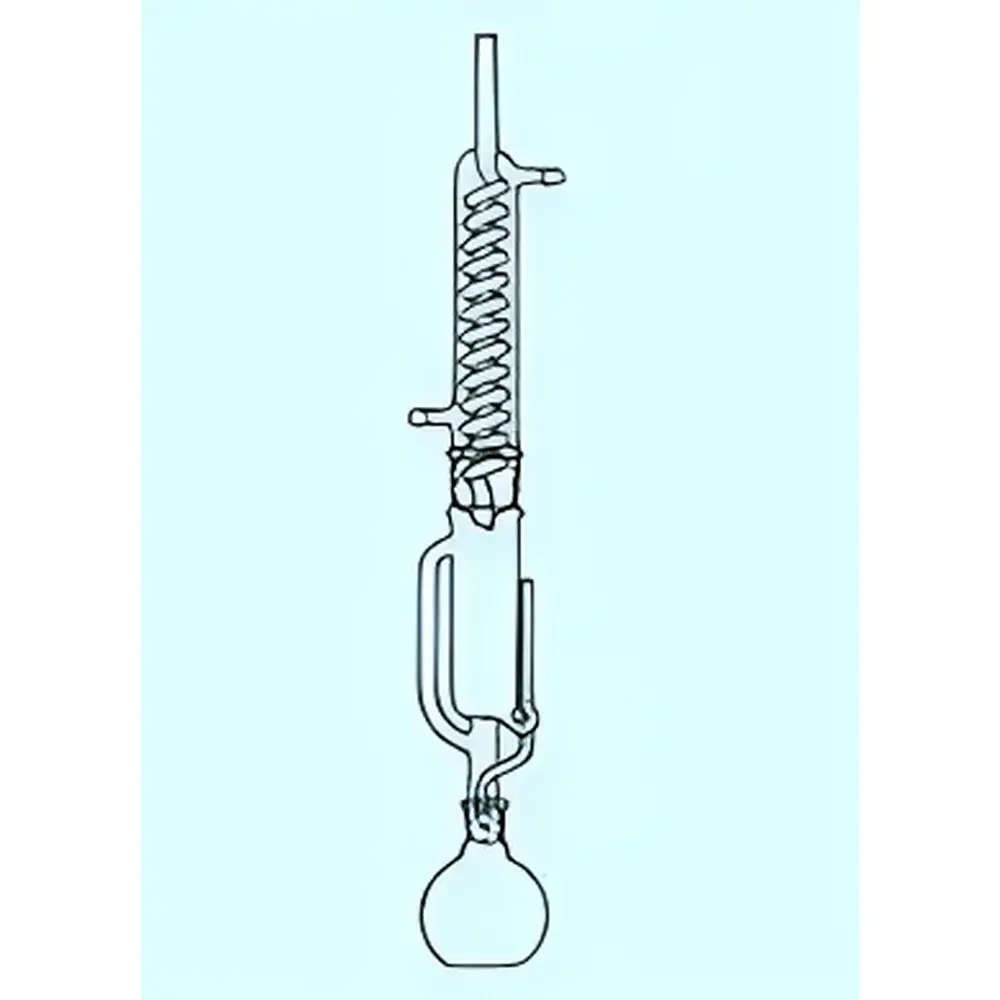
The Hanuo SXT-02 Soxhlet Extractor is a benchtop, dual-channel laboratory instrument engineered for quantitative fat and lipid extraction using the classical Soxhlet principle—based on continuous solvent reflux and cyclic percolation. It operates via thermally driven solvent vaporization (e.g., petroleum ether, diethyl ether, or hexane), condensation, and gravitational siphoning through a thimble-contained sample matrix. This closed-loop architecture ensures high extraction efficiency with minimal solvent consumption and operator intervention. Designed for routine analysis in food, agricultural, environmental, and feed quality control laboratories, the SXT-02 supports standardized methodologies aligned with AOAC 920.39, ISO 6496, and GB/T 5009.6–2016 for crude fat determination. Its robust stainless-steel heating mantle, borosilicate glass assembly, and integrated cooling system deliver consistent thermal management and long-term operational stability under GLP-compliant workflows.
Key Features
- Dual independent extraction channels enable parallel processing of two samples, improving throughput without cross-contamination.
- Precisely adjustable temperature control (ambient +5 °C to 100 °C) accommodates diverse solvent boiling points and matrix sensitivities—critical for heat-labile analytes or low-boiling solvents.
- Automated solvent recovery system minimizes volatile organic compound (VOC) emissions and reduces solvent disposal costs while enhancing lab safety compliance.
- Integrated timing function with audible end-of-cycle alarm ensures reproducible extraction durations across batches—essential for method validation and inter-laboratory comparability.
- Borosilicate glass components (extraction thimbles, condensers, flasks) provide chemical resistance, optical clarity for process monitoring, and compatibility with common organic solvents.
- Compact footprint (750 × 360 × 550 mm) and modular design facilitate integration into standard fume hoods or dedicated extraction workstations.
Sample Compatibility & Compliance
The SXT-02 accommodates solid and semi-solid matrices including cereal grains, animal feed, oilseeds, soil sediments, and dried biological tissues. Samples are prepared in pre-weighed, solvent-rinsed filter paper thimbles (standard size: 25 × 80 mm), ensuring uniform packing density and consistent mass transfer kinetics. The instrument complies with fundamental requirements of ISO/IEC 17025 for test method validation and supports traceable calibration via external PT100 probe verification. While not inherently 21 CFR Part 11 compliant (as it lacks electronic audit trail functionality), its mechanical timer and analog temperature controller meet basic regulatory expectations for non-GMP routine testing environments where manual recordkeeping is accepted.
Software & Data Management
The SXT-02 operates as a standalone hardware platform with no embedded microprocessor or digital interface. All operational parameters—including heating setpoint, extraction duration, and alarm activation—are configured manually via front-panel dials and switches. Data recording follows traditional wet-lab practice: users log start/end times, solvent type, sample mass, flask tare weights, and final residue weights in bound notebooks or LIMS-integrated spreadsheets. For laboratories requiring digital workflow integration, third-party USB data loggers (e.g., Omega OM-DAQPRO-5300) may be connected to external temperature sensors for time-stamped thermal profiling—supporting internal QA audits and method transfer documentation.
Applications
- Routine crude fat quantification in nutritional labeling (e.g., AOAC 991.36 for dairy products).
- Lipid content assessment in animal feed formulations per ASTM D4980 and ISO 6496.
- Soil organic matter screening in environmental monitoring programs (EPA Method 3541 adaptation).
- Oilseed quality control during harvest and storage—tracking rancidity precursors via sequential extractions.
- Method development for novel solvent systems (e.g., ethanol–water mixtures) in green chemistry initiatives.
- Educational use in undergraduate analytical chemistry and food science laboratories for teaching gravimetric analysis fundamentals.
FAQ
What types of solvents are compatible with the SXT-02?
Petroleum ether (bp 40–60 °C), diethyl ether (bp 34.6 °C), hexane (bp 69 °C), and chloroform (bp 61 °C) are commonly used. Always verify solvent compatibility with glassware and ensure proper fume hood ventilation.
Can the SXT-02 be used for non-fat extractions?
Yes—provided the target analyte exhibits sufficient solubility in the selected solvent and remains stable under reflux conditions. Examples include caffeine (in dichloromethane), waxes, or certain polyphenols.
Is the extraction flask volume fixed at 500 mL?
Each channel uses a standard 500 mL round-bottom extraction flask; alternative sizes (e.g., 250 mL or 1000 mL) may be installed manually if physically compatible with the heating mantle geometry.
Does the unit include a built-in cooling water circulator?
No—the SXT-02 requires an external tap water supply or recirculating chiller connected to the condenser inlet/outlet ports (G1/4″ threaded). Optimal condensation efficiency is achieved at coolant temperatures ≤15 °C.
How often should the glass joints be greased?
Light application of PTFE-based grease on ground-glass joints before each use prevents seizing and ensures vacuum-tight seals—especially critical during prolonged extractions (>6 h).



