
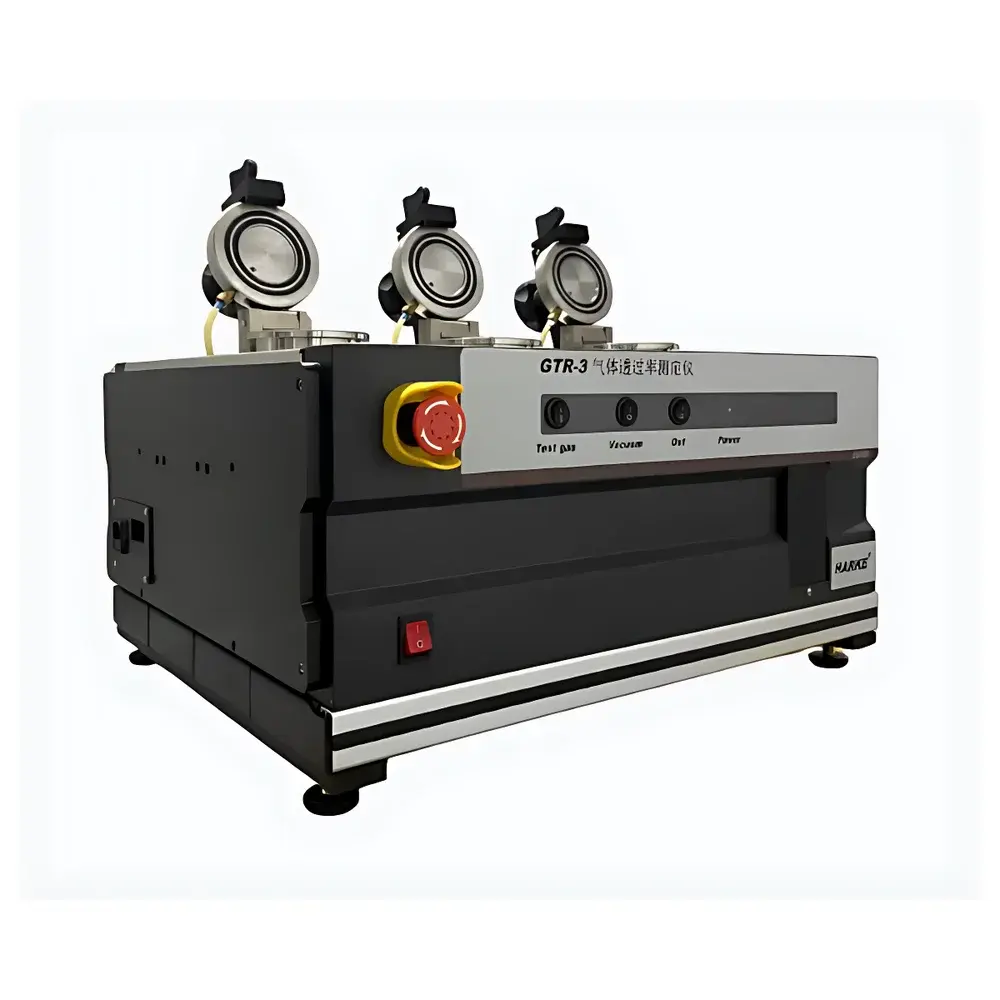
HARKE GTR-3 Gas Permeability and Oxygen Transmission Rate Tester
| Brand | HARKE |
|---|---|
| Origin | Beijing, China |
| Manufacturer Type | Direct Manufacturer |
| Product Category | Domestic (China-made) |
| Model | GTR-3 |
| Pricing | Upon Request |
Overview
The HARKE GTR-3 Gas Permeability and Oxygen Transmission Rate (OTR) Tester is a precision-engineered instrument designed for quantitative measurement of gas transmission behavior through flexible packaging materials and thin films. It operates on the principle of coulometric detection combined with dynamic steady-state permeation analysis—compliant with standardized test methods including ASTM D3985 (O₂), ASTM F2622 (mixed gases), ISO 15105-2, and GB/T 1038. The system quantifies both gas transmission rate (GTR, in cm³/m²·day·MPa) and permeability coefficient (P, in cm³·mm/m²·day·MPa) in a single test cycle, enabling direct correlation between material structure and barrier performance under controlled environmental conditions.
Key Features
- VOV Triple-Chamber Independent Architecture: Three physically isolated test chambers operate simultaneously with independent pressure, flow, and sensor control—eliminating cross-contamination and enabling parallel evaluation of heterogeneous samples or method validation studies.
- Variable Optimal Versatile (VOV) Gas Chamber Design: Each chamber features motorized, stepless volume adjustment (range: 5–120 mL), allowing real-time optimization of test cavity size to match sample barrier level—ensuring sensor operation within its highest signal-to-noise ratio zone for enhanced reproducibility.
- High-Accuracy Environmental Control: Integrated Peltier-based temperature regulation (range: 5–50 °C, ±0.1 °C stability) and RH control (10–90% RH, ±1% RH) meet ISO 2556 and ASTM D1249 conditioning requirements.
- Multigas Capability: Standard configuration supports O₂, N₂, and CO₂; optional configurations include H₂, He, and custom-certified flammable gas modules (e.g., CH₄, C₂H₄) with ATEX-compliant safety interlocks.
- Coulometric Sensor Core: All sensors are factory-calibrated, traceable to NIST standards, and feature dual-electrode redundancy to ensure long-term baseline stability and minimal drift (<0.5% per 30 days).
- Full Automation & Audit Trail Compliance: Test initiation, parameter ramping, equilibrium monitoring, and endpoint determination are executed without manual intervention. Software enforces 21 CFR Part 11–compliant electronic signatures, audit trails, and data integrity protocols required for GLP/GMP-regulated environments.
Sample Compatibility & Compliance
The GTR-3 accommodates rigid and flexible substrates up to 150 mm × 150 mm, including laminated foils, polymer films (PET, PE, PP, EVOH), coated papers, metallized substrates, and pharmaceutical blister packaging. Sample clamping uses pneumatic, uniform-pressure sealing (up to 0.8 MPa) to prevent edge leakage—a critical factor in low-permeability measurements. Instrument compliance extends to ISO/IEC 17025 calibration documentation, ASTM E2915 verification protocols, and full traceability to national metrology institutes (NIM, China). All firmware and software updates follow IEC 62304 medical device software lifecycle standards where applicable.
Software & Data Management
HARKE PermaControl™ v4.2 software provides intuitive workflow navigation, real-time permeation curve visualization, and automated calculation of diffusion coefficient (D), solubility coefficient (S), and activation energy (Eₐ) via Arrhenius modeling. Raw sensor output, temperature/RH logs, and chamber pressure profiles are stored in encrypted SQLite databases with SHA-256 hashing. Export options include CSV, PDF test reports (with digital signature), and XML for LIMS integration. Role-based user permissions (Admin, Technician, Reviewer) enforce separation of duties, while all data modifications generate immutable timestamps and operator IDs—fully satisfying FDA 21 CFR Part 11 and EU Annex 11 requirements.
Applications
- Quality control of food packaging barrier integrity across shelf-life simulation conditions
- Development and validation of high-barrier coatings (SiOₓ, AlOₓ) for flexible electronics encapsulation
- Regulatory submission support for pharmaceutical primary packaging (blister cards, sachets) per USP and EP 3.2.1
- Accelerated aging studies correlating OTR shifts with thermal/UV exposure history
- Comparative analysis of biodegradable film degradation kinetics via time-resolved permeability tracking
- Method equivalence verification between lab-scale GTR-3 and industrial inline laser-based permeation monitors
FAQ
Does the GTR-3 comply with ASTM D3985 for oxygen transmission rate testing?
Yes—the instrument implements the coulometric sensor method specified in ASTM D3985-22, with documented uncertainty budgets validated per ISO/IEC 17025.
Can I test samples with extremely low OTR values (e.g., <0.01 cm³/m²·day)?
Yes—VOV chamber volume reduction to 5 mL minimizes system dead volume and enhances detection sensitivity, enabling reliable measurement down to 0.005 cm³/m²·day at 23 °C/0% RH.
Is remote monitoring and multi-site data synchronization supported?
Yes—PermaControl™ includes optional cloud-enabled telemetry (TLS 1.3 encrypted) for centralized fleet management and cross-laboratory data harmonization.
What calibration standards are supplied with the instrument?
Each unit ships with NIST-traceable certified reference films (CRF-OTR-0.5, CRF-OTR-50) and a full calibration certificate valid for 12 months.
How is sensor longevity maintained during testing with aggressive gases like chlorine or ammonia?
Custom sensor modules with chemically resistant anode/cathode materials and integrated scrubber cartridges are available upon request—subject to pre-test compatibility assessment.






