
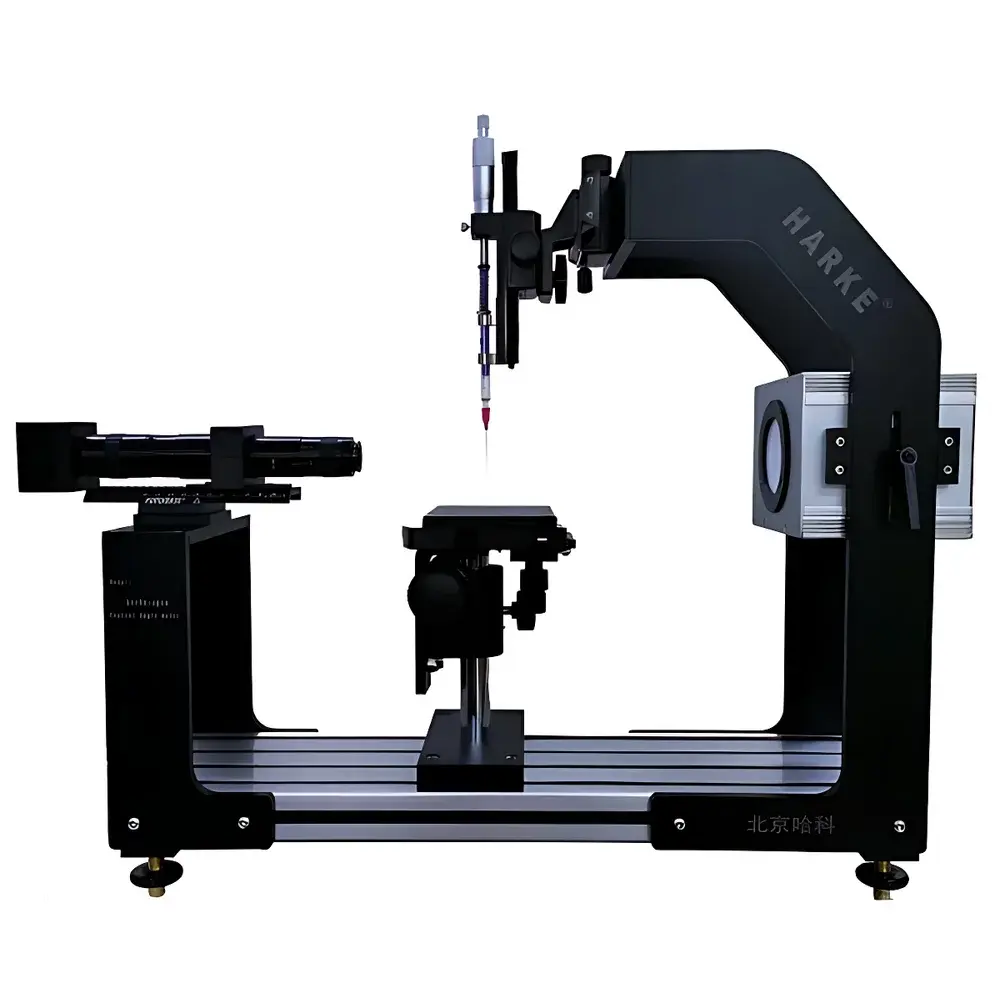
HARKE HARKE-SPC A Video-Based Optical Contact Angle Analyzer
| Brand | HARKE |
|---|---|
| Origin | Beijing, China |
| Manufacturer Type | Direct Manufacturer |
| Instrument Category | Domestic |
| Model | HARKE-SPC A |
| Instrument Type | Benchtop Laboratory System |
| Contact Angle Measurement Range | 0–180° |
| Contact Angle Accuracy | ±0.1° |
| Sample Stage Dimensions | 100 mm × 120 mm |
| Optical Magnification | 0.7×–4.5× |
| Surface/Interfacial Tension Range | 0–1000 mN/m |
| Surface/Interfacial Tension Resolution | 0.01 mN/m |
| Imaging System | USB 3.0 Camera, Software-Controlled at 30 fps (Optional: 100/300/1000+ fps) |
| Measurement Methods | Circle Fitting, Ellipse Fitting, Height-Width, Young-Laplace Fitting, Spline, Polynomial, Axisymmetric Drop Shape Analysis (ADSA), and Tangent Method |
| Software | SPCA 1.0 |
| Power Supply | 220 V, 3 A, 50 Hz |
| Operating Temperature | Ambient |
| Positioning Accuracy (X/Y/Z) | ±0.1 mm |
| Total Weight | 30 kg |
| Footprint | 300 mm × 760 mm |
| Lens Vertical Travel | 30 mm |
| Syringe Dispenser Travel | 30 mm |
Overview
The HARKE HARKE-SPC A is a precision benchtop video-based optical contact angle analyzer engineered for quantitative characterization of solid-liquid interfacial behavior. It operates on the principle of axisymmetric drop shape analysis (ADSA), leveraging high-resolution imaging and rigorous numerical solutions to the Young–Laplace equation to determine contact angle (θ) with sub-degree accuracy. By capturing dynamic or static sessile or pendant droplets via a calibrated optical path—including a motorized zoom lens (0.7×–4.5×) and USB 3.0 camera—the system reconstructs the liquid–solid–vapor triple-phase boundary geometry in real time. This enables direct measurement of θ over the full theoretical range (0°–180°), supporting both equilibrium and advancing/receding angle determinations. The instrument simultaneously computes surface free energy (SFE) of solids using established models (e.g., Owens–Wendt, Wu, van Oss–Chaudhury–Good), and quantifies liquid surface tension and interfacial tension via pendant drop or du Noüy ring methods—fully traceable to SI units and compliant with ASTM D724, ISO 19403, and ISO 1420 standards.
Key Features
- Benchtop modular architecture with rigid aluminum frame and vibration-damped optical baseplate for long-term measurement stability
- Motorized zoom lens (0.7×–4.5×) with fixed magnification steps ensures repeatable image scaling and eliminates parallax-induced calibration drift
- High-speed USB 3.0 imaging system (standard 30 fps; optional up to 1000 fps) captures rapid wetting dynamics—critical for porous media, powders, and stimuli-responsive surfaces
- Three-axis precision motion control: X-axis for focus adjustment, Y/Z for sample and syringe positioning—each with ±0.1 mm repeatability
- Integrated syringe dispenser with programmable volume delivery (0.1–100 µL) and automated dispensing sequence for multi-drop or sequential wetting experiments
- SPCA 1.0 software platform featuring eight independent contact angle calculation algorithms—including Young–Laplace fitting, ellipse/circle regression, and spline-based contour extraction—to accommodate heterogeneous, rough, or anisotropic surfaces
- Full audit trail capability with timestamped metadata (operator ID, environmental conditions, calibration logs) aligned with GLP/GMP documentation requirements
Sample Compatibility & Compliance
The HARKE-SPC A accommodates flat, curved, fibrous, granular, and porous substrates within its 100 mm × 120 mm stage. Its non-contact optical methodology eliminates mechanical interference, enabling measurements on soft hydrogels, thin films, coatings, textiles, and biomedical membranes. Powder wettability analysis is supported via dynamic absorption tracking: high-frame-rate video records capillary rise or imbibition kinetics, and SPCA 1.0 automatically extracts time-resolved contact angles and calculates Washburn coefficients. All measurement protocols adhere to international test standards including ASTM D5725 (surface wettability of paper), ISO 19403-2/-3 (contact angle determination), and ISO 1420 (rubber—determination of resistance to penetration by liquids). Data export formats (CSV, PNG, TIFF, XML) support integration into LIMS and comply with FDA 21 CFR Part 11 requirements when paired with user-defined electronic signatures and access controls.
Software & Data Management
SPCA 1.0 is a Windows-native application built on a deterministic computational engine validated against NIST-traceable reference surfaces. It provides synchronized hardware control, real-time droplet segmentation using adaptive thresholding and edge detection, and batch processing for statistical analysis across multiple samples. Raw images are stored with embedded EXIF metadata (lens position, exposure time, gain, temperature). Each measurement session generates a structured project file containing raw frames, fitted contours, calculated parameters (θ, γLV, γSV, γSL), and uncertainty propagation estimates based on pixel resolution and noise modeling. Export modules support CSV (for Excel/Python analysis), PDF reports (with customizable templates), and TIFF sequences for third-party ADSA validation. Audit logs record all user actions—including method edits, calibration updates, and data deletions—with immutable timestamps and operator attribution.
Applications
- Quality control of hydrophobic/hydrophilic coatings in semiconductor photomasks, anti-fog lenses, and medical device packaging
- R&D of functional textiles (e.g., oil-repellent fabrics, moisture-wicking sportswear) under dynamic wetting conditions
- Characterization of battery electrode slurries and separator wettability in Li-ion cell development
- Surface energy mapping of plasma-treated polymers for adhesion optimization in automotive composites
- Pharmaceutical tablet coating uniformity assessment via contact angle heterogeneity analysis
- Soil science and agronomy studies evaluating surfactant-enhanced water infiltration in clay–sand mixtures
- Biomedical research on protein adsorption kinetics and cell-substrate affinity via time-lapsed contact angle decay
FAQ
What contact angle calculation methods does the HARKE-SPC A support?
It implements eight algorithms: Circle Fitting, Ellipse Fitting, Height–Width, Tangent, Spline, Polynomial, Young–Laplace Fitting, and Axisymmetric Drop Shape Analysis (ADSA)—each selectable per measurement to match surface morphology and droplet symmetry.
Can the system measure contact angles on powders or porous materials?
Yes. Using high-speed video capture (up to 1000 fps), it records liquid absorption dynamics and computes time-resolved contact angles via automated contour tracking and Washburn model fitting.
Is the software compliant with regulatory data integrity requirements?
SPCA 1.0 supports ALCOA+ principles: Attributable, Legible, Contemporaneous, Original, Accurate data generation, with full audit trail, electronic signature options, and export-ready formats for FDA 21 CFR Part 11 and EU Annex 11 compliance.
What is the minimum resolvable surface tension value?
The system achieves a resolution of 0.01 mN/m across the full 0–1000 mN/m range, verified using certified reference liquids (e.g., ultrapure water, diiodomethane) per ISO 1420 calibration protocols.
Does the instrument require external environmental control?
No. It operates stably at ambient laboratory conditions (15–30°C, 30–70% RH); optional environmental chamber integration is available for temperature- or humidity-controlled experiments.



