
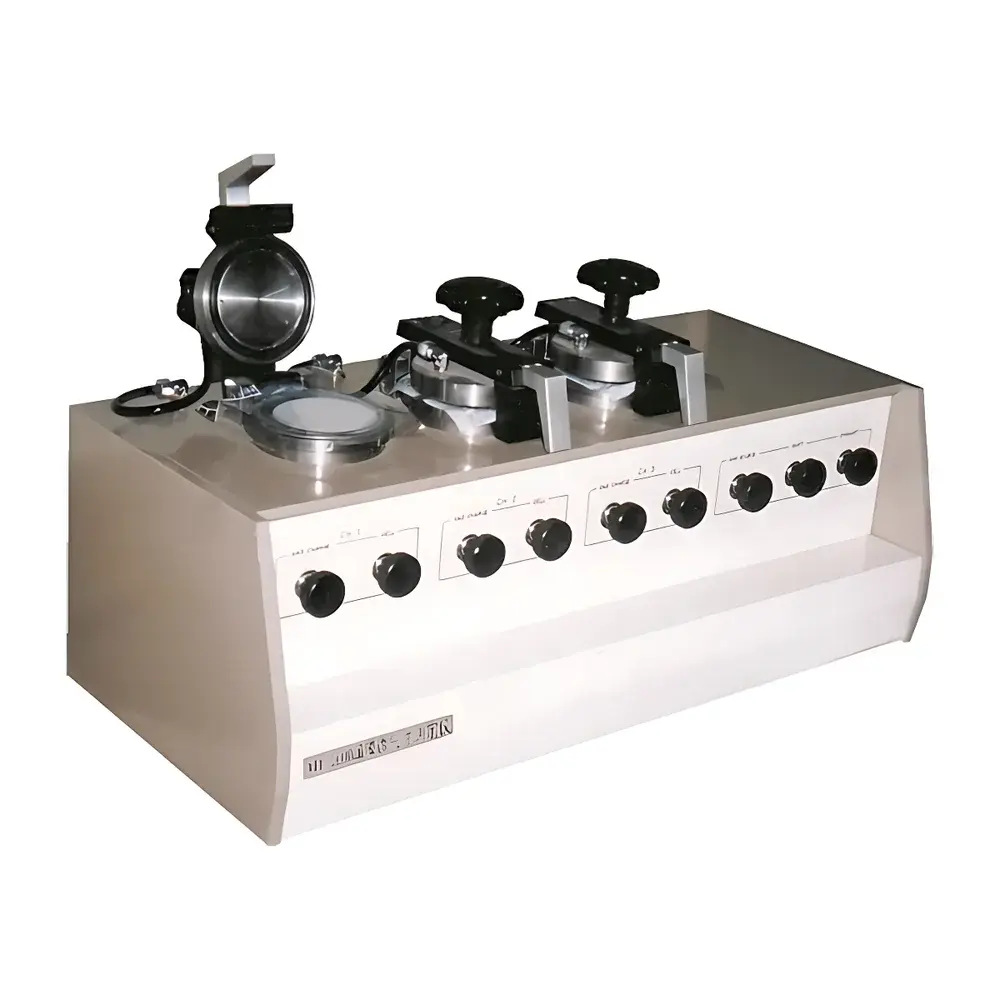
HARKE HARKE-TQ3 Gas Permeability Tester for Plastic Films
| Brand | HARKE |
|---|---|
| Origin | Beijing, China |
| Manufacturer Type | Manufacturer |
| Country of Origin | China |
| Model | HARKE-TQ3 |
| Pricing | Upon Request |
| Measurement Principle | Differential Pressure (Manometric) Method |
| Compliant Standards | ISO 2556:1974, GB/T 1038–2000, ASTM D1434–75 |
| Permeation Rate Range (Chamber A) | 3–6000 cm³/(m²·d·Pa) |
| Permeation Rate Range (Chamber B) | 0.3–600 cm³/(m²·d·Pa) |
| Test Area | 38.46 cm² (Ø70 mm) |
| Specimen Size | 90 mm × 90 mm |
| Specimen Thickness Range | 10 µm – 2 mm |
| Test Gases | O₂, N₂, CO₂ |
| Pressure Differential Range | 0–10⁵ Pa |
| Pressure Measurement Accuracy | ±0.1 Pa |
| Power Supply | AC 220 V, 10 A |
| Control Interface | PC-based Windows software with real-time data logging, curve plotting, report generation (bilingual EN/CN), audit-ready export, and secure file management |
Overview
The HARKE HARKE-TQ3 Gas Permeability Tester is a precision differential pressure (manometric) instrument engineered for the quantitative determination of gas transmission rates—specifically oxygen (O₂), nitrogen (N₂), and carbon dioxide (CO₂)—through plastic films and thin polymer sheets. It operates on the fundamental principle of establishing a controlled pressure gradient across a sealed test specimen: the high-pressure chamber is pressurized to 10⁵ Pa with the test gas, while the low-pressure chamber is evacuated to near-vacuum conditions using an integrated vacuum pump. As gas permeates through the film, the resulting pressure rise in the low-pressure chamber is measured continuously via a high-resolution digital pressure transducer (±0.1 Pa accuracy). The instrument calculates both gas permeability coefficient (P, in cm³·cm/(cm²·s·Pa)) and gas transmission rate (GTR, in cm³/(m²·d·Pa)) in accordance with internationally recognized transport thermodynamics for diffusion-controlled barrier materials. Designed for laboratory-grade reproducibility and long-term stability, the HARKE-TQ3 delivers traceable, standards-aligned results essential for R&D validation, QC release testing, and regulatory documentation in packaging development.
Key Features
- Dual-range manometric detection system supporting wide dynamic measurement spans: Chamber A (3–6000 cm³/(m²·d·Pa)) for high-permeability films; Chamber B (0.3–600 cm³/(m²·d·Pa)) optimized for high-barrier materials such as metallized PET or PVDC-coated substrates.
- Standardized test area of 38.46 cm² (Ø70 mm) and specimen fixture accommodating 90 mm × 90 mm samples—fully compliant with ISO 2556, GB/T 1038, and ASTM D1434 dimensional requirements.
- Integrated vacuum system with ultimate pressure <1 Pa, ensuring rapid stabilization and minimal baseline drift during extended permeation monitoring.
- PC-controlled operation via Windows-native software featuring real-time pressure curve visualization, automatic endpoint detection, and multi-point time-series data interpolation.
- Mercury-free design meeting modern occupational health and safety protocols (OSHA, REACH, and ISO 14001-compliant labs); eliminates vapor toxicity risks and simplifies instrument maintenance and disposal.
- Full audit trail capability—including user login timestamps, parameter change logs, raw data export (CSV/Excel), and PDF report generation with bilingual (English/Chinese) headers and footers—supports GLP/GMP environments and FDA 21 CFR Part 11 readiness when paired with validated IT infrastructure.
Sample Compatibility & Compliance
The HARKE-TQ3 accommodates flexible polymeric specimens ranging from 10 µm ultrathin cast films to 2 mm rigid laminates, including but not limited to LDPE, HDPE, PP, PET, PA, EVOH, aluminum foil composites, and SiOₓ/PVDC barrier coatings. Its mechanical clamping system ensures uniform sealing force distribution across the entire 90 mm × 90 mm sample perimeter, minimizing edge leakage and enabling reliable measurements even on low-tensile-strength or heat-sensitive substrates. All operational parameters—including temperature control (ambient to 40 °C optional), pressure ramp profiles, and dwell times—are programmable within the software interface to replicate real-world storage or sterilization conditions. The instrument’s metrological traceability is anchored to national pressure calibration standards (e.g., NIM China), and its performance verification protocol aligns with ISO/IEC 17025 clause 5.9 for testing equipment validation.
Software & Data Management
The HARKE-TQ3 is operated exclusively through its proprietary Windows-based application, built on .NET Framework with SQLite backend architecture for local data integrity. The interface supports multi-user role assignment (admin/operator/viewer), password-protected method templates, and version-controlled test protocols. Raw pressure vs. time datasets are stored with metadata (operator ID, date/time stamp, environmental T/RH if logged externally, calibration certificate ID). Export functions include CSV for third-party statistical analysis (JMP, Minitab), XML for LIMS integration, and PDF reports conforming to ISO/IEC 17025 Annex A3 formatting guidelines. All reports contain embedded digital signatures, revision history, and full uncertainty budget disclosure per GUM (Guide to the Expression of Uncertainty in Measurement).
Applications
- Barrier performance qualification of food packaging films (e.g., snack pouches, dairy lids, meat trays) under accelerated shelf-life modeling.
- Development and comparative evaluation of novel biodegradable polymers (PLA, PHA, starch blends) against conventional petrochemical barriers.
- QC release testing for medical device pouches (ISO 11607-1), pharmaceutical blister lidding foils (USP ), and sterile barrier systems.
- Failure analysis of delaminated or pinholed multilayer structures via localized permeation mapping (when used with masking fixtures).
- Regulatory dossier preparation for FDA 510(k), EU MDR Annex I, or CFDA Class III packaging submissions requiring documented permeability evidence.
FAQ
What gases can be tested with the HARKE-TQ3?
O₂, N₂, and CO₂ are fully supported; other permanent gases may be evaluated subject to compatibility verification with the internal elastomer seals and pressure sensor range.
Is temperature control integrated into the base model?
The standard HARKE-TQ3 operates at ambient laboratory temperature; optional Peltier-based thermal chambers (–10 °C to +60 °C) are available as add-on modules with independent PID regulation.
How is leak integrity verified prior to each test?
An automated vacuum hold test is executed before specimen loading; the system rejects runs where pressure rise exceeds 0.05 Pa/min over a 5-minute stabilization period.
Can the instrument be connected to a central LIMS or MES platform?
Yes—via configurable OPC UA or REST API endpoints (available under extended software license); raw data schema and authentication protocols are documented in the Instrument Integration Manual.
Does the software support 21 CFR Part 11 compliance out-of-the-box?
The base software provides audit trail, electronic signature, and data immutability features; full Part 11 compliance requires site-specific validation documentation and IT infrastructure alignment (e.g., domain authentication, encrypted backups), which HARKE supports through its Validation Services Package.






