
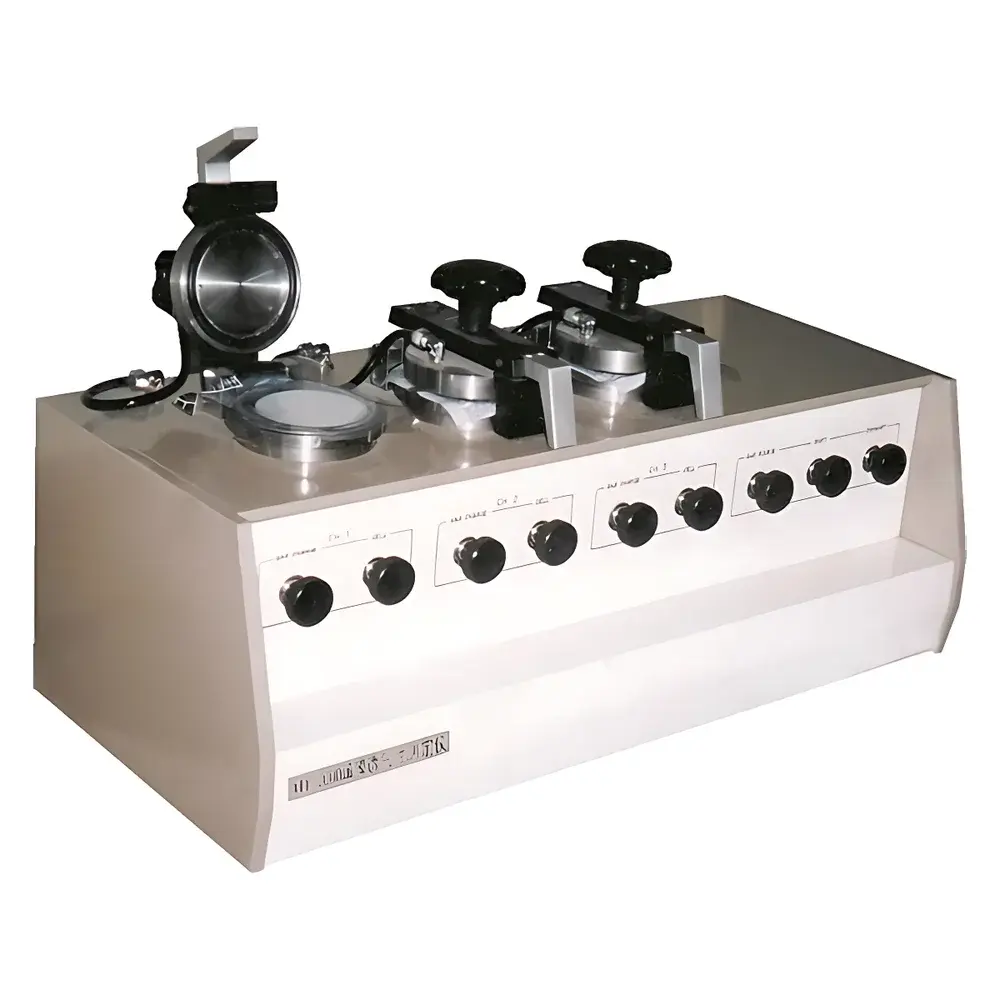
HARKE HK-G3 Gas Permeability Tester
| Brand | HARKE |
|---|---|
| Model | HK-G3 |
| Measurement Range | 10–10,000 s/100 mL·in² at 1.22 kPa |
| Pressure Control Range | 0–20 kPa (customizable) |
| Sample Thickness Limit | ≤5 mm |
| Test Area | 0.025 in² |
| Vacuum Resolution | 0.1 Pa |
| Sample Count per Run | 1 |
| Gas Compatibility | O₂, N₂, CO₂, air, He, H₂, CH₄, C₃H₈, C₄H₁₀, NH₃ (hazardous gases require pre-consultation) |
| Interface | Ø8 mm tubing |
| Dimensions (L×W×H) | 730 × 510 × 350 mm |
| Power Supply | AC 220 V, 50 Hz |
| Net Weight | 68 kg |
| Control System | Embedded 32-bit ARM processor with TFT color touchscreen |
| Automation Level | Fully automatic sample clamping, pressure regulation, vacuum evacuation, and data acquisition |
| Output Parameters | Gas Transmission Rate (GTR), Permeability Coefficient (P), Diffusion Coefficient (D), Solubility Coefficient (S) |
Overview
The HARKE HK-G3 Gas Permeability Tester is a precision-engineered instrument designed for quantitative evaluation of gas transmission behavior through thin-film materials under controlled vacuum conditions. It operates on the principle of the vacuum-manometric method (ASTM D1434, ISO 2556, ISO 15105-1), where a known test area of specimen is sealed between two chambers — one evacuated to high vacuum and the other maintained at atmospheric or regulated pressure of the test gas. The rate at which gas permeates through the sample into the vacuum chamber is measured via high-resolution pressure transduction over time. This enables derivation of fundamental transport parameters: Gas Transmission Rate (GTR, expressed in standard cubic centimeters per square meter per day at specified temperature and partial pressure difference), Permeability Coefficient (P, in cm³·mm/m²·day·kPa), Diffusion Coefficient (D), and Solubility Coefficient (S). The system’s 0.1 Pa vacuum resolution and calibrated 0.025 in² (16.13 mm²) test area ensure traceable repeatability across low-to-ultra-high barrier materials.
Key Features
- Fully automated sample loading and clamping mechanism eliminates operator-induced variability and reduces cycle time per test.
- Embedded 32-bit ARM architecture with real-time OS ensures deterministic control of vacuum sequencing, pressure ramping, and sensor sampling intervals.
- TFT high-definition color touchscreen interface supports multi-language operation and intuitive navigation without external PC dependency.
- Imported high-stability piezoresistive vacuum sensors and mass flow-controlled gas delivery modules guarantee measurement fidelity across the full 10–10,000 s/100 mL·in² range (equivalent to ~1.6–1600 mL·µm/m²·day·kPa for O₂ at 23°C).
- Modular gas manifold with Ø8 mm quick-connect ports facilitates safe, leak-tight integration of external gas sources — including certified cylinders for O₂, N₂, CO₂, He, H₂, and hydrocarbon gases.
- Structural design accommodates specimens up to 5 mm thick, enabling characterization of laminated pharmaceutical blisters, battery separator stacks, and reinforced polymer composites.
- Compliance-ready architecture supports audit trails, user-level access control, and electronic signature capability — aligned with FDA 21 CFR Part 11 and GLP/GMP documentation requirements when paired with optional software modules.
Sample Compatibility & Compliance
The HK-G3 is validated for use with rigid and flexible packaging substrates including aluminum foil composites, metallized PET/PVC, PVDC-coated films, coextruded multilayer structures, pharmaceutical cold-forming foils, and medical-grade barrier laminates. It also supports emerging material classes such as biodegradable polyesters (PLA, PHA), ceramic-coated separators for lithium-ion batteries, and functionalized membranes for gas separation R&D. All testing protocols adhere to internationally recognized standards: ASTM D1434 (O₂ transmission), ISO 2556 (general gas permeability), ISO 15105-1 (differential pressure method), and GB/T 1038 (Chinese national standard). For hazardous gases (e.g., H₂, NH₃, CH₄), users must conduct pre-test risk assessment and install appropriate ventilation, leak detection, and emergency shutoff systems per OSHA 1910.120 and IEC 60079-10-1.
Software & Data Management
The HK-G3 operates natively via its onboard embedded system but integrates seamlessly with HARKE’s optional PC-based PermeaSoft™ Suite (v4.x). This application provides advanced curve fitting using Fickian and non-Fickian diffusion models, batch report generation compliant with ISO/IEC 17025, and export to CSV, PDF, or XML formats. Raw pressure-vs.-time datasets are timestamped and stored with metadata (operator ID, calibration certificate ID, environmental temperature/humidity logs). Audit trail functionality records all parameter modifications, test starts/stops, and firmware updates — supporting laboratory accreditation under ISO/IEC 17025:2017 and regulatory submissions to EMA, PMDA, or Health Canada.
Applications
This instrument serves critical quality assurance and R&D functions across regulated industries: food packaging shelf-life modeling (O₂ ingress into snack pouches), pharmaceutical primary packaging validation (moisture and O₂ barrier integrity of blister cards), battery safety engineering (Li-ion separator gas permeability under thermal stress), aerospace composite outgassing analysis, and biomaterial permeability screening (artificial skin oxygen transfer rates). Its adaptability to variable test gas chemistries and pressure differentials makes it suitable for evaluating novel barrier coatings, nanocomposite films, and stimuli-responsive membranes under accelerated aging or dynamic humidity conditions.
FAQ
What gases can be tested on the HK-G3?
Oxygen, nitrogen, carbon dioxide, air, helium, hydrogen, methane, propane, butane, and ammonia — subject to pre-installation safety review for flammable or toxic species.
Is calibration traceable to national standards?
Yes; factory calibration uses NIST-traceable reference films and certified pressure standards. Optional annual recalibration services include uncertainty budgets per ISO/IEC 17025.
Can the HK-G3 operate at elevated temperatures?
The base configuration maintains ambient temperature control. For thermal testing (e.g., 5–40°C), an external environmental chamber with feedthrough ports is required and must be integrated during system commissioning.
Does the system support multiple samples per run?
No; it performs single-specimen analysis per test cycle to ensure optimal seal integrity and vacuum stability. High-throughput labs typically deploy parallel units or schedule sequential runs.
What maintenance is required?
Quarterly verification of vacuum integrity, annual sensor recalibration, and periodic replacement of O-rings and filter elements per manufacturer’s maintenance log — all documented in the built-in service history tracker.






