
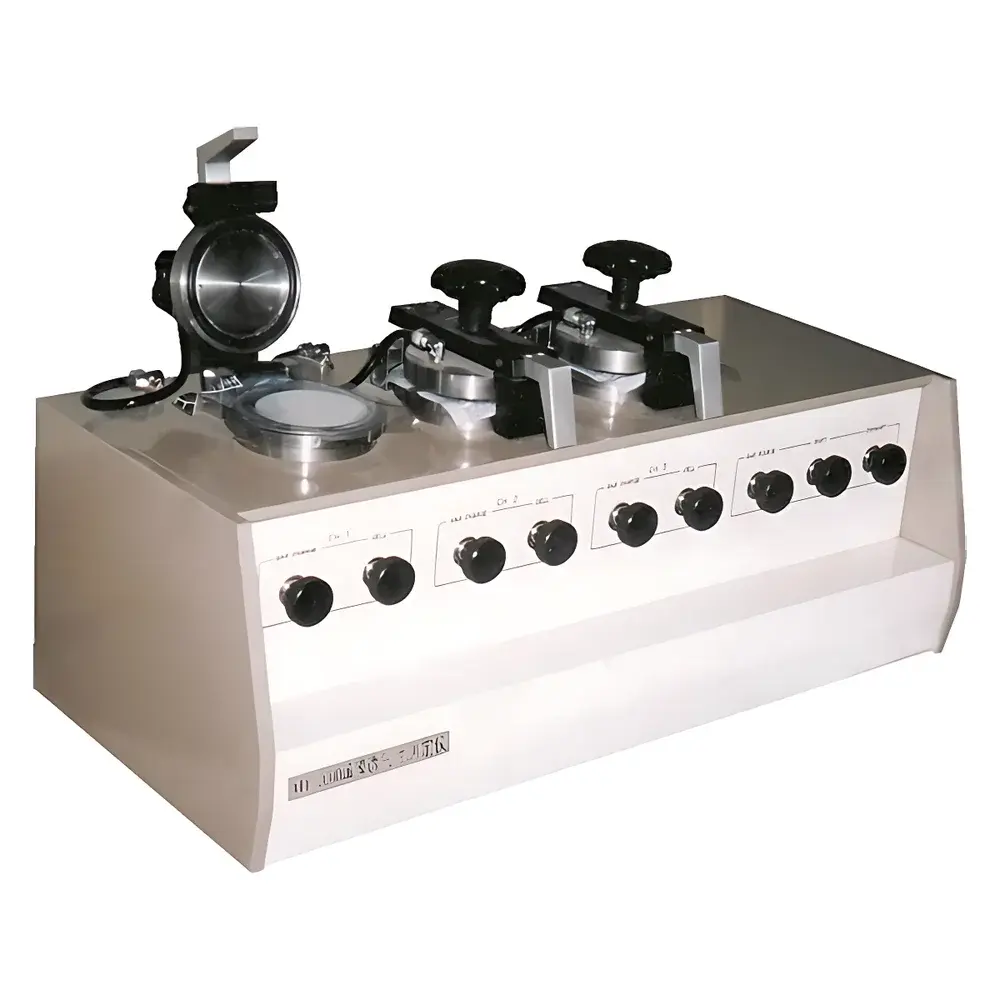
HARKE HK-GR3 Differential Pressure Gas Permeability Tester
| Brand | HARKE |
|---|---|
| Origin | Beijing, China |
| Manufacturer Type | Manufacturer |
| Region of Origin | Domestic (China) |
| Model | HK-GR3 |
| Quotation | Available upon request |
| Measurement Principle | Vacuum-based differential pressure method |
| Test Range | 0.05–160,000 cm³/m²·24h·0.1MPa (standard configuration) |
| Resolution | 0.001 cm³/m²·24h·0.1MPa |
| Specimen Count | 1 |
| Vacuum Resolution | 0.1 Pa |
| Temperature Control Range | 5°C–95°C (external chiller/heater required) |
| Temperature Accuracy | ±0.1°C |
| Max Specimen Thickness | ≤5 mm (customizable) |
| Specimen Dimensions | ≥150 mm × 94 mm or circular |
| Effective Test Area | 48 cm² |
| Test Gases | O₂, N₂, CO₂, air, He, H₂, CH₄, C₃H₈, C₄H₁₀, NH₃ (user-supplied gas sources) |
| Test Pressure Range | −0.1 MPa to +0.1 MPa (standard) |
| Gas Supply Pressure | 0.3–1.0 MPa |
| Gas Inlet Port | Ø8 mm |
| Dimensions (L×D×H) | 330 × 600 × 330 mm |
| Power Supply | AC 220 V, 50 Hz |
| Net Weight | 28 kg |
Overview
The HARKE HK-GR3 Differential Pressure Gas Permeability Tester is a precision-engineered instrument designed for quantitative determination of gas transmission rates through polymeric, laminated, metallic, and composite packaging materials under controlled temperature and pressure differentials. It operates on the vacuum-based differential pressure principle—compliant with ISO 15105-1, ASTM D1434, and GB/T 1038—where a specimen separates two chambers: one maintained at atmospheric or elevated pressure (upstream), and the other evacuated to high vacuum (downstream). The transient pressure rise in the downstream chamber is measured via high-stability capacitance manometers, enabling calculation of gas permeability (P), diffusion coefficient (D), solubility coefficient (S), and permeation rate (TR) using Fick’s laws and Henry’s law assumptions. This gravimetrically traceable, non-destructive methodology ensures high reproducibility across diverse barrier substrates, including ultra-high-barrier films used in pharmaceutical blister packaging, lithium-ion battery separators, and aerospace-grade composites.
Key Features
- Vacuum-resolution sensing system with 0.1 Pa detection limit, ensuring accurate quantification of low-permeability materials (e.g., AlOx-coated PET, SiOx-deposited films)
- High-precision temperature control interface (±0.1°C stability) compatible with external Peltier or recirculating chillers for testing across 5–95°C—critical for Arrhenius-based activation energy analysis
- Standardized 48 cm² test area with rigid clamping mechanism minimizing edge leakage; accommodates rectangular (≥150 × 94 mm) or circular specimens up to 5 mm thickness
- Modular gas handling architecture supporting inert (N₂, Ar), reactive (CO₂, NH₃), and flammable (H₂, CH₄, C₃H₈) gases—requires user-provided regulated gas supply (0.3–1.0 MPa) and pre-installation hazard assessment
- Robust stainless-steel vacuum chamber with leak-tight sealing (helium leak rate <1 × 10⁻⁹ mbar·L/s), validated per ISO 20483 Annex B
- Single-specimen configuration optimized for GLP-compliant sequential testing and inter-laboratory method transfer
Sample Compatibility & Compliance
The HK-GR3 supports a broad spectrum of industrial and regulatory-grade substrates: aluminum foil composites, PVDC-coated films, cold-forming blister foils (e.g., medicinal PVC/PVDC), coextruded multilayer pouches, biodegradable PLA/PHA laminates, microporous battery separators (polyolefin, ceramic-coated), synthetic membranes for gas separation, and elastomeric components (tire innerliners, medical tubing). All test protocols align with pharmacopoeial standards (USP , Ph. Eur. 2.6.25) and food contact material regulations (EU 10/2011, FDA 21 CFR Part 177). For hazardous gas applications (e.g., H₂, NH₃), users must conduct site-specific risk assessments and install secondary containment—documentation required prior to commissioning.
Software & Data Management
Instrument control, real-time data acquisition, and permeation parameter derivation are executed via HARKE PermeCalc™ v3.2 software (Windows 10/11 compatible). The application enforces ALCOA+ data integrity principles: automated audit trails, electronic signatures (21 CFR Part 11 compliant), and encrypted raw-data storage (.hpk binary + CSV export). Permeability curves are fitted using nonlinear regression (Levenberg–Marquardt algorithm) against time-lag models; diffusion and solubility coefficients are derived from slope-intercept analysis of transient pressure vs. √t plots. Calibration certificates (traceable to NIM, China) and IQ/OQ documentation packages are provided with each unit.
Applications
- Quality assurance of pharmaceutical primary packaging—verifying O₂ transmission rates (OTR) in cold-forming foils and child-resistant blisters
- Accelerated shelf-life modeling for retortable pouches and aseptic cartons via temperature-dependent permeability profiling
- R&D evaluation of nanocomposite barrier coatings (clay, graphene oxide) and plasma-enhanced CVD layers
- Regulatory submission support for FDA 510(k) and CE marking of implantable device packaging (ISO 11607-1)
- Characterization of hydrogen permeation in fuel cell membrane electrodes and battery electrolyte containment films
- Validation of sterilization compatibility—measuring post-EtO or gamma irradiation changes in film permeability
FAQ
Is the HK-GR3 compliant with ISO 15105-1 and ASTM D1434?
Yes—the instrument’s vacuum differential pressure architecture, sensor calibration hierarchy, and data reduction algorithms fully satisfy both standards’ requirements for steady-state and time-lag permeability measurement.
Can it measure water vapor transmission (WVTR)?
No—this model is configured exclusively for permanent gases and vapors with condensation points below −40°C. For WVTR, HARKE offers the HK-W3000 series using modulated IR detection.
What external equipment is mandatory for operation?
A certified temperature-controlled bath or Peltier chiller (−10°C to 100°C range), calibrated gas pressure regulator (0.3–1.0 MPa), and certified gas cylinders with residual pressure monitoring are required.
Does the system support multi-gas simultaneous testing?
No—it performs single-gas tests sequentially. Gas switching requires manual line purging and system re-evacuation to prevent cross-contamination and ensure measurement fidelity.
Is technical training and on-site installation included?
HARKE provides remote commissioning, operator certification webinars, and optional on-site IQ/OQ execution by qualified field engineers—quoted separately.






