
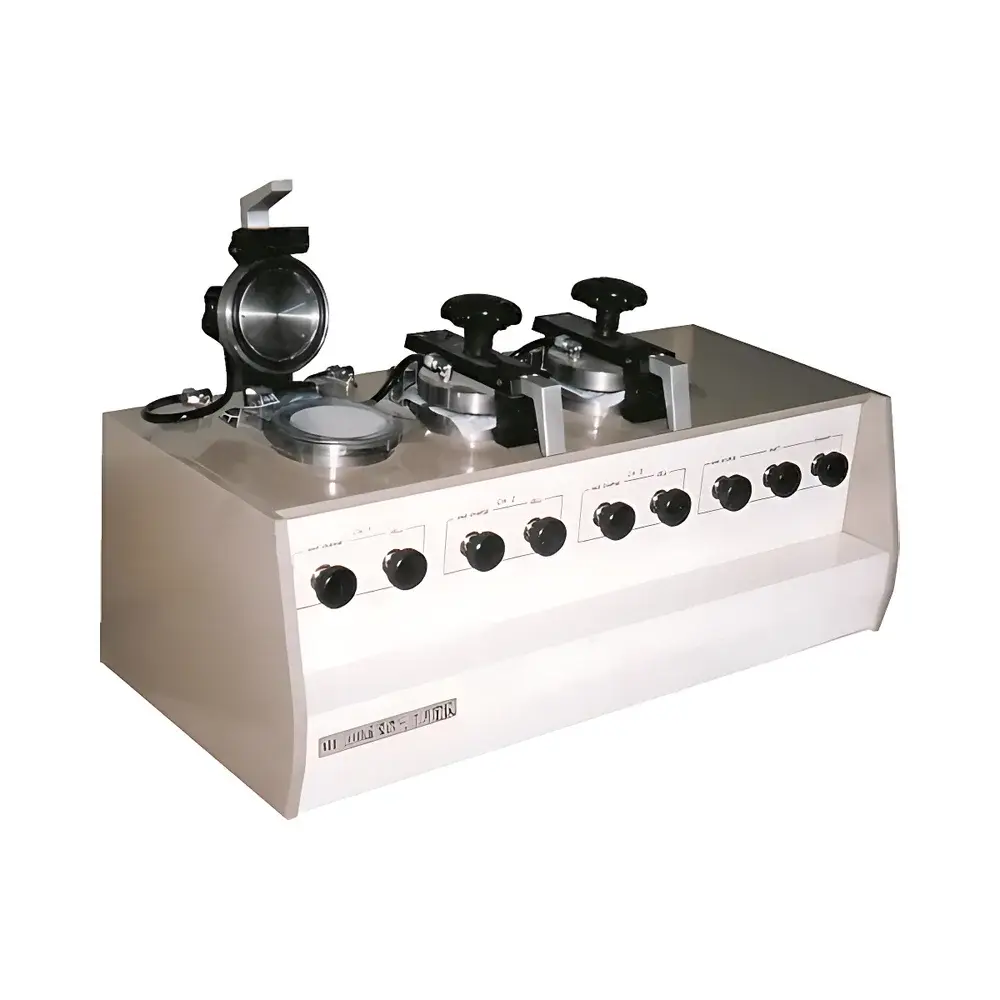
Harke HK-R7 Gas Permeability Tester
| Brand | Harke |
|---|---|
| Origin | Beijing, China |
| Manufacturer | Harke Instrument Co., Ltd. |
| Model | HK-R7 |
| Temperature Control Range | 5 °C to 95 °C (external chiller required) |
| Temperature Accuracy | ±0.1 °C |
| Vacuum Resolution | 0.1 Pa |
| Test Area | 48 cm² |
| Sample Thickness Limit | ≤5 mm (customizable) |
| Sample Dimensions | ≥150 mm × 94 mm or circular |
| Gas Permeation Range | 0.05–160,000 cm³/m²·24h·0.1MPa |
| Resolution | 0.001 cm³/m²·24h·0.1MPa |
| Test Gases | O₂, N₂, CO₂, air, He, H₂, CH₄, C₃H₈, C₄H₁₀, NH₃ (hazardous gases require pre-order specification) |
| Operating Pressure Range | −0.1 to +0.1 MPa |
| Supply Pressure | 0.3–1.0 MPa |
| Inlet Port | Ø8 mm |
| Power | AC 220 V, 50 Hz |
| Net Weight | 28 kg |
| Dimensions | 330 mm (L) × 600 mm (D) × 330 mm (H) |
| Compliance | GB/T 1038, ISO 15105-1, ISO 2556, ASTM D1434, JIS K7126-1, YBB00082003 |
Overview
The Harke HK-R7 Gas Permeability Tester is a precision vacuum-manometric instrument engineered for the quantitative determination of gas transmission rates (GTR), permeability coefficients (P), diffusion coefficients (D), and solubility coefficients (S) in flexible and rigid packaging materials. It operates on the principle of volumetric pressure-rise measurement under controlled vacuum conditions—commonly referred to as the vacuum method per ISO 15105-1 and ASTM D1434. This methodology ensures high reproducibility for low- to ultra-high-permeability materials across a broad dynamic range, from barrier films (e.g., AlOx-coated PET, SiOx-laminates) to highly permeable elastomers and microporous membranes. The system maintains rigorous thermal stability via external temperature-controlled bath integration (5 °C to 95 °C), enabling kinetic studies of gas transport mechanisms—including Arrhenius-based activation energy analysis—under standardized or application-specific thermal profiles.
Key Features
- Triple independent test chambers (optional configuration) for parallel, statistically robust multi-sample evaluation without cross-contamination or pressure interference
- High-resolution vacuum transduction (0.1 Pa) coupled with digital pressure ramping algorithms for precise detection of minute gas influx during steady-state permeation
- Automated pneumatic clamping mechanism ensuring repeatable sample sealing integrity and eliminating operator-induced torque variability
- Three configurable test termination modes: proportional threshold, fuzzy logic-based stabilization assessment, and fixed-duration acquisition—supporting both regulatory-compliant and R&D-driven workflows
- Modular range extension capability for high-flux applications (e.g., battery separators, breathable medical fabrics), maintaining resolution down to 0.001 cm³/m²·24h·0.1MPa
- Gas compatibility with non-corrosive and reactive species—including H₂, NH₃, and hydrocarbons—subject to factory-installed material upgrades (e.g., stainless-steel wetted parts, fluoropolymer seals, explosion-proof solenoids) and pre-delivery hazard review
Sample Compatibility & Compliance
The HK-R7 accommodates flat-sheet specimens up to 5 mm thick and minimum dimensions of 150 mm × 94 mm (or Ø100 mm circular), covering industry-standard formats for pharmaceutical blister foils (e.g., cold-forming aluminum), IV bag multilayer coextrusions, aerospace polymer composites, and biomedical membranes. All hardware and firmware are designed to meet GLP documentation requirements, including audit-trail-enabled test logging, user-access-level controls, and timestamped raw-data capture. The instrument conforms to critical regulatory test standards including GB/T 1038 (China), ISO 2556 (gas transmission rate—manometric method), ISO 15105-1 (permeability coefficient calculation), ASTM D1434 (standard test method for determining gas permeability of plastics), JIS K7126-1 (Japanese industrial standard for plastic film permeability), and YBB00082003 (Chinese pharmaceutical packaging guidance). Full traceability to NIST-traceable pressure and temperature references is supported via optional calibration certificate packages.
Software & Data Management
Control and analysis are executed via HarkePermea v3.x software—a Windows-based platform compliant with FDA 21 CFR Part 11 requirements when configured with electronic signatures, role-based permissions, and immutable audit trails. Real-time visualization includes dual-axis permeation curves (pressure vs. time), automatic slope derivation for steady-state identification, and integrated calculation modules for P, D, and S using Fickian diffusion models. Export formats include CSV, PDF reports (with customizable templates), and XML for LIMS integration. Raw sensor data files retain full metadata—including environmental chamber logs, valve actuation timestamps, and error flags—ensuring full reprocessing capability and forensic traceability during regulatory inspections.
Applications
- Pharmaceutical packaging validation: moisture/oxygen barrier performance of PTP blisters, sachets, and cold-forming foils per USP <671>
- Food packaging shelf-life modeling: O₂ transmission rate (OTR) and CO₂ transmission rate (CTR) of retort pouches, vacuum-sealed trays, and modified-atmosphere packaging (MAP) films
- Advanced materials R&D: permeability anisotropy mapping in electrospun nanofibers, graphene-enhanced composites, and solid polymer electrolytes for lithium-ion batteries
- Tire and rubber component testing: helium leak rate quantification in inner liners and cured elastomer compounds per ASTM D7470
- Medical device evaluation: gas exchange kinetics in wound dressings, artificial skin scaffolds, and dialysis membranes under physiological temperature gradients
- Sustainable packaging development: comparative permeation profiling of bio-based polymers (PLA, PHA), compostable laminates, and recycled PET blends
FAQ
Does the HK-R7 support simultaneous multi-gas testing?
No—the system performs single-gas measurements per test cycle. Sequential multi-gas evaluation is possible via manual gas line switching and recalibration; automated multi-gas manifolds are available as an OEM add-on.
Is external temperature control mandatory?
Yes. The HK-R7 requires an externally connected recirculating chiller or heating bath for precise thermal regulation between 5 °C and 95 °C. An integrated Peltier module is not included in the base configuration.
Can the instrument be validated for GMP environments?
Yes—when equipped with IQ/OQ documentation packages, electronic signature modules, and 21 CFR Part 11-compliant software settings, the HK-R7 supports formal GMP validation protocols including installation qualification (IQ), operational qualification (OQ), and performance qualification (PQ).
What safety provisions exist for flammable or toxic gases?
Testing with Class 2/3 hazardous gases (e.g., H₂, CH₄, NH₃) mandates pre-order engineering review. Required modifications include ATEX-rated components, gas-phase scrubbers, redundant pressure relief valves, and dedicated exhaust ducting—fully documented in the Hazardous Gas Addendum (HGA-01).
How is sample leakage detected during testing?
The software implements real-time leak-rate diagnostics by monitoring baseline pressure drift during vacuum hold phases. Deviations exceeding 0.5 Pa/min trigger automatic test suspension and alert generation, with root-cause logs identifying seal failure, pinhole defects, or valve leakage.





