
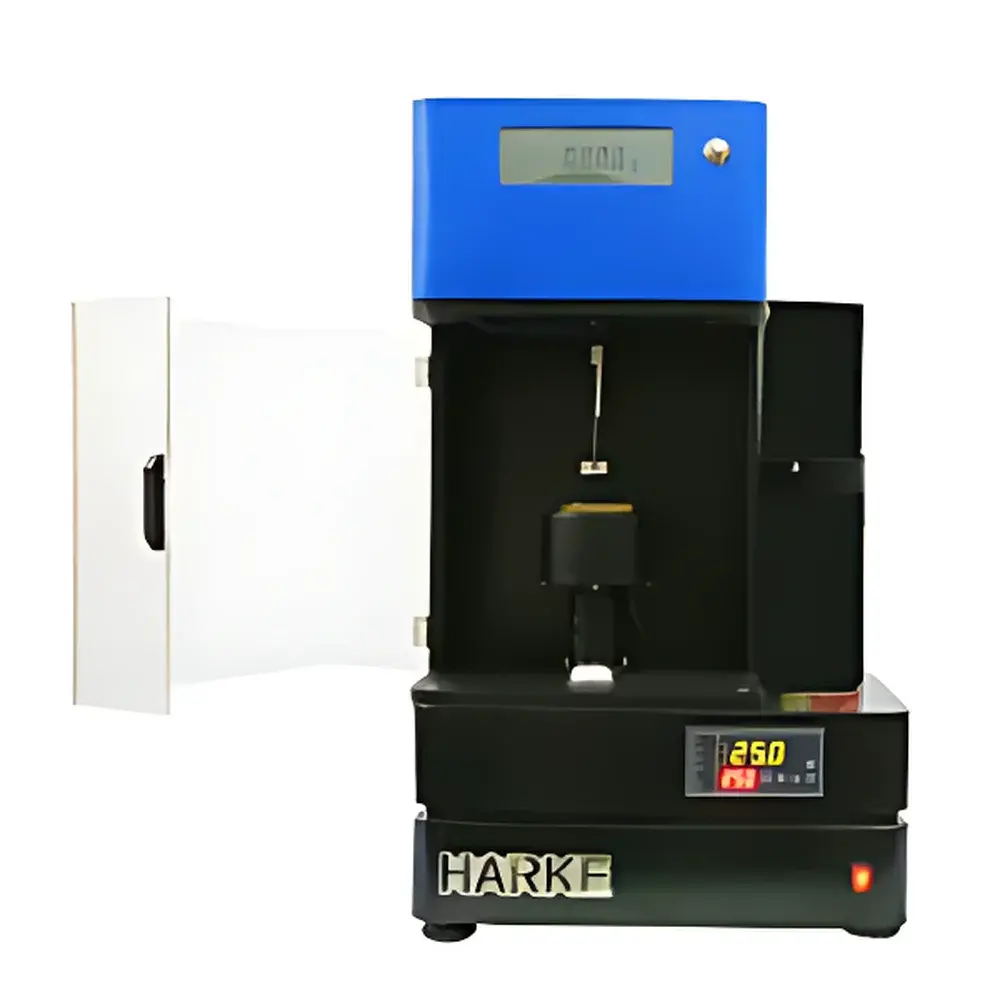
HARKE HK-SFT-A1 Advanced Surface Tensiometer
| Brand | HARKE |
|---|---|
| Model | HK-SFT-A1 |
| Measurement Principle | Du Noüy Ring Method |
| Measurement Range | 0–400 mN/m |
| Resolution | ±0.01 mN/m |
| Accuracy | ±0.1 mN/m |
| Temperature Display Range | 0–90 °C |
| Temperature Display Accuracy | ±0.1 °C |
| Sensor Type | Electromagnetic Force Compensation Balance |
| Sensor Capacity | 0–120 g |
| Stage Travel Distance | 0–80 mm |
| Stage Vertical Speed | 0–10 mm/s |
| Stage Positioning Accuracy | ±0.1 mm |
| Sample Holder Diameter | Φ50 mm |
| Software | SFT-A |
| Dimensions (W×D×H) | 360×360×620 mm |
| Weight | 20 kg |
| Compliance | GB/T 6541, ISO 1409, GB/T 22237, SH/T 1156, ISO 6295, JB/T 18396, GB/T 5549 (ISO 304) |
Overview
The HARKE HK-SFT-A1 Advanced Surface Tensiometer is a precision laboratory instrument engineered for the quantitative determination of surface and interfacial tension using the standardized Du Noüy ring method. Based on the principle of force balance measurement—where the maximum pull force required to detach a platinum-iridium ring from a liquid–air or liquid–liquid interface is directly correlated to the interfacial tension—the HK-SFT-A1 delivers traceable, repeatable, and operator-independent results. Its electromagnetic force compensation transducer eliminates mechanical hysteresis and thermal drift, ensuring long-term stability across extended measurement campaigns. Designed for routine QC laboratories, R&D facilities, and academic surface science groups, the instrument supports both surface tension (liquid–air) and interfacial tension (liquid–liquid) measurements under ambient or temperature-controlled conditions. The system meets essential metrological requirements for regulatory-compliant testing in petrochemicals, surfactant formulation, pharmaceutical emulsions, coatings, and polymer dispersion development.
Key Features
- Electromagnetic force compensation sensor with 0–120 g capacity, delivering high linearity (10⁶ cycles.
- Integrated dual-method capability: fully configurable operation with platinum ring (Du Noüy) and optional platinum plate (Wilhelmy plate) modules—both supported by automatic immersion depth control and real-time force profiling.
- 5-inch capacitive touchscreen HMI with intuitive workflow navigation; displays real-time tension curve, peak detection lock, equivalent tension calculation, environmental temperature, and auto-compensated 20 °C reference values.
- Fully automated measurement sequence: automatic stage ascent/descent with programmable speed (0–10 mm/s), intelligent meniscus contact detection, dynamic peak capture, and self-terminating cycle—eliminating manual intervention and observer bias.
- Multi-point calibration suite: includes standard mass calibration (certified weights), reference liquid calibration (distilled water and anhydrous ethanol per ISO 304), and full-range auto-zero compensation with one-touch tare function and zero-drift suppression.
- Thermal compensation algorithm: uses water and ethanol as primary standards to correct raw tension data to the thermodynamically referenced value at 20 °C—critical for cross-laboratory comparability and ASTM/ISO reporting.
- Modular sample stage with silent stepper-driven vertical motion, ±0.1 mm positioning repeatability, and tool-free platinum ring/plate mounting fixtures enabling rapid method switching and in-situ verification.
Sample Compatibility & Compliance
The HK-SFT-A1 accommodates a broad spectrum of Newtonian and non-Newtonian fluids—including hydrocarbon oils, aqueous surfactant solutions, polymer melts, microemulsions, biological fluids, and molten salts—within its 0–400 mN/m range. Its Φ50 mm sample cup geometry ensures adequate meniscus formation while minimizing edge effects. The instrument conforms to multiple international test standards, including but not limited to: GB/T 6541–1986 (petroleum oil–water interfacial tension), ISO 1409:1995 (plastics and rubber dispersions), GB/T 22237–2008 (surfactants), SH/T 1156–1995 (synthetic latices), ISO 6295:1983 (mineral oil–water systems), JB/T 18396–2001 (natural rubber latex), and GB/T 5549 (ISO 304:1985) for surface tension by ring method. All calibration and validation procedures are documented to support GLP/GMP audit readiness and ISO/IEC 17025 traceability frameworks.
Software & Data Management
The proprietary SFT-A software provides full instrument control, real-time graphing (force vs. distance/time), automatic peak identification with adjustable sensitivity thresholds, and export of raw datasets in CSV and XML formats. Audit trail functionality logs all user actions, parameter changes, calibration events, and measurement timestamps—fully compliant with FDA 21 CFR Part 11 requirements when deployed on validated Windows OS platforms. Data reports include metadata such as ambient temperature, operator ID, sample ID, calibration certificate numbers, and uncertainty estimates per GUM (Guide to the Expression of Uncertainty in Measurement). Optional integration with LIMS via TCP/IP or OPC UA enables centralized data aggregation and automated QA flagging.
Applications
- Surfactant critical micelle concentration (CMC) determination and adsorption isotherm modeling
- Quality control of industrial cleaning agents, wetting agents, and defoamers
- Interfacial rheology screening for enhanced oil recovery (EOR) formulations
- Stability assessment of pharmaceutical emulsions and liposomal drug carriers
- Surface energy evaluation of coating resins and ink vehicle systems
- Environmental monitoring of surfactant contamination in wastewater streams
- Academic research in colloid and interface science, including Langmuir monolayer studies
FAQ
What measurement methods does the HK-SFT-A1 support?
The instrument natively implements the Du Noüy ring method per ISO 304 and GB/T 5549. Wilhelmy plate functionality is available as a factory-installed option with separate calibration protocols.
Can the HK-SFT-A1 perform temperature-controlled measurements?
Yes—when equipped with the optional electrically heated circulating jacket accessory, the system maintains sample temperature between 10 °C and 90 °C with ±0.2 °C stability, enabling Arrhenius-based surface tension modeling.
Is the software compatible with networked laboratory environments?
SFT-A supports domain authentication, remote desktop access, and secure data export via encrypted FTP/SFTP—enabling centralized deployment in multi-user analytical labs.
How often should calibration be performed?
Daily zero calibration is recommended before first use; full two-point liquid calibration (water + ethanol) is advised per shift or after any change in ambient humidity or temperature exceeding ±2 °C.
Does the instrument meet regulatory requirements for pharmaceutical testing?
Yes—the SFT-A software’s audit trail, electronic signature, and calibration traceability features align with USP , ICH Q5C, and EU Annex 11 expectations for surface property characterization in drug product development.



