
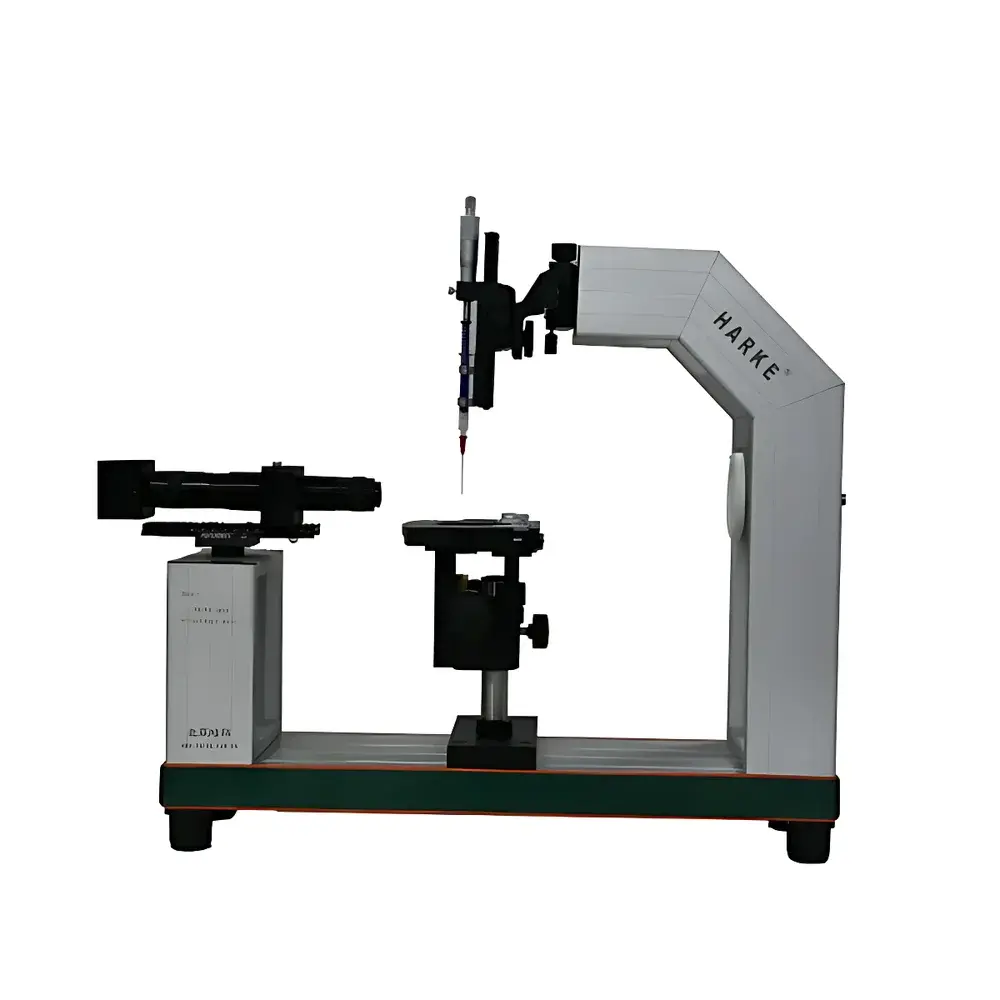
HARKE HK-SPCAS Manual Sessile Drop Contact Angle Goniometer
| Brand | HARKE |
|---|---|
| Origin | Beijing, China |
| Manufacturer Type | Direct Manufacturer |
| Product Category | Domestic |
| Model | HK-SPCAS |
| Instrument Type | Benchtop Laboratory System |
| Contact Angle Measurement Range | 0–180° |
| Contact Angle Measurement Accuracy | ±0.1° |
| Contact Angle Display Resolution | 0.01° |
| Sample Stage Dimensions | 400 mm × 400 mm |
| Optical Zoom Magnification | 0.7×–4.5× |
| Surface/Interfacial Tension Measurement Method | Pendant Drop Method |
| Surface/Interfacial Tension Range | 0–1000 mN/m |
| Surface/Interfacial Tension Accuracy | 0.01 mN/m |
| Imaging System | USB 2.0 High-Speed Camera (30 fps standard |
| Lens Travel | 120 mm |
| System Dimensions | 260 mm × 700 mm (W × H) |
| Weight | ~30 kg |
| Software | HARKE-SPCA v1.0 |
| Power Supply | 220 V / 3 A / 50 Hz |
| Operating Temperature | Ambient |
| Surface Energy Calculation Methods | Equation of State (EOS), Circle Fitting, Ellipse Fitting, Small-Drop Method |
| Compliance | ASTM D7334, ISO 19403-2, ISO 19403-3, ISO 14210, USP <1058> (for instrument qualification framework) |
Overview
The HARKE HK-SPCAS Manual Sessile Drop Contact Angle Goniometer is an optically based benchtop instrument engineered for precise quantification of interfacial interactions at solid–liquid–vapor boundaries. It operates on the principle of sessile drop analysis—capturing high-resolution side-view images of a liquid droplet dispensed onto a solid substrate and applying geometric contour fitting algorithms to determine the contact angle at the three-phase contact line. This measurement serves as a fundamental indicator of surface wettability, hydrophobicity/hydrophilicity, coating uniformity, and interfacial thermodynamic compatibility. Unlike automated systems with motorized stages or syringe pumps, the HK-SPCAS employs manual liquid dispensing and stage positioning, offering direct operator control over drop placement, volume selection, and environmental observation—making it especially suitable for method development, teaching laboratories, and routine QC screening where flexibility and cost-efficiency are prioritized over high-throughput automation.
Key Features
- High-precision optical imaging platform featuring a ZF-180 fixed-position zoom lens with continuous magnification range from 0.7× to 4.5×, enabling clear visualization of droplet morphology across diverse sample geometries and surface roughness levels.
- Large-format sample stage (400 mm × 400 mm) accommodates oversized substrates—including wafers, coated panels, textiles, and composite laminates—without requiring sample sectioning or repositioning.
- USB 2.0 high-speed camera system (standard 30 fps; optional upgrade paths to 100/300/1000 fps) supports dynamic contact angle measurements including advancing/receding angle determination via controlled droplet volume modulation.
- HARKE-SPCA v1.0 software implements multiple analytical models—Circle Fit, Ellipse Fit, and Young–Laplace-based Axisymmetric Drop Shape Analysis (ADSA)—to ensure robust angle extraction under varied surface conditions (e.g., heterogeneous, tilted, or rough surfaces).
- Integrated pendant drop module enables surface and interfacial tension quantification in the range of 0–1000 mN/m with resolution down to 0.01 mN/m, compliant with ASTM D971 and ISO 14435 standards.
- Equation of State (EOS) surface energy calculation engine supports multi-liquid protocols using polar/apolar probe liquids (e.g., water, diiodomethane, ethylene glycol), delivering Owens–Wendt, Wu, and van Oss–Chaudhury–Good outputs.
Sample Compatibility & Compliance
The HK-SPCAS accommodates rigid and semi-rigid planar samples up to 400 mm × 400 mm and 50 mm in thickness. Compatible substrates include silicon wafers, glass slides, polymer films, metal foils, ceramic tiles, and functionalized membranes. Non-planar or highly curved samples may be measured with auxiliary tilt-stage accessories (sold separately). The system meets foundational requirements for GLP-compliant documentation workflows: all image captures, parameter inputs, and analysis logs are time-stamped and exportable in CSV/PNG formats. While not inherently 21 CFR Part 11 compliant out-of-the-box, the software architecture supports audit trail configuration and user access controls when deployed within validated IT environments per ISO/IEC 17025 and FDA guidance for laboratory instrument qualification (USP ).
Software & Data Management
HARKE-SPCA v1.0 provides a modular, Windows-based interface with dual-mode operation: real-time video preview with live contact angle overlay, and post-capture batch analysis. Each measurement session generates a structured project file (.spca) containing raw images, metadata (camera settings, timestamp, operator ID), fitted contours, and calculated parameters. Export options include calibrated TIFF sequences, summary reports in PDF/Excel, and raw data tables compatible with MATLAB, Python (Pandas), or JMP for statistical process control. The software supports calibration verification via certified reference goniometer standards (e.g., NIST-traceable 30°/60°/90° angle wedges) and includes built-in drift compensation for long-duration stability assessments.
Applications
- Quality assurance of hydrophobic coatings on medical devices (catheters, stents) per ISO 10993-1 biocompatibility screening protocols.
- Surface treatment validation for plasma-, corona-, or flame-treated polyolefin films used in packaging and flexible electronics.
- Adhesion promoter efficacy testing in automotive paint shops and aerospace composite layup facilities.
- Academic research in colloid science, biomaterials, and nanomaterials—particularly for characterizing self-assembled monolayers (SAMs) and stimuli-responsive surfaces.
- Regulatory documentation support for pharmaceutical tablet film-coating homogeneity assessment (ICH Q5C, Q5E).
- Failure analysis of delamination or blistering in multilayer barrier structures through localized wettability mapping.
FAQ
Is the HK-SPCAS suitable for measuring dynamic contact angles (advancing/receding)?
Yes—when paired with optional high-speed camera modules (≥100 fps) and manual syringe-controlled dosing, users can incrementally increase/decrease droplet volume and extract hysteresis profiles per ASTM D7334.
Does the system support temperature-controlled measurements?
The base configuration operates at ambient temperature. Environmental chambers (−20°C to +80°C) and heated/cooled stages are available as configurable accessories.
Can surface energy be calculated for porous or fibrous materials?
While EOS-based surface energy assumes non-porous, homogeneous surfaces, the software includes empirical correction factors and multi-point averaging tools to improve repeatability on moderately textured substrates.
What calibration standards are recommended?
Certified goniometer calibration wedges (e.g., Rame-Hart Model 190) and pendant drop reference fluids (e.g., ultra-pure water, n-hexadecane) are advised for periodic verification per ISO 19403-4.
Is remote operation or network integration supported?
The system operates via local USB connection; however, the software supports scheduled measurement scripts and network-shared project folders for collaborative lab environments.



