
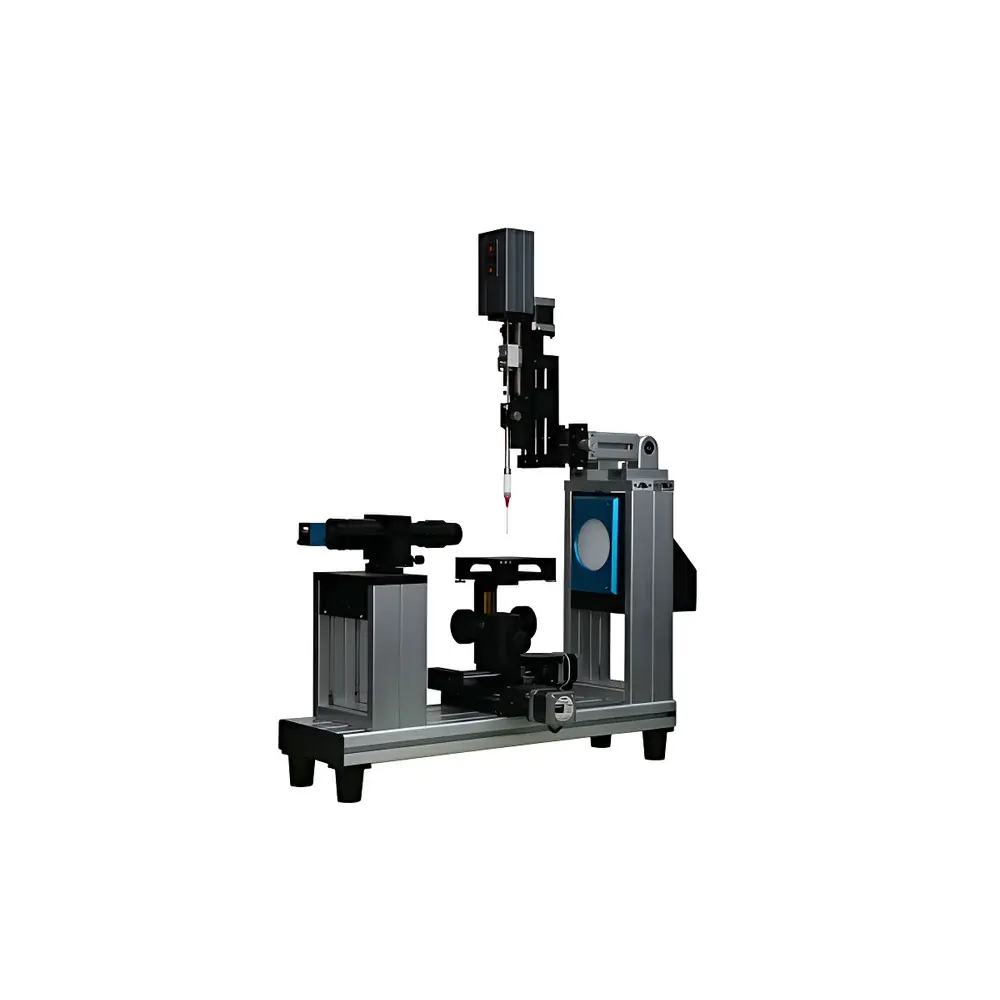
HARKE HKCA-10 Video-Based Optical Contact Angle Analyzer
| Brand | HARKE |
|---|---|
| Model | HKCA-10 |
| Origin | Beijing, China |
| Manufacturer Type | Direct Manufacturer |
| Instrument Category | Domestic |
| Instrument Type | Benchtop Laboratory System |
| Contact Angle Measurement Range | 0–180° |
| Contact Angle Accuracy | ±0.1° |
| Sample Stage Dimensions | 100 × 100 mm |
| Optical Magnification | 0.5×–0.7× Fixed-Position Zoom Lens |
| Surface/Interfacial Tension Range | 0–1000 mN/m |
| Surface/Interfacial Tension Resolution | 0.01 mN/m |
| Imaging System | USB 3.0 Camera, Software-Controlled Frame Rate (40 fps standard |
| optional | 100/300/1000+ fps) |
| Measurement Methods | Sessile Drop, Captive Bubble, Immersion, Tilting Plate (Sliding Angle), Expansion–Contraction, Rolling-off |
| Surface Energy Calculation | Owens–Wendt, Wu, Fowkes, van Oss–Chaudhury–Good models |
| Software | HKCA10 v3.x with Real-Time Dynamic Analysis, Auto-Drop Initiation, Time-Resolved Curve Export, and GLP-Compliant Audit Trail (Optional FDA 21 CFR Part 11 Module) |
Overview
The HARKE HKCA-10 is a benchtop video-based optical contact angle analyzer engineered for high-precision quantification of solid–liquid interfacial interactions. It operates on the principle of sessile drop geometry analysis using real-time image capture and advanced edge-detection algorithms to determine contact angle values from digitized drop profiles. The system supports multiple standardized measurement modes—including static, advancing/receding (via expansion–contraction or tilting plate), sliding angle, captive bubble, and immersion—enabling comprehensive characterization of wettability, surface heterogeneity, and dynamic interfacial behavior. Designed for rigorous laboratory environments, the HKCA-10 complies with core methodology standards referenced in ASTM D7334 (Standard Practice for Surface Wettability of Coated Surfaces by Contact Angle Measurement), ISO 19403-2 (Paints and Varnishes — Contact Angle Measurements), and GB/T 24368–2009 (Glass Surface Hydrophobic Contaminant Detection via Contact Angle). Its modular architecture allows seamless integration into quality control workflows across materials science, pharmaceutical packaging, polymer R&D, and thin-film development.
Key Features
- Benchtop design with compact footprint (710 × 160 mm) and 25 kg mass for stable operation on standard lab benches
- Motorized XYZ sample stage with 60 mm vertical injection syringe travel and manual X-axis fine positioning
- High-resolution optical path featuring a fixed-position 0.5×–0.7× zoom lens optimized for minimal distortion and consistent pixel-to-length calibration
- USB 3.0 high-speed camera supporting up to 1000 fps (optional) for capturing rapid wetting dynamics, droplet oscillation, or capillary-driven spreading
- Automated drop dispensing with zero-moment recognition and programmable deposition timing
- Real-time visualization of contact angle evolution, including simultaneous display of left/right angles, base diameter, and drop volume
- Multi-algorithm fitting engine: automatic circle, ellipse, and Young–Laplace curve fitting for non-ideal drops on rough or chemically heterogeneous surfaces
- Integrated surface energy module supporting Owens–Wendt, Wu, Fowkes, and van Oss–Chaudhury–Good models with user-defined reference liquid database
Sample Compatibility & Compliance
The HKCA-10 accommodates diverse sample geometries and material classes—including rigid substrates (glass, silicon wafers, metals), flexible films (PET, PP, PE), porous media (paper, filter membranes), fibrous assemblies (single fibers, nonwovens), and powdered compacts (pressed pellets, granular beds). Its 100 × 100 mm stage permits uniform illumination and full-field imaging without edge occlusion. All measurement protocols adhere to internationally recognized test frameworks: ASTM D5725 (Surface Wettability of Paper), ISO 105-C06 (Color Fastness to Water), and USP (Analytical Instrument Qualification) for instrument verification. Optional temperature-controlled stages (ambient to 120°C) enable thermal stability studies compliant with ICH Q5C guidelines for biopharmaceutical formulation interfaces.
Software & Data Management
The HKCA10 software suite (v3.x) provides full traceability under GLP/GMP conditions. It features time-stamped audit trails, user access levels, electronic signatures, and exportable CSV/PDF reports conforming to FDA 21 CFR Part 11 requirements when configured with optional compliance modules. Data acquisition includes synchronized timestamping across all channels (angle, volume, time), automated batch processing for multi-sample sequences, and customizable pass/fail thresholds for QC release. Raw image sequences are stored losslessly in TIFF format; processed results support direct import into MATLAB, Python (via Pandas), or statistical platforms such as JMP and Minitab for advanced regression modeling of surface energy components.
Applications
- Quality assurance of hydrophobic coatings on medical device substrates (e.g., catheter tubing, biosensor chips)
- Characterization of plasma-treated polymer surfaces for adhesive bonding optimization
- Dynamic contact angle profiling during inkjet printing ink spreading on absorbent paper substrates
- Surface energy mapping of functionalized graphene oxide films for composite interface design
- Interfacial tension validation of surfactant formulations used in enhanced oil recovery (EOR) screening
- Wettability assessment of battery separator membranes under electrolyte soaking conditions
- Correlation of contact angle hysteresis with surface roughness parameters derived from AFM topography
FAQ
What measurement methods does the HKCA-10 support?
Sessile drop, captive bubble, immersion, tilting plate (sliding angle), expansion–contraction cycling, and rolling-off—each configurable for static or time-resolved analysis.
Is the system compatible with non-aqueous liquids?
Yes. The optical design and software calibration accommodate low-surface-tension fluids (e.g., hexadecane, chloroform) and volatile solvents when used in controlled fume hood environments.
Can surface free energy be calculated automatically?
Yes. The HKCA10 software includes built-in models (Owens–Wendt, Wu, Fowkes, van Oss–Chaudhury–Good) with editable liquid property databases and uncertainty propagation for component estimation.
Does the system meet regulatory documentation requirements for pharmaceutical labs?
With the optional 21 CFR Part 11 compliance package, it delivers full electronic record integrity, audit trail logging, and role-based user authentication required for FDA-submitted analytical data.
What is the minimum resolvable contact angle increment?
The system displays angles to 0.01° resolution; measurement repeatability is ±0.1° under ISO 19403-2 test conditions using certified calibration standards.



