
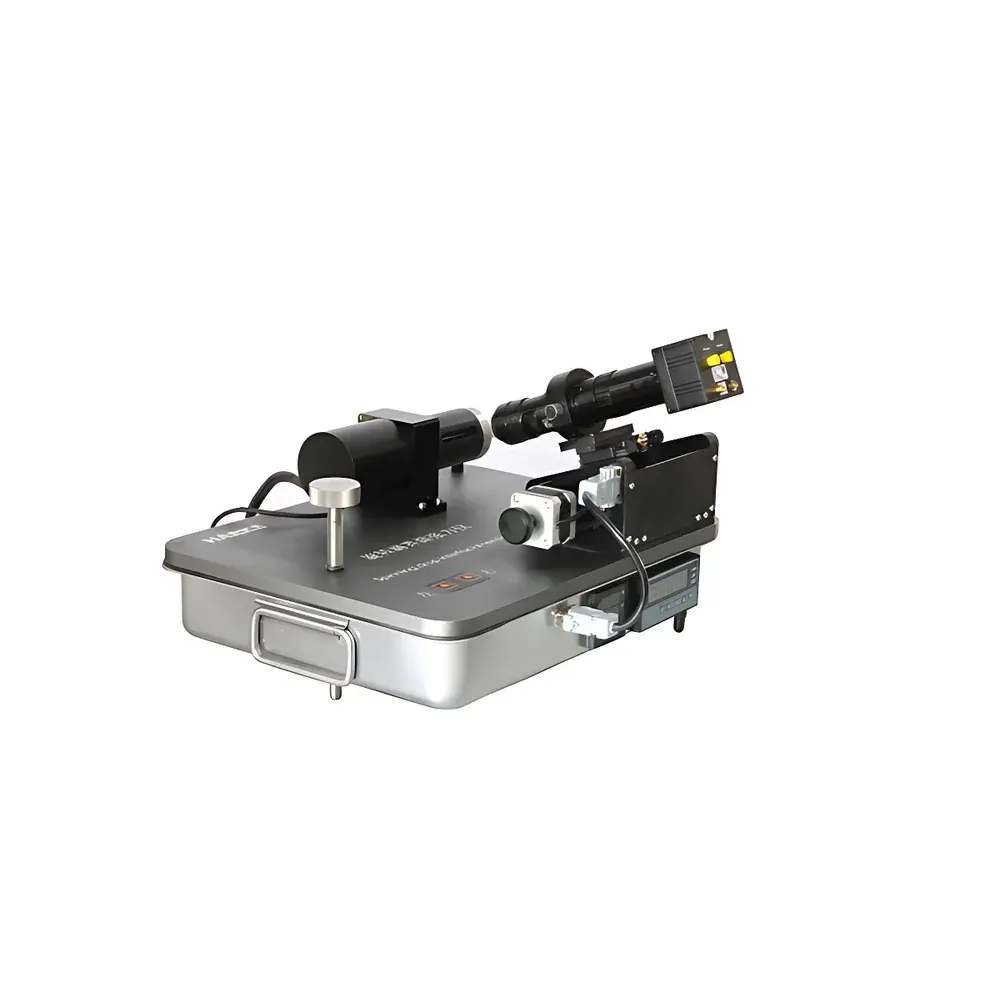
HARKE SDT-SP Advanced Rotating Drop Ultra-Low Interfacial Tensiometer
| Brand | HARKE |
|---|---|
| Origin | Beijing, China |
| Manufacturer Type | Direct Manufacturer |
| Product Category | Domestic |
| Model | SDT-SP |
| Measurement Range | 1×10⁻⁷–100 mN/m |
| Resolution | 0.01 mN/m |
| Accuracy | ±0.01 mN/m |
| Rotation Speed Range | 1000–10,000 rpm (control accuracy: ±0.1%) |
| Temperature Control Range | 0–110 °C (display accuracy: ±0.1 °C) |
| Optical Zoom | 0.5–4.5× continuous hardware zoom + 2× digital software zoom |
| Video Capture Rate | 25 fps |
| Image Acquisition Interface | USB VIDEO + RS-232 |
| Sample Tube ID | 2 mm or 6 mm (quartz) |
| Light Source | High-stability LED-strobed or continuous green LED illumination |
| Data Output | Time–Interfacial Tension curve, Width–Time curve, raw image sequence with timestamped metadata |
Overview
The HARKE SDT-SP is an advanced rotating drop ultra-low interfacial tensiometer engineered for precise, reproducible measurement of interfacial and surface tension in the critical range of 1×10⁻⁷ to 100 mN/m. It operates on the well-established rotating drop principle—a hydrodynamic method where a denser droplet of one liquid phase is suspended within a less-dense continuous phase inside a horizontally rotating quartz capillary tube. Under controlled centrifugal force, the droplet elongates; its shape equilibrium is governed by the balance between interfacial tension and rotational inertia. By analyzing the droplet’s axial diameter via high-resolution video imaging and applying the Vonnegut–Bashford–Rosen equation (or its numerical variants), the instrument computes interfacial tension with trace-level sensitivity. This physical principle enables reliable characterization of surfactant-laden oil–water systems, microemulsions, polymer blends, and other low-energy interfaces central to enhanced oil recovery (EOR), formulation science, and colloidal stability research.
Key Features
- High-precision digitally controlled rotation system: brushless synchronous motor with 1000–10,000 rpm range and ±0.1% speed stability—eliminating belt-driven drift and maintenance downtime
- Dual-temperature control architecture: integrated resistive heating (0–110 °C) or optional external water bath interface, both delivering ±0.1 °C thermal resolution for isothermal interfacial kinetics studies
- Optimized quartz sample tubes: 2 mm and 6 mm inner diameters available; redesigned geometry minimizes bubble entrapment during sample loading and improves droplet symmetry
- Computer-controlled optical tracking: motorized X-axis stage automatically repositions the camera to maintain centration of the rotating droplet throughout acquisition
- LED-based illumination system: strobe or continuous green LED source ensures uniform, non-thermal, long-life (≥50,000 h) illumination without UV degradation of sensitive surfactants
- Real-time dual-curve visualization: simultaneous display of interfacial tension vs. time and droplet width vs. time—enabling direct assessment of adsorption kinetics and interfacial relaxation
Sample Compatibility & Compliance
The SDT-SP accommodates a broad spectrum of immiscible liquid pairs—including crude oil–brine, polymer–solvent, silicone–water, and fluorocarbon–hydrocarbon systems—without requiring calibration standards for each fluid combination. Its design conforms to ASTM D971 (Standard Test Method for Interfacial Tension of Oil Against Water by the Ring Method) principles as adapted for rotating drop methodology, and supports GLP-compliant workflows through full audit trail logging (user, timestamp, parameter set, image hash, calculation algorithm version). While not FDA 21 CFR Part 11–certified out-of-the-box, the software architecture permits integration with validated electronic lab notebook (ELN) systems and supports export of raw TIFF sequences with embedded EXIF metadata for third-party verification per ISO/IEC 17025 requirements.
Software & Data Management
The open-architecture Windows 7–compatible application provides deterministic image processing: droplet edge detection uses sub-pixel centroiding and Hough-transform-assisted ellipse fitting to minimize operator bias. All measurements are stored in structured SQLite databases containing image thumbnails, full-resolution frames (25 fps), calculated tension values, and associated environmental metadata (temperature, rpm, timestamp). Export options include CSV (for Excel or MATLAB), PDF reports with embedded curves, and DICOM-compatible TIFF stacks. The software supports batch processing of saved image libraries, enabling retrospective analysis of aging or temperature-ramp experiments. No proprietary runtime environments or internet-dependent modules are required—ensuring minimal vulnerability to OS updates or malware propagation.
Applications
- Enhanced oil recovery (EOR): screening of alkali–surfactant–polymer (ASP) formulations for ultra-low IFT (<10⁻³ mN/m) targeting residual oil saturation reduction
- Pharmaceutical emulsion development: quantifying interfacial stabilization efficiency of lecithin, polysorbates, and block copolymers at oil–water interfaces
- Agrochemical formulation: assessing compatibility and interfacial activity of adjuvants in pesticide concentrates
- Coating & ink R&D: correlating surfactant structure with dynamic interfacial rheology during film formation
- Colloid & interface science: measuring interfacial elasticity moduli via oscillatory rotation protocols (user-defined waveform import supported)
FAQ
What is the minimum detectable interfacial tension value?
The SDT-SP achieves reliable quantification down to 1×10⁻⁷ mN/m, validated using standardized n-decane–aqueous sodium dodecyl sulfate (SDS) systems under controlled humidity and temperature conditions.
Can the instrument measure dynamic interfacial tension?
Yes—by programming time-resolved rotation profiles (e.g., stepwise rpm increase) and synchronizing image capture, users can derive interfacial tension evolution over seconds to hours.
Is quartz tube cleaning and reuse supported?
Quartz capillaries are chemically inert and fully cleanable using chromic acid, piranha solution, or oxygen plasma—provided mechanical integrity is verified before each use.
Does the system support automated temperature ramping?
Temperature ramping is programmable via external bath control; the internal heater operates in static-setpoint mode only.
How is measurement traceability ensured?
Each measurement includes embedded EXIF tags (camera model, exposure, gain), calibrated pixel-to-mm mapping via stainless steel reference scale, and version-locked calculation algorithms—fully auditable per ISO 17025 clause 7.7.



