
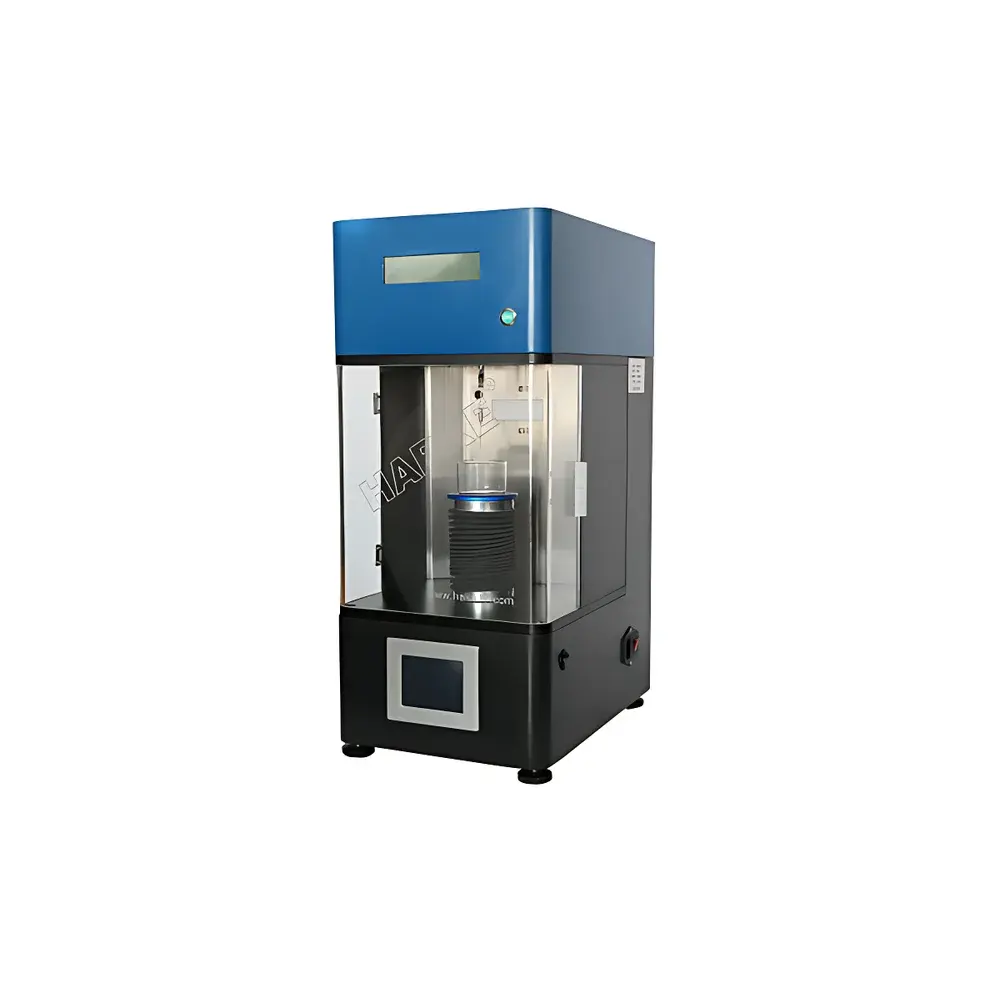
HARKE SFT-C1 Advanced Surface Tensiometer
| Brand | HARKE |
|---|---|
| Model | SFT-C1 |
| Measurement Principle | Du Noüy Ring Method |
| Measurement Range | 0–400 mN/m |
| Resolution | 0.01 mN/m |
| Accuracy | ±0.1 mN/m |
| Temperature Control Range | 0–90 °C |
| Temperature Resolution | 0.01 °C |
| Sensor Type | Electromagnetic Balance Force Sensor (0–120 g capacity) |
| Sample Stage Travel | 0–80 mm |
| Stage Speed | 0–10 mm/sec |
| Stage Positioning Accuracy | ±0.1 mm |
| Sample Vessel Diameter | Φ50 mm |
| Dimensions (W×D×H) | 260 × 350 × 500 mm |
| Weight | 15 kg |
| Software | SFT-C1 v3.x |
| Compliance | ASTM D971, ISO 6295, DIN 53914, USP <721>, EN 14370 |
| Optional Accessories | Peltier-based temperature control module, external recirculating chiller interface, electrothermal heating stage |
Overview
The HARKE SFT-C1 Advanced Surface Tensiometer is a precision-engineered instrument designed for reliable, high-reproducibility measurement of surface and interfacial tension using the standardized Du Noüy ring method. Based on the principle of force balance—where the maximum pull force required to detach a platinum-iridium ring from a liquid–air or liquid–liquid interface is quantified—the SFT-C1 delivers traceable, metrologically sound results aligned with internationally recognized test protocols. Its electromagnetic balance sensor architecture eliminates mechanical drift inherent in torsion-wire systems, ensuring long-term stability and eliminating zero-point recalibration during routine operation. Integrated temperature monitoring and optional thermal regulation enable controlled measurements across physiologically and industrially relevant ranges (0–90 °C), supporting studies of temperature-dependent surfactant behavior, micellization thermodynamics, and formulation stability.
Key Features
- Electromagnetic balance force sensor with 0–120 g capacity and ±0.1 mN/m absolute accuracy—certified per ISO/IEC 17025-accredited calibration procedures
- Du Noüy ring geometry compliant with ASTM D971 and ISO 6295: platinum-iridium alloy ring (Φ19.2 mm), precision-welded and polished to eliminate edge irregularities affecting wetting dynamics
- Motorized vertical sample stage with programmable speed (0–10 mm/sec), travel range (0–80 mm), and positioning resolution (±0.1 mm) for precise immersion depth control and reproducible detachment kinetics
- Embedded computing platform running SFT-C1 v3.x software—no external PC required; supports full data acquisition, real-time force–distance curve visualization, and post-acquisition baseline correction
- Dual-display capability: simultaneous numeric surface tension value (mN/m) and dynamic force profile plot during ring withdrawal—enabling direct verification against Young–Laplace-derived theoretical models
- Integrated microbalance functionality (0.01 mg resolution) for concurrent density determination via pycnometric methods or mass calibration of surfactant solutions
- Modular thermal management: standard ambient-temperature operation; optional Peltier-controlled stage or external recirculating chiller interface (±0.1 °C stability over 1 h)
Sample Compatibility & Compliance
The SFT-C1 accommodates aqueous, organic, and multiphase systems—including surfactant solutions, polymer melts, ionic liquids, crude oil–water interfaces, and pharmaceutical emulsions—in standard Φ50 mm glass or quartz sample vessels. All measurement routines adhere strictly to regulatory and quality frameworks: data audit trails comply with FDA 21 CFR Part 11 requirements when operated under validated SFT-C1 software configuration; raw force traces and processed tension values are timestamped, user-logged, and exportable in CSV and PDF formats for GLP/GMP documentation. Test methods implemented include ASTM D971 (ring method for petroleum products), ISO 6295 (surface tension of detergents), DIN 53914 (interfacial tension of immiscible liquids), and USP (surface tension of pharmaceutical preparations). Ring and plate dimensions conform to ISO 1409:2016 dimensional tolerances.
Software & Data Management
SFT-C1 v3.x is a Windows-compatible, embedded application delivering full experimental control without dependency on third-party operating systems. It features intuitive workflow navigation, customizable method templates (A3/A4/A5 per HARKE’s proprietary implementation of ISO-compliant ring correction algorithms), and automated calculation of correction factors (Harkins–Jordan, Zuidema–Waters). All raw sensor output—including force vs. displacement time-series—is retained at native acquisition rate (100 Hz) and can be reprocessed with alternative baseline algorithms. Data export supports traceability: each measurement file embeds instrument ID, operator name, calibration certificate number, environmental conditions (ambient temperature/humidity), and thermal history. Audit logs record all parameter changes, user logins, and software updates—fully compatible with laboratory information management systems (LIMS) via ODBC connectivity.
Applications
- Quality control of surfactants, wetting agents, and dispersants in coatings, agrochemicals, and personal care formulations
- Interfacial tension characterization of enhanced oil recovery (EOR) surfactant systems at reservoir-relevant salinities and temperatures
- Stability assessment of nanoemulsions and liposomal drug carriers through interfacial rigidity profiling
- Fundamental research on critical micelle concentration (CMC), adsorption kinetics, and Gibbs monolayer thermodynamics
- Regulatory submission support for pharmaceutical excipients per ICH Q5C and USP
- Density and surface tension co-determination for solvent purity verification and mixture composition analysis
FAQ
What standards does the SFT-C1 comply with for surface tension measurement?
ASTM D971, ISO 6295, DIN 53914, EN 14370, and USP . Ring geometry and correction methodologies follow ISO 1409:2016 specifications.
Can the instrument measure interfacial tension between two immiscible liquids?
Yes—using the Du Noüy ring method with appropriate density-matched subphase selection and calibrated ring immersion depth.
Is the software compliant with FDA 21 CFR Part 11 requirements?
When deployed in validated configuration with electronic signatures, audit trail logging, and role-based access control enabled, yes.
What is the maximum sample viscosity supported for reliable ring detachment?
Up to 1000 mPa·s; higher viscosities require extended equilibration and customized withdrawal speed profiles to minimize viscous drag artifacts.
Does the SFT-C1 support automated temperature ramping during measurement?
Not natively—but with the optional Peltier stage or external chiller interface, isothermal holds at user-defined setpoints are fully programmable and stabilized to ±0.1 °C.
Related Products



