
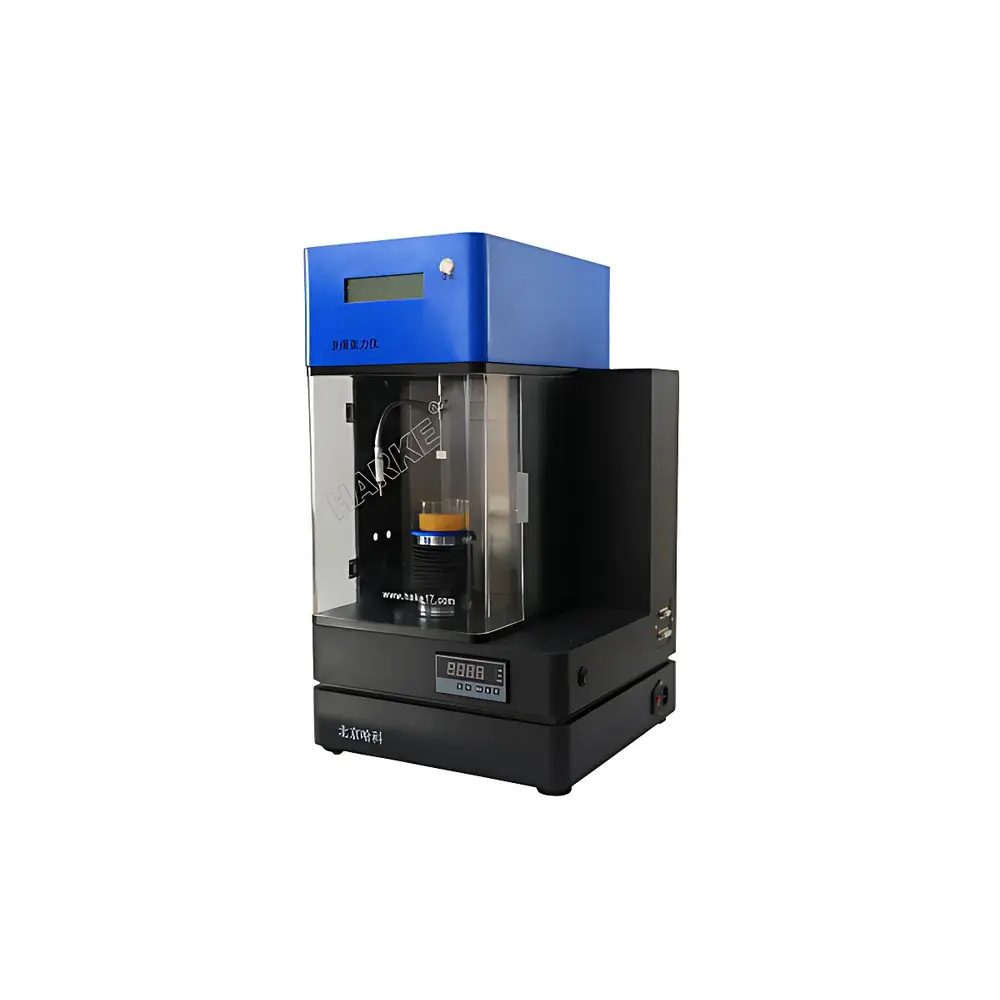
HARKE SFT-D1 Automatic Surface Tensiometer
| Brand | HARKE |
|---|---|
| Model | SFT-D1 |
| Measurement Principle | Wilhelmy Plate & Du Noüy Ring Methods (Force-Balance) |
| Surface/Interfacial Tension Range | 0–400 mN/m |
| Accuracy | ±0.1 mN/m |
| Display Resolution | ±0.01 mN/m |
| Density Measurement Range | 0–1000 g/cm³ |
| Sensor Capacity | 0–120 g |
| Sample Stage Vertical Speed | 0–10 mm/sec |
| Maximum Stage Travel | 80 mm |
| Stage Positioning Accuracy | ±0.1 mm |
| Sample Vessel Diameter | Φ50 mm |
| Temperature Control Range | 0–98 °C |
| Dimensions (W×D×H) | 360 × 360 × 620 mm |
| Weight | 25 kg |
| Software | SFT-D1 Control & Analysis Suite |
| Compliance | ASTM D971, ISO 4291, ISO 6295, USP <721>, DIN 53914 |
| Optional Accessories | Peltier-based heating module, external thermostatic circulation jacket |
Overview
The HARKE SFT-D1 Automatic Surface Tensiometer is a precision force-balance instrument engineered for high-reproducibility measurement of surface and interfacial tension using standardized Wilhelmy plate (A3/A5 methods) and Du Noüy ring (A4 method) techniques. It operates on the fundamental principle of quantifying the vertical force exerted on a calibrated solid probe—either a platinum-iridium plate or ring—as it interfaces with a liquid phase. This force, directly proportional to the surface tension coefficient (γ, in mN/m), is captured by an electromagnetic balance transducer with sub-micron force resolution. Unlike legacy torsion-wire systems, the SFT-D1 eliminates mechanical drift, zero-point instability, and manual locking artifacts through its monolithic electromagnetic sensor architecture. Its integrated embedded computing platform replaces external PCs while maintaining full computational parity—enabling real-time data acquisition, dynamic curve visualization, and automated parameter calculation without latency or driver dependency.
Key Features
- Electromagnetic force transducer with 0–120 g capacity and ±0.1 mN/m absolute accuracy—certified per ISO/IEC 17025 traceable calibration protocols
- Dual-method compliance: Fully supports ASTM D971 (ring), ISO 4291 (plate), ISO 6295 (interfacial), and USP (pharmaceutical surfactant characterization)
- Programmable immersion/extraction kinetics: Adjustable stage velocity (0–10 mm/sec), dwell time (0–300 sec), and total travel (0–80 mm) with ±0.1 mm repeatability
- Integrated density determination module: Leverages same force sensor and calibrated geometry to compute liquid density (0–1000 g/cm³) via buoyancy-based mass displacement
- Embedded thermal control: PID-regulated temperature range from 0 to 98 °C; compatible with optional Peltier heating or external recirculating chiller integration
- Simultaneous dual-display mode: Real-time numeric tension value + synchronized force-vs.-position plot—enabling direct verification against literature-derived correction factors (e.g., Harkins-Jordan, Zuidema-Waters)
- Standardized probe fabrication: Platinum-iridium Wilhelmy plates (19.0 × 10.0 × 0.2 mm) and Du Noüy rings (Φ19.0 mm, wire Ø0.3 mm) manufactured to ISO 6295 dimensional tolerances
Sample Compatibility & Compliance
The SFT-D1 accommodates aqueous, organic, and multiphase systems—including surfactant solutions, polymer melts, ionic liquids, and microemulsions—within standard Φ50 mm glass or quartz sample vessels. All measurement protocols adhere strictly to internationally recognized standards: ASTM D971 for petroleum products, ISO 4291 for general surfactants, ISO 6295 for oil-water interfacial tension, and USP for pharmaceutical excipient qualification. The instrument’s firmware and software architecture support 21 CFR Part 11-compliant audit trails, electronic signatures, and data integrity controls when deployed in GLP/GMP-regulated environments. Probe cleaning routines, calibration log export, and method versioning are fully scriptable and timestamped.
Software & Data Management
The SFT-D1 Control & Analysis Suite (v3.x) runs natively on the onboard ARM-based Linux system. It provides a 12.1-inch capacitive touchscreen interface with customizable workspaces, multi-language support (EN/DE/FR/JP/CN), and export-ready reporting in PDF, CSV, and XML formats. Raw force-position datasets are stored with metadata tags (operator ID, method ID, ambient RH/T, vessel ID). Advanced analysis modules include automatic baseline subtraction, dynamic contact angle estimation (via Wilhelmy hysteresis), and batch processing for up to 96 sequential samples. All software updates are delivered via secure HTTPS OTA channels with SHA-256 signature validation.
Applications
This tensiometer serves critical roles across R&D and QC laboratories: formulation optimization of detergents and agrochemical adjuvants; stability assessment of colloidal dispersions and nanoemulsions; interfacial rheology screening for enhanced oil recovery fluids; quality control of parenteral drug vehicles per USP ; and fundamental research in soft matter physics involving Langmuir monolayers and Marangoni flow. Its density measurement capability further enables rapid specific gravity checks for battery electrolytes, lubricants, and flavor emulsions—eliminating need for separate pycnometer workflows.
FAQ
What calibration standards are recommended for routine verification?
Certified reference liquids—e.g., ultra-pure water (72.75 mN/m at 20 °C), diethylene glycol (47.7 mN/m), and formamide (58.2 mN/m)—are traceable to NIST SRM 849a and must be used with documented temperature stabilization (±0.1 °C).
Can the SFT-D1 perform interfacial tension measurements between immiscible liquids?
Yes—when equipped with a dual-layer sample cell and appropriate ring/plate geometry, it measures oil-water, silicone-oil-air, and molten-salt/gas interfaces per ISO 6295 Annex B.
Is method validation documentation available for regulatory submissions?
HARKE provides IQ/OQ/PQ protocols, uncertainty budgets per GUM (JCGM 100:2008), and raw data file structure specifications compliant with ALCOA+ principles.
How is temperature uniformity ensured across the sample volume?
The built-in Pt100 sensor monitors liquid bulk temperature within 1 mm of the probe interface; optional external circulation jackets maintain ΔT ≤ 0.2 °C across Φ50 mm diameter.
Does the software support custom formula entry for non-standard corrections?
Yes—the “Advanced Calculation Engine” allows user-defined expressions referencing raw force, position, time, and temperature variables with real-time syntax validation.



