
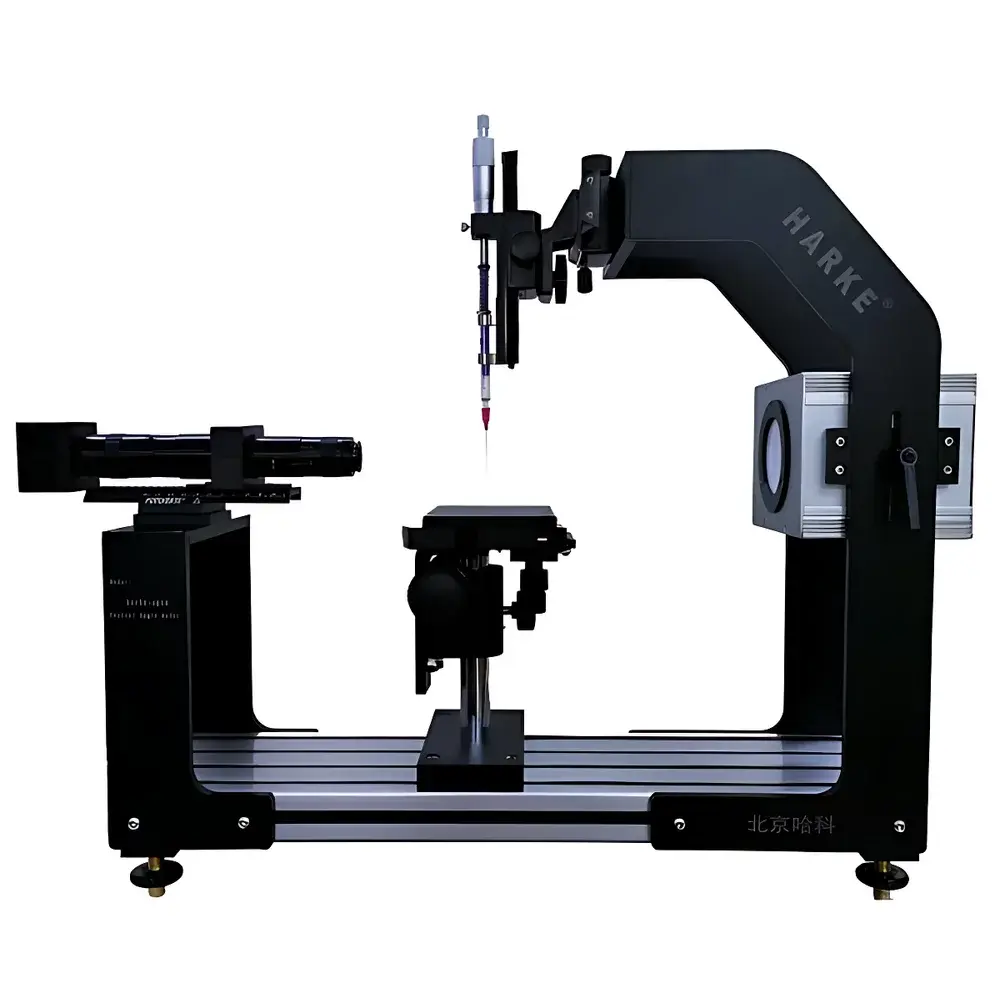
HARKE SPCAX1 Video-Based Optical Contact Angle Analyzer
| Brand | HARKE |
|---|---|
| Origin | Beijing, China |
| Manufacturer Type | Direct Manufacturer |
| Instrument Category | Domestic (China-made) |
| Model | SPCAX1 |
| Instrument Type | Benchtop Laboratory System |
| Contact Angle Measurement Range | 0–180° |
| Contact Angle Measurement Accuracy | ±0.1° |
| Fixed Sample Stage Dimensions | 120 × 120 mm |
| Optical Magnification | 0.7×–4.7× |
| Surface/Interfacial Tension Range | 0–1000 mN/m |
| Surface/Interfacial Tension Accuracy | 1×10⁻²–2×10³ mN/m |
Overview
The HARKE SPCAX1 is a high-precision, benchtop video-based optical contact angle analyzer engineered for rigorous surface and interfacial property characterization in academic research laboratories, quality control environments, and industrial R&D settings. It operates on the fundamental principle of optical silhouette imaging: a high-resolution CMOS camera captures the profile of a liquid droplet (or captive bubble) deposited on or beneath a solid substrate, and advanced image analysis algorithms extract geometric parameters—primarily the tangent angle at the three-phase boundary—to quantify wettability. The system supports both sessile drop and captive bubble configurations, enabling bidirectional assessment of solid–liquid and solid–gas–liquid interactions. Its modular mechanical architecture—featuring motorized XYZ sample stage translation, precision syringe dosing, and continuously variable zoom optics—ensures stable, repeatable positioning across heterogeneous or topographically complex surfaces, including curved, inclined, and microstructured substrates.
Key Features
- Optical subsystem: Custom-designed 0.75×–4.5× parfocal zoom microscope with fixed focal plane during magnification change—eliminating refocusing drift during dynamic measurement sequences.
- Droplet dispensing: Dual-mode delivery—computer-controlled micro-syringe (0–100 µL, ±0.1 µL resolution) and manual 1 mL syringe—enabling precise volume control for static, advancing/receding, and multi-droplet comparative studies.
- Image acquisition: High-speed digital CMOS camera with real-time recording, frame-by-frame playback, programmable time-lapse capture, and single-frame export from video sequences.
- Analysis algorithms: Seven validated fitting methods—including automatic circle, ellipse, tangent to full contour, local tangent, height-width ratio, Young–Laplace curve fitting, and curve ruler—each optimized for specific surface morphologies and droplet regimes (e.g., small-volume, low-contact-angle, or highly asymmetric profiles).
- Mechanical flexibility: Independent motorized movement for sample stage (X: ±35 mm, Y: ±20 mm, Z: ±25 mm), injection needle (X: ±50 mm, Z: ±50 mm), and microscope objective (Z: ±50 mm), plus extended travel for fixed plate (Z: +30 mm, X: ±75 mm), accommodating irregular or oversized specimens up to 100 mm (W) × 80 mm (D) × arbitrary height.
Sample Compatibility & Compliance
The SPCAX1 accommodates flat, curved, tilted, and textured substrates without hardware modification. Its adjustable stage geometry permits contact angle measurement on surfaces inclined up to ±90° relative to horizontal, with built-in curvature correction for cylindrical or spherical samples. All software-driven workflows—including calibration, image capture, analysis, and report generation—support audit-ready documentation per GLP and GMP requirements. Data files retain full metadata (timestamp, operator ID, instrument configuration, environmental conditions if logged externally), and optional user permission controls align with FDA 21 CFR Part 11 principles for electronic records and signatures. While not certified to a specific ISO standard out-of-the-box, the instrument’s measurement traceability follows ASTM D7334 (Standard Practice for Surface Wettability Assessment) and ISO 19403-2 (Paints and Varnishes — Contact Angle Measurement — Part 2: Static Contact Angle), provided calibration procedures are performed using NIST-traceable reference liquids (e.g., ultrapure water, diiodomethane, ethylene glycol).
Software & Data Management
The proprietary HARKE Analysis Suite provides an intuitive graphical interface for real-time droplet visualization, batch processing of time-series data, and automated surface energy calculation via Zisman Plot, Fowkes, Owens–Wendt–Rabel–Kaelble (OWRK), and Wu harmonic mean models. Software modules compute adhesion work, spreading coefficient, and interfacial tension using the same image-derived contact angles and known liquid phase properties. All results are exportable in CSV, PDF, and XML formats; raw images and video clips are stored with embedded EXIF metadata. Version-controlled software updates maintain backward compatibility with legacy project files, and local database archiving supports long-term reproducibility tracking across instrument deployments.
Applications
The SPCAX1 serves critical roles in polymer surface modification validation, biomedical coating development (e.g., anti-fouling hydrogels, drug-eluting stent coatings), semiconductor wafer cleaning verification, inkjet print head fluid compatibility screening, and nanomaterial dispersion stability assessment. Its dynamic contact angle capability enables hysteresis quantification for predictive modeling of capillary-driven flow in porous media, while its high angular resolution (±0.1°) supports statistical evaluation of surface heterogeneity through spatially resolved mapping across millimeter-scale regions. In regulatory contexts, it supports ICH Q5C stability protocols for protein formulation containers and USP analytical instrument qualification when integrated into documented validation frameworks.
FAQ
What droplet formation methods does the SPCAX1 support?
Sessile drop and captive bubble configurations are fully supported, allowing contact angle determination on both air-facing and submerged solid surfaces.
Can the system measure contact angles on non-planar surfaces?
Yes—the mechanical design includes tilt adjustment, curvature compensation algorithms, and flexible stage kinematics to accommodate convex, concave, and angled substrates.
Is surface energy calculation automated?
Yes—multiple thermodynamic models (Zisman, Fowkes, OWRK, Wu) are implemented with one-click execution and uncertainty propagation reporting.
Does the software comply with 21 CFR Part 11 requirements?
The software supports role-based access control, electronic signatures, and audit trail logging—meeting foundational elements of Part 11; full compliance requires site-specific validation per organizational SOPs.
What is the maximum sample thickness the instrument can accommodate?
With full extension of the fixed plate and stage, specimens up to 80 mm thick may be positioned within the optical field of view while maintaining focus and illumination uniformity.



