
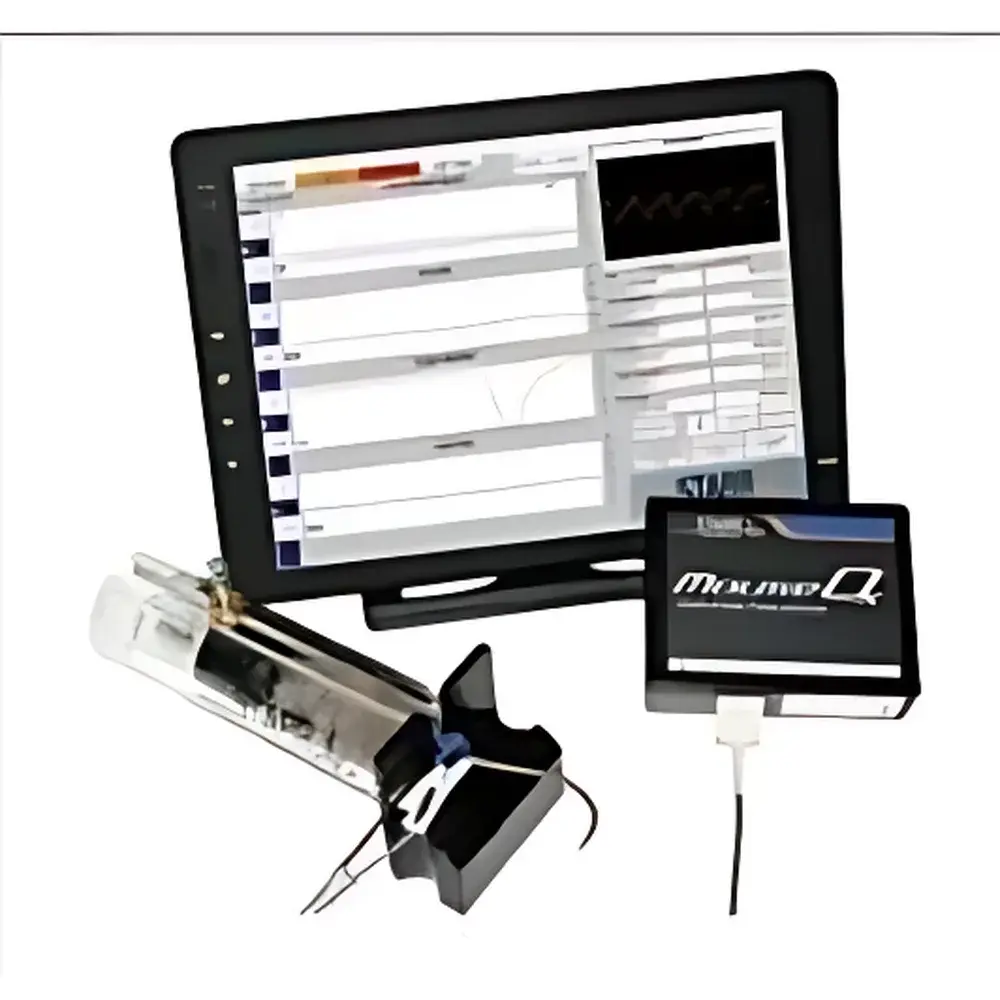
Harvard Apparatus MouseOx Non-Invasive Pulse Oximeter for Small Animals
| Brand | Harvard Apparatus |
|---|---|
| Origin | USA |
| Model | MouseOx |
| Sensor Type | Reflectance-based photoplethysmographic probe |
| Measurement Parameters | SpO₂ (0–100%, accuracy < ±1.5% across full range), Pulse Rate (90–900 BPM, update latency 0.72 s per beat), Respiratory Rate (25–450 breaths/min, reported as 10-breath moving average every 1.7 s), Pulse Amplitude (0–800 µm vessel diameter equivalent, accuracy < ±2.4%), Respiratory Amplitude (quantified as thoracic/abdominal displacement magnitude) |
Overview
The Harvard Apparatus MouseOx is a dedicated non-invasive pulse oximeter engineered for continuous, real-time physiological monitoring of small laboratory animals—including neonatal and adult mice, rats, guinea pigs, and rabbits—during acute experiments, surgical procedures, and longitudinal studies. It operates on the principle of dual-wavelength reflectance photoplethysmography (PPG), utilizing red (660 nm) and infrared (850 nm) light to quantify arterial oxygen saturation (SpO₂) by analyzing differential absorption in pulsatile arterial blood. Unlike transmission-based systems, its reflectance architecture enables robust signal acquisition from superficial vascular beds (e.g., paw, tail base, or ear) without requiring trans-illuminated anatomical sites—critical for species with limited tissue transparency or constrained positioning. The device simultaneously extracts synchronized hemodynamic and respiratory waveforms, enabling concurrent assessment of cardiorespiratory coupling, autonomic responsiveness, and anesthetic depth. Its design adheres to principles of GLP-compliant instrumentation, supporting traceable, repeatable measurements essential for preclinical pharmacology, toxicology, and translational physiology research.
Key Features
- Multi-parameter acquisition from a single, lightweight, adhesive-free reflectance sensor—no clipping, suturing, or tissue penetration required.
- Real-time SpO₂ reporting with ≤0.72-second latency post-pulse detection; validated against invasive arterial blood gas analysis across the 0–100% saturation range (mean absolute error <1.5%).
- High-fidelity pulse amplitude quantification (0–800 µm vascular displacement equivalent), calibrated to estimate peripheral perfusion changes during vasoactive interventions or hypotensive challenges.
- Respiratory rate derived from impedance-modulated thoracic motion or abdominal excursion, updated every 1.7 seconds as a 10-breath rolling average to suppress artifact while preserving dynamic responsiveness.
- Integrated analog output module (Starr Link) provides isolated 0–5 V DC signals for each parameter—enabling seamless integration with data acquisition systems (e.g., PowerLab, Spike2, or custom LabVIEW environments) and synchronization with electrophysiological or imaging modalities.
- Rugged, fanless enclosure with ESD-protected front panel and medical-grade isolation—designed for use inside ventilated biosafety cabinets, stereotaxic rigs, and temperature-controlled chambers.
Sample Compatibility & Compliance
The MouseOx supports consistent signal acquisition across diverse rodent strains and developmental stages—from P3 neonatal mice to 500 g New Zealand White rabbits—without recalibration. Sensor placement is optimized for anatomical sites with high capillary density and minimal fur interference (e.g., plantar surface, pinna, or interscapular region). All hardware components comply with IEC 61000-6-2 (immunity) and IEC 61000-6-4 (emissions) standards. The system meets essential requirements for ISO 13485-aligned quality management systems and is routinely deployed in FDA-regulated nonclinical laboratory studies. While not a Class II medical device, its measurement methodology and validation protocols align with ASTM F2699-21 (Standard Practice for Evaluating Pulse Oximeters) and ISO 80601-2-61 (Particular Requirements for Basic Safety and Essential Performance of Pulse Oximeter Equipment).
Software & Data Management
The MouseOx operates as a standalone hardware platform with embedded firmware—no host PC is required for core functionality. Analog outputs enable direct connection to third-party DAQ systems supporting timestamped, multi-channel recording at user-defined sampling rates (up to 1 kHz per channel). For extended session logging, optional Harvard Apparatus AcqKnowledge-compatible drivers permit synchronized acquisition alongside physiological inputs (e.g., ECG, EMG, temperature). All analog channels support configurable scaling, offset correction, and low-pass filtering (1–30 Hz cutoff). Audit trails are maintained via hardware-generated timestamps embedded in analog output streams, satisfying basic 21 CFR Part 11 readiness when paired with compliant DAQ software featuring electronic signatures and change control.
Applications
- Intraoperative monitoring during survival surgery to maintain target SpO₂ (>92%) and detect hypoventilation-induced desaturation before irreversible hypoxic injury occurs.
- Pharmacodynamic evaluation of respiratory depressants (e.g., opioids, GABAergics) or bronchodilators via time-resolved respiratory rate and amplitude kinetics.
- Assessment of autonomic dysfunction in genetically modified models (e.g., db/db mice, SHR rats) through pulse amplitude variability and SpO₂ stability metrics.
- Validation of closed-loop anesthesia delivery systems by feeding real-time SpO₂ and pulse rate feedback into proportional-integral-derivative (PID) controllers.
- Longitudinal tracking of cardiopulmonary recovery following ischemia-reperfusion injury or pulmonary challenge models (e.g., LPS, bleomycin).
FAQ
Is the MouseOx suitable for neonatal mouse pups (P1–P7)?
Yes—the reflectance sensor’s sensitivity to microvascular pulsations and low-light requirements enable stable SpO₂ and pulse rate acquisition even in unpigmented neonates with thin skin and high heart rates (>500 BPM).
Can the device be used under isoflurane anesthesia?
Yes—MouseOx has been validated under volatile anesthetics up to 2.5% isoflurane; motion artifact is minimized via adaptive signal averaging and hardware-level motion-tolerance algorithms.
Does the system support digital data export (e.g., CSV, HDF5)?
No native digital interface is provided; data export relies on analog capture via external DAQ systems, ensuring compatibility with institutional data governance policies and legacy infrastructure.
What is the recommended calibration frequency?
No routine user calibration is required—the device is factory-calibrated using NIST-traceable blood gas reference standards; recalibration is only advised after physical impact or exposure to >85% relative humidity for >72 hours.
Is the sensor reusable?
Yes—the silicone-based reflectance probe is autoclavable (121°C, 15 psi, 20 min) and rated for ≥100 sterilization cycles without optical degradation or adhesive failure.




