
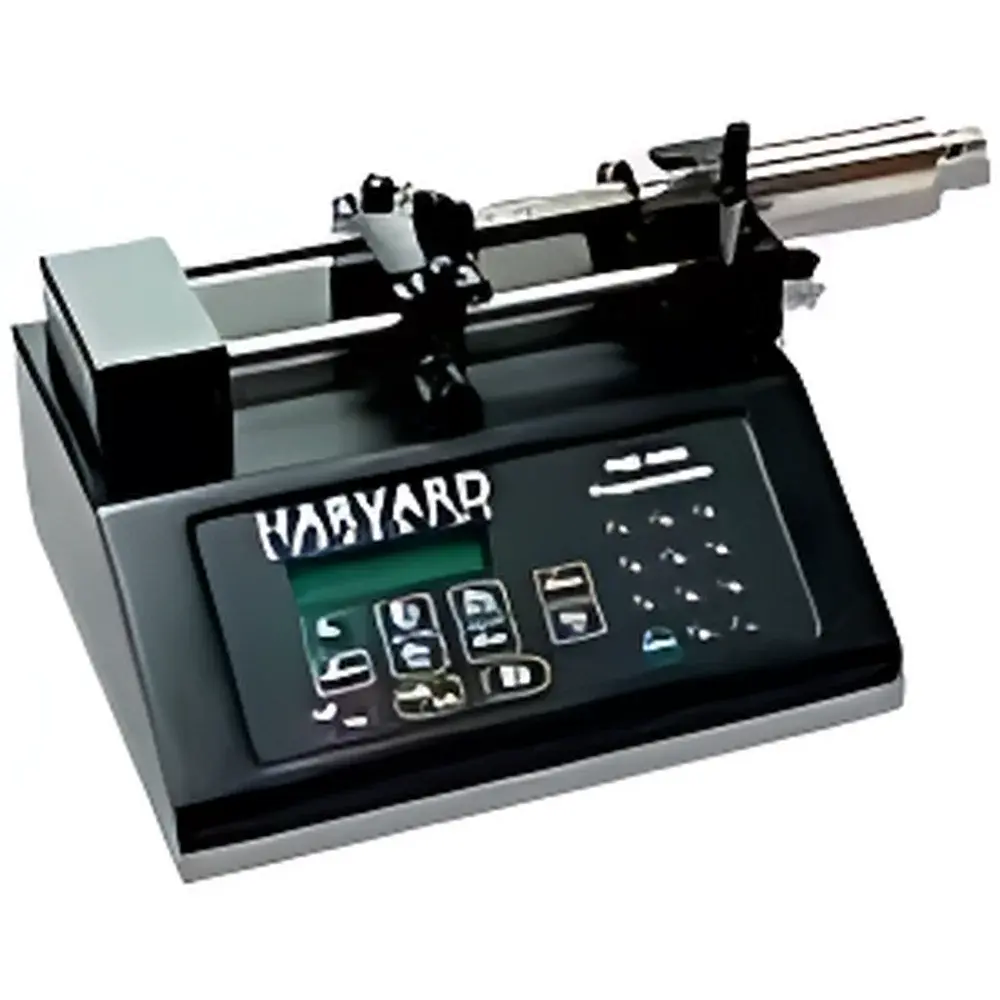
Harvard Apparatus PHD ULTRA™ 4400 High-Pressure Syringe Pump
| Brand | Harvard Apparatus |
|---|---|
| Origin | USA |
| Model | PHD ULTRA™ 4400 |
| Type | Microprocessor-Driven Single-Channel Syringe Pump |
| Accuracy | ±0.35% |
| Repeatability | ±0.05% |
| Syringe Volume Range | 0.5 µL to 140 mL |
| Flow Rate Range | 3.06 pL/min to 215.8 mL/min |
| Linear Force | 91 kg (200 lbs) at 100% force selection |
| Motor | 1.8° stepper motor |
| Input Voltage | 100–240 VAC, 50/60 Hz, 50 W |
| Interface Options | RS-232 (9-pin D-Sub), RS-485, IEEE-1394 (FireWire), USB Type-B, TTL I/O (15-pin D-Sub) |
| Standalone Unit Dimensions (H×W×D) | 30.48 × 21.59 × 18.4 cm |
| Remote Unit Dimensions (H×W×D) | 27.9 × 13.5 × 18.4 cm |
| Standalone Weight | 5.5 kg |
| Remote Unit Weight | 6.4 kg |
Overview
The Harvard Apparatus PHD ULTRA™ 4400 is a microprocessor-controlled, single-channel high-pressure syringe pump engineered for precision fluid delivery in demanding laboratory and preclinical applications. Unlike conventional peristaltic or piston-driven pumps, the PHD ULTRA 4400 employs a direct-drive linear actuator coupled with a high-torque 1.8° hybrid stepper motor to generate up to 91 kg (200 lbs) of programmable linear force—enabling consistent, pulseless infusion across an exceptionally wide flow range (3.06 pL/min to 215.8 mL/min). Its closed-loop control architecture ensures stable volumetric delivery independent of backpressure fluctuations, making it suitable for applications involving viscous media, microfluidic resistance networks, high-pressure chromatography columns, or intravascular infusions where pressure stability and volumetric fidelity are critical. The system operates as either a standalone instrument or in remote configuration, supporting both manual operation and fully automated integration into larger experimental workflows.
Key Features
- High-force linear actuation delivering up to 91 kg (200 lbs) at full motor torque—optimized for stainless-steel syringes and high-resistance fluid paths
- Exceptional metrological performance: ±0.35% accuracy and ±0.05% repeatability over the full syringe volume range (0.5 µL to 140 mL)
- Dual operational modes: Standalone mode with intuitive front-panel interface; Remote mode enabling autonomous execution of multi-step protocols without PC dependency
- Multi-interface connectivity including RS-232, RS-485, IEEE-1394 (FireWire), USB Type-B, and TTL-triggered I/O (15-pin D-Sub)—facilitating seamless integration with data acquisition systems, PLCs, or custom LabVIEW environments
- Rugged aluminum chassis and industrial-grade mechanical design rated for continuous duty and long-term reliability under laboratory conditions
- Comprehensive syringe compatibility—validated exclusively with Harvard Apparatus stainless-steel syringes to ensure dimensional consistency, thermal stability, and chemical inertness across pH 1–14 and organic solvent exposure
Sample Compatibility & Compliance
The PHD ULTRA 4400 is designed for use with Harvard Apparatus-certified stainless-steel syringes only, eliminating compliance risks associated with dimensional drift, plunger slippage, or material degradation under sustained load. This exclusivity supports traceable calibration pathways aligned with ISO/IEC 17025 requirements for accredited testing laboratories. While not classified as a medical device under FDA 21 CFR Part 820, the pump’s firmware architecture includes audit-trail-capable event logging (timestamped start/stop/pause/resume commands, parameter changes, and error states), supporting GLP and GMP-aligned documentation practices. Its electrical safety conforms to IEC 61010-1:2010 for laboratory equipment, and electromagnetic compatibility meets EN 61326-1:2013 Class A standards.
Software & Data Management
Harvard Apparatus provides the PHD ULTRA Control Software—a Windows-based application supporting real-time monitoring, protocol sequencing, and export of time-stamped flow rate, volume delivered, and pressure-equivalent force data in CSV or XML format. The software implements secure user-level access control (administrator/operator tiers) and enables version-controlled method storage compliant with ALCOA+ principles. For regulated environments, optional firmware upgrades support 21 CFR Part 11-compliant electronic signatures, audit trails, and role-based permissions when deployed with validated IT infrastructure. All communication protocols are deterministic and latency-bound (<10 ms command response), ensuring synchronization with external triggers in time-critical experiments such as electrophysiology or fast-scan cyclic voltammetry.
Applications
- Preclinical neuroscience: Chronic intracerebroventricular (ICV), intraparenchymal, or intrathecal infusions requiring ultra-low flow rates and pressure resilience
- Microfluidics and organ-on-chip platforms: Precise metering of reagents, drugs, or cell suspensions into high-impedance microchannels
- High-performance liquid chromatography (HPLC) and preparative LC: Solvent delivery under elevated backpressures exceeding 10,000 psi when paired with compatible stainless-steel syringes and fittings
- Materials science: Controlled dispensing of nanoparticle dispersions, polymer melts, or ceramic slurries where shear-thinning behavior necessitates constant-force delivery
- In vitro diagnostic assay development: Reproducible reagent addition in ELISA, lateral flow, or microtiter plate-based formats requiring sub-microliter precision
FAQ
Is the PHD ULTRA 4400 compatible with glass or plastic syringes?
No. Only Harvard Apparatus stainless-steel syringes are supported due to their dimensional stability under high axial load and resistance to creep deformation.
Can the pump be used in explosion-proof or inert-atmosphere enclosures?
Yes—the unit contains no internal batteries or volatile components; its 100–240 VAC input and sealed electronics allow safe operation within certified gloveboxes or nitrogen-purged chambers when installed with appropriate feedthroughs.
Does the remote configuration support analog voltage input for external triggering?
Yes—TTL-compatible digital inputs (0–5 V logic) and configurable analog inputs (±10 V) are available via the 15-pin D-Sub I/O port for synchronized start/stop or flow rate modulation.
What maintenance intervals are recommended for long-term operation?
No scheduled lubrication or recalibration is required; periodic verification using NIST-traceable volumetric standards every 6–12 months is advised for GLP/GMP applications.
Is firmware update capability available through the serial interface?
Yes—field-upgradable firmware is distributed via Harvard Apparatus’ secure portal and installed using the RS-232 interface with signed binary validation.



