
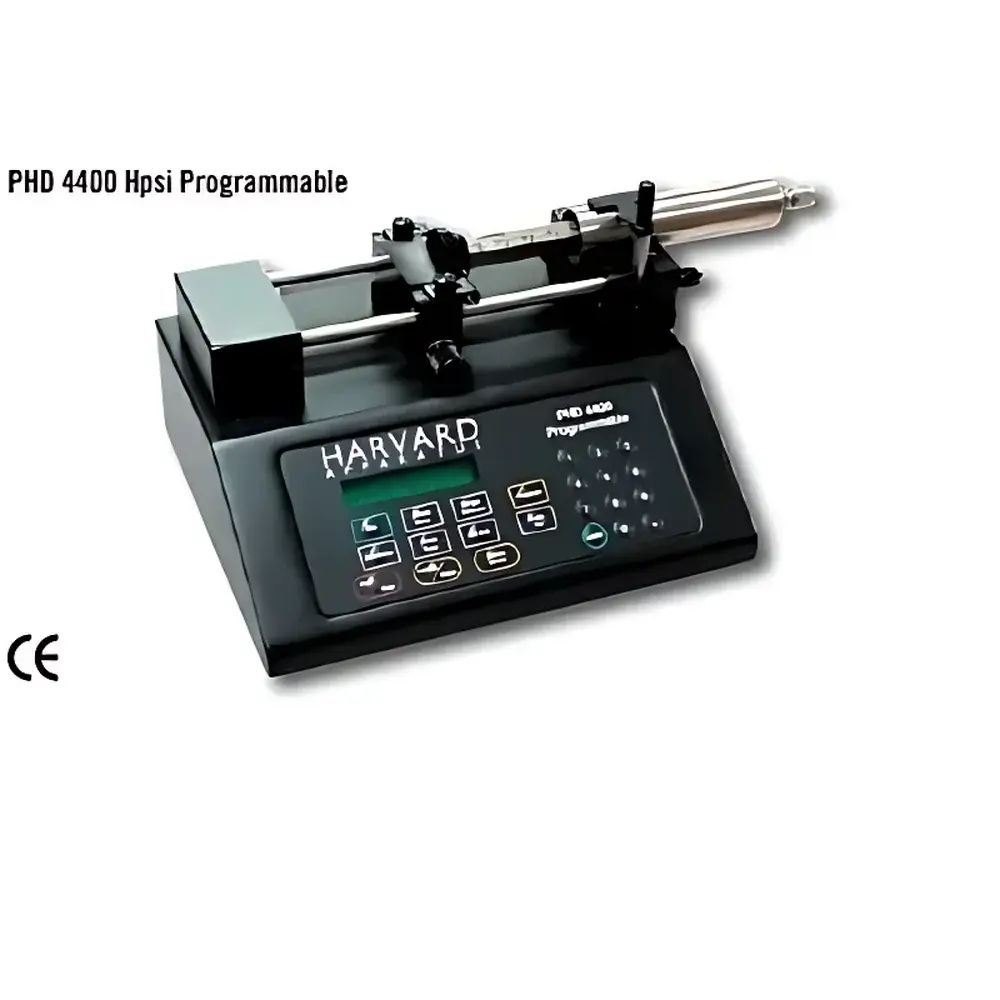
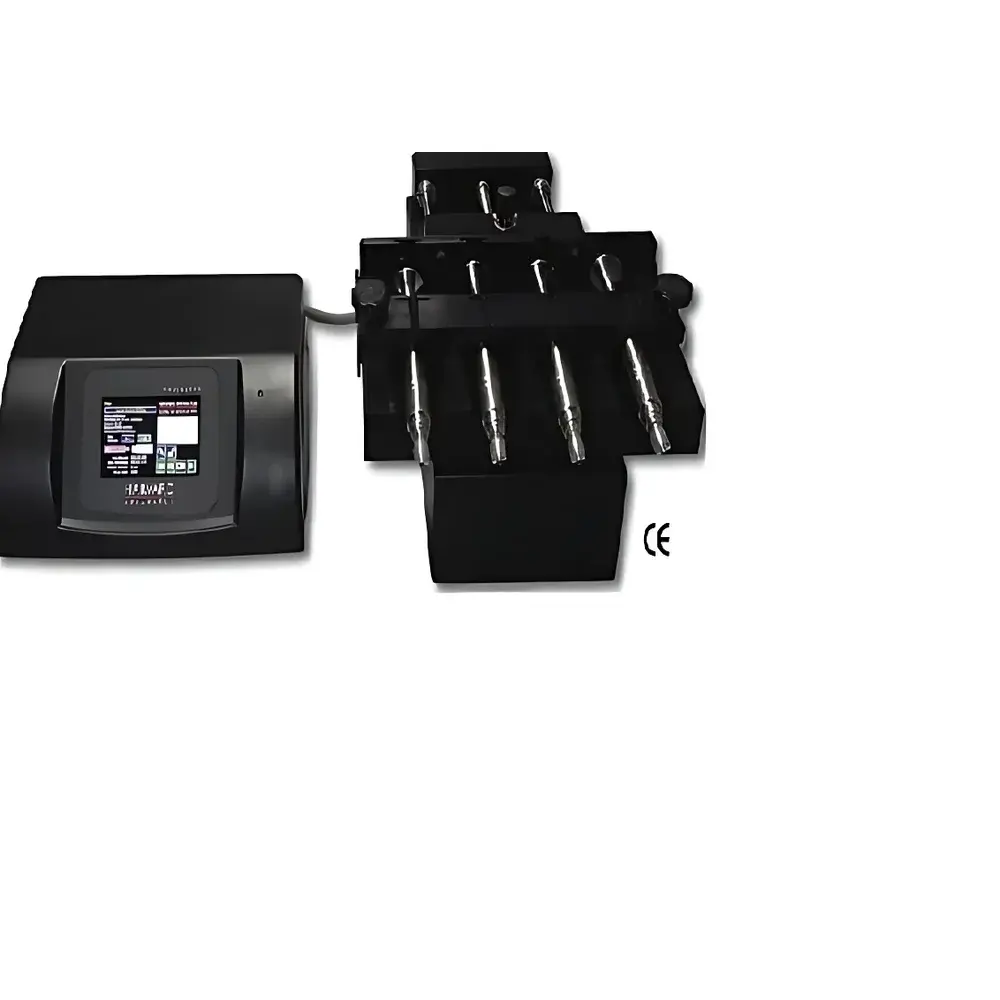
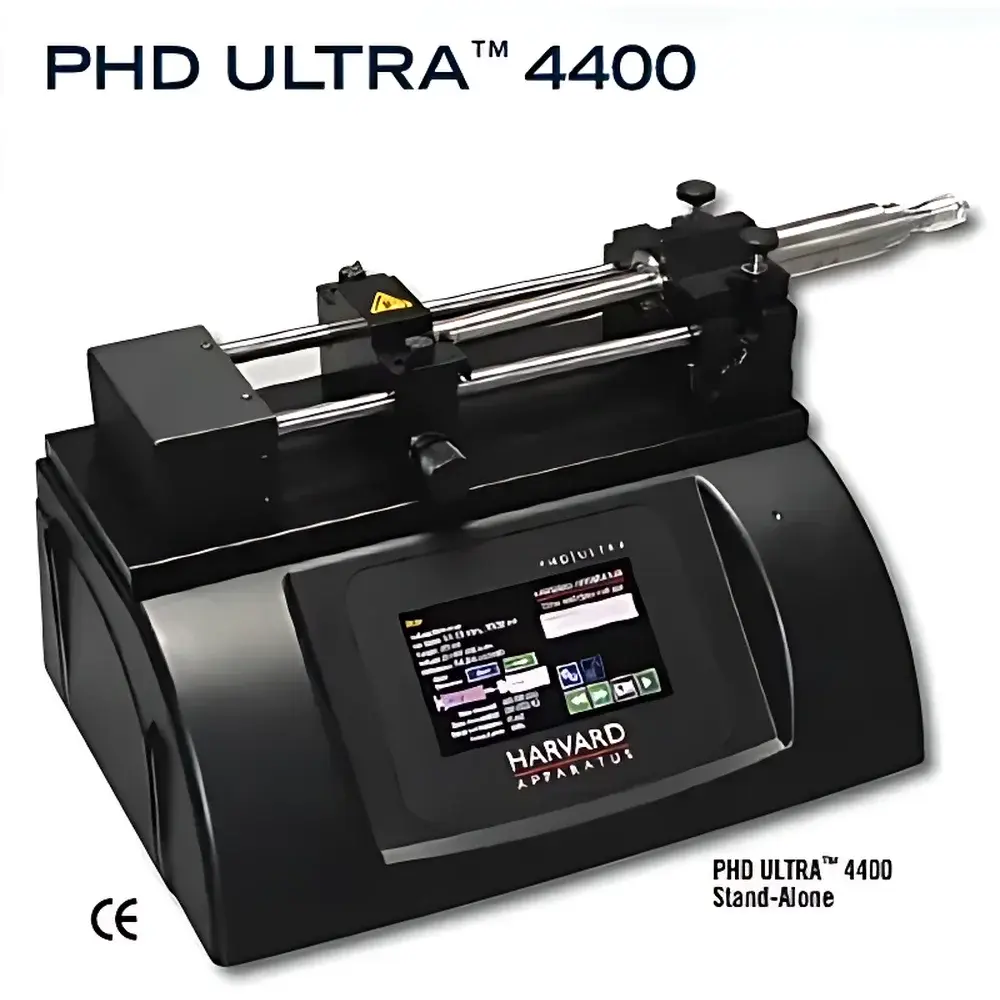
Harvard Apparatus PHD ULTRA 4400 / HPSI / XF High-Pressure Syringe Pump System
| Brand | Harvard Apparatus |
|---|---|
| Origin | USA |
| Model | PHD ULTRA 4400 / HPSI / XF |
| Syringe Compatibility | Stainless steel, plastic, glass |
| Min Syringe Volume | 0.5 µL |
| Max Syringe Volume | 200 mL |
| Min Flow Rate | 3.06 pL/min |
| Max Flow Rate | 216.0 mL/min |
| Max Linear Force | 454 kg |
| Interface | USB + RS-232 |
Overview
The Harvard Apparatus PHD ULTRA 4400, HPSI, and XF series represent a family of high-precision, high-pressure syringe pump systems engineered for demanding laboratory applications requiring accurate, repeatable, and bidirectional fluid delivery—infusion and withdrawal—under controlled conditions. These pumps operate on the principle of linear motor-driven plunger displacement, translating digital command inputs into precise mechanical motion via microstepping stepper motors and high-resolution encoders. Unlike peristaltic or piston-based alternatives, the PHD ULTRA architecture eliminates pulsation artifacts and ensures laminar, pulseless flow across an exceptionally wide dynamic range—from picoliter-per-minute nanofluidic dosing to milliliter-per-minute macro-infusion. The system’s modular design supports both standalone operation and integration into automated workflows, making it suitable for neuroscience microinjection, microfluidic chip priming, chromatography solvent delivery, and long-term pharmacokinetic studies in preclinical models.
Key Features
- High-force linear actuation: Select models (e.g., HPSI and XF) deliver up to 454 kg (1000 lbf) of push/pull force, enabling reliable operation with high-viscosity fluids, clogged capillaries, or backpressure-prone microfluidic networks.
- Ultra-low flow capability: Achieves volumetric resolution down to 3.06 pL/min using 0.5 µL syringes—critical for single-cell electrophysiology, CRISPR reagent delivery, or nanoliter-scale assay development.
- Bidirectional programmability: Independent control of infusion and withdrawal rates, volumes, and dwell times; supports multi-step protocols with ramped acceleration/deceleration profiles to minimize shear-induced sample degradation.
- Dual communication interface: Standard USB 2.0 and RS-232 ports ensure compatibility with legacy lab automation controllers, PLCs, and modern Windows/Linux-based acquisition software.
- Modular rack integration: Optional 10×140 mm rack mounting (e.g., PHD ULTRA HPSI Remote) enables synchronized multi-pump configurations for gradient generation or parallel sample processing.
- Robust mechanical architecture: All-metal housing, stainless-steel lead screws, and sealed optical encoders provide long-term stability under continuous operation and meet IP20 environmental ratings for standard laboratory use.
Sample Compatibility & Compliance
The PHD ULTRA platform accommodates a broad spectrum of syringe materials—including borosilicate glass, polypropylene, PTFE-lined plastic, and medical-grade stainless steel—ensuring chemical compatibility with organic solvents, aqueous buffers, cell suspensions, and viscous polymer solutions. Syringe volume range spans from 0.5 µL micro-syringes to 200 mL industrial barrels, with automatic calibration routines that compensate for barrel diameter tolerance and plunger seal friction. From a regulatory standpoint, the system supports audit-ready operation when paired with compliant software: logged event timestamps, user-access controls, and protocol versioning align with GLP and GMP documentation requirements. While the hardware itself does not carry FDA 510(k) clearance, its deterministic flow behavior and traceable calibration procedures make it widely accepted in ISO 17025-accredited testing laboratories and academic core facilities conducting ASTM D3418 (viscosity standards) or USP (dissolution apparatus calibration) workflows.
Software & Data Management
Harvard Apparatus provides the proprietary PHD ULTRA Software Suite (v5.x), a Windows-native application supporting real-time monitoring, script-based protocol authoring, and export of time-stamped CSV datasets. The software implements full command logging—including parameter changes, start/stop events, and error flags—with optional encryption and electronic signature modules compatible with FDA 21 CFR Part 11 Annex 11 requirements. For integration into enterprise environments, the pump responds to ASCII command sets over serial/USB, allowing seamless interoperability with LabVIEW, MATLAB, Python (via pySerial), or custom SCADA platforms. All firmware updates are digitally signed and delivered through Harvard’s secure support portal, ensuring version traceability and cybersecurity compliance.
Applications
- Neuroscience: Stereotaxic microinjection of viral vectors, tracers, or optogenetic constructs into rodent brain tissue with sub-nanoliter precision.
- Microfluidics: Priming and pressure-balancing of organ-on-chip devices, droplet generation, and continuous-flow synthesis reactors.
- Pharmaceutical R&D: Controlled release profiling, dissolution testing auxiliary pumping, and formulation stability assessment under variable shear stress.
- Materials science: Precise deposition of nanomaterial inks, polymer precursor injection into 3D-printed molds, and rheological characterization via coupled viscometry.
- Clinical diagnostics: Automated reagent metering in point-of-care analyzers and calibration fluid delivery for IVD instrument validation.
FAQ
Can the PHD ULTRA pump be used for both infusion and withdrawal in a single protocol?
Yes. All models support fully independent programming of infusion and withdrawal phases, including dwell periods, flow rate transitions, and volume-limited termination triggers.
What syringe types are certified for use with the 454 kg force models?
Only syringes rated for >100 bar operating pressure—such as Hamilton 1001TLL glass syringes or SGE 100R-FR PTFE-plunger units—are recommended for sustained high-force operation.
Is remote triggering via TTL or analog input supported?
No native TTL/analog trigger input is provided; however, external hardware interfaces (e.g., National Instruments DAQ) can initiate pump commands via serial API polling or scheduled software calls.
Does the system include NIST-traceable calibration documentation?
Calibration certificates are available upon request and include uncertainty budgets per ISO/IEC 17025 guidelines, covering linearity, repeatability, and temperature drift at defined flow points.
How often does the lead screw require maintenance or lubrication?
The stainless-steel lead screw is permanently lubricated and sealed; no scheduled maintenance is required within the first 10,000 hours of operation under typical laboratory conditions.



