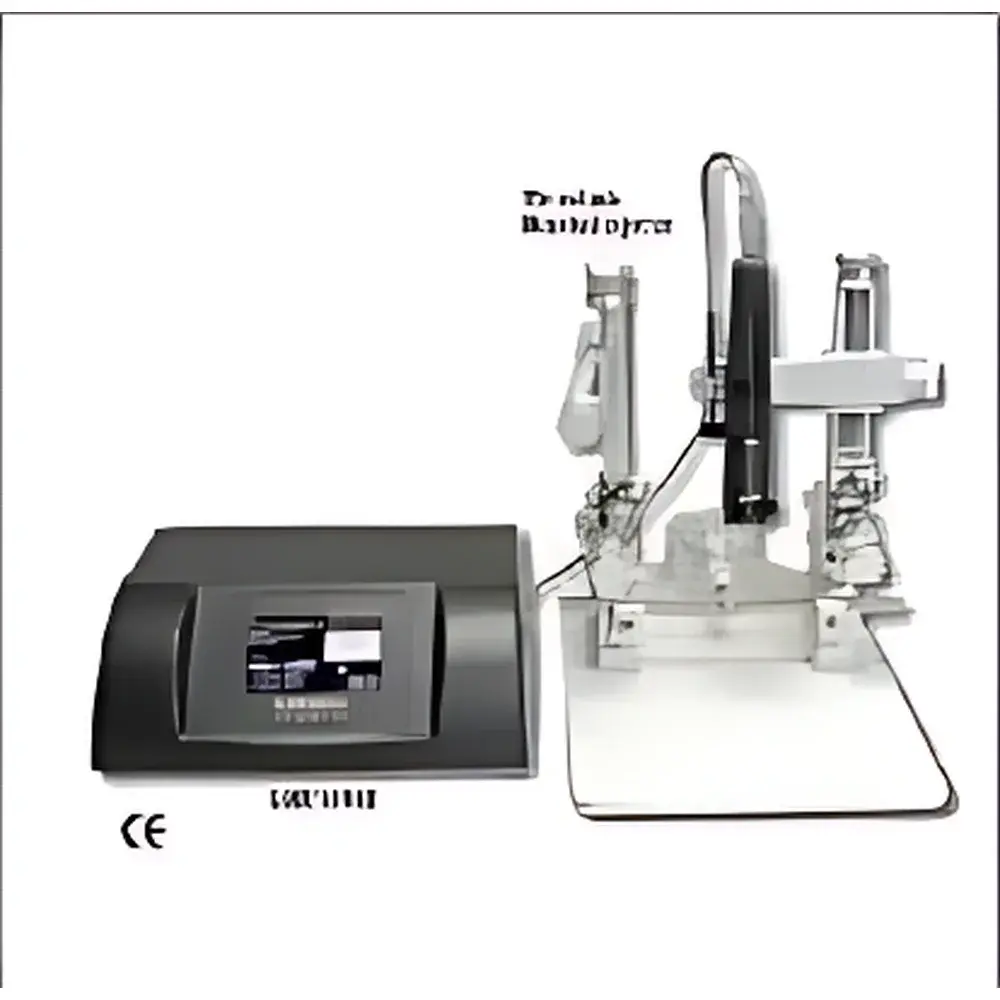
Harvard Apparatus PHD ULTRA Nanomite Infusion/Withdrawal Programmable Single-Syringe Microinfusion Pump
| Brand | Harvard Apparatus |
|---|---|
| Origin | USA |
| Model | PHD ULTRA Nanomite |
| Flow Rate Range | 3.66 pL/min to 3.818 mL/min |
| Accuracy | ±0.5% (stability), ±0.05% (repeatability) |
| Syringe Capacity | 0.5 µL – 1 mL |
| Linear Force | 5 kg (adjustable) |
| Display | 4.3" WQVGA TFT color touchscreen |
| Interfaces | USB, RS-485, TTL digital I/O, footswitch (9-pin D-Sub), optional RS-232 (RJ-11) |
| Compliance | CE, EU RoHS |
| Power | 100–240 VAC, 50/60 Hz, 75 W |
| Dimensions (Controller) | 30.5 × 21.6 × 11.1 cm |
| Weight (Controller) | 2.06 kg |
Overview
The Harvard Apparatus PHD ULTRA Nanomite is a microprocessor-driven, single-channel programmable infusion/withdrawal pump engineered for high-precision fluid delivery in demanding life science applications—particularly stereotactic neurosurgery, intracerebral microinjection, and regenerative medicine workflows. Unlike manual or basic motorized syringe pumps, the Nanomite employs closed-loop stepper motor control with sub-micron positional resolution (0.198 µm per microstep) to achieve exceptional volumetric accuracy and temporal reproducibility. Its operation is grounded in positive-displacement mechanics: linear actuation of the syringe plunger enables precise control over both infusion and withdrawal cycles without cross-contamination or backflow risk. Designed for integration into animal surgery rigs and clean-bench environments, the system operates independently of host computers while supporting full external automation via industry-standard digital interfaces—making it suitable for GLP-compliant preclinical studies requiring audit-trail-capable parameter logging.
Key Features
- Self-contained operation: Onboard touchscreen GUI enables creation, storage, and execution of >50 user-defined protocols—including multi-phase ramps, pauses, bidirectional cycles, and conditional triggers—without PC dependency.
- Ultra-low flow capability: Validated performance down to 3.66 picoliters per minute, enabling nanoliter-scale dosing essential for targeted neuronal transfection, CRISPR delivery, or optogenetic vector administration.
- Modular architecture: Separated controller and syringe drive units (connected via 6-ft shielded cable) minimize mechanical coupling noise and simplify mounting on stereotaxic frames or robotic stages.
- Configurable force output: Adjustable linear thrust up to 5 kg ensures compatibility with diverse syringe materials (glass, polypropylene, borosilicate) and viscosities—critical when delivering viscous hydrogels or viral suspensions.
- Multi-interface connectivity: Native support for USB (for firmware updates and data export), RS-485 (multi-pump daisy-chaining), TTL-level digital I/O (for synchronization with electrophysiology rigs or imaging triggers), and footswitch input (9-pin D-Sub) for hands-free start/stop control during surgery.
Sample Compatibility & Compliance
The PHD ULTRA Nanomite accommodates standard Luer-lock syringes ranging from 0.5 µL microcapillaries to 1 mL glass barrels, with automatic detection of syringe diameter (via manual entry or barcode scanning when paired with optional accessories). It maintains ISO 8536-4 and ASTM D3122-compliant sealing integrity across its operational range. The device conforms to CE marking requirements under Directive 2014/30/EU (EMC) and 2011/65/EU (RoHS), and its electrical safety design meets IEC 61010-1:2010 standards for laboratory equipment. While not classified as a medical device under FDA 21 CFR Part 820, its deterministic control architecture and parameter traceability support alignment with GLP documentation practices required for IND-enabling toxicology and biodistribution studies.
Software & Data Management
All protocol parameters—including flow rate profiles, volume targets, dwell times, direction toggles, and force settings—are stored in non-volatile memory with timestamped versioning. Exportable logs (CSV format) capture real-time plunger position, elapsed time, and error flags (e.g., occlusion detection, stall recovery). When connected to a host PC via USB, the pump supports Harvard Apparatus’ NetLab software suite, which provides remote monitoring, batch protocol deployment, and compliance-ready audit trails meeting FDA 21 CFR Part 11 requirements for electronic records and signatures. Optional RS-232 (RJ-11) interface enables legacy system integration with LabVIEW, MATLAB, or custom Python-based orchestration frameworks.
Applications
- Stereotactic intracranial injection in rodent models: precise delivery of AAV vectors, siRNA, or stem cells to submillimeter brain regions (e.g., hippocampus, substantia nigra).
- In vitro cellular microinjection: controlled cytoplasmic or nuclear loading of dyes, antibodies, or nucleic acids into primary neurons or iPSC-derived organoids.
- Pharmacokinetic microdosing: repeatable sub-microliter bolus administration during awake-behaving experiments or chronic cannula-based paradigms.
- Tissue engineering scaffold perfusion: low-shear infusion of growth factors or differentiation media into 3D bioprinted constructs.
- Microfluidic interface priming: calibrated filling of nanoliter-volume channels prior to single-cell analysis or droplet generation.
FAQ
Can the PHD ULTRA Nanomite operate without a computer?
Yes—the pump features an embedded operating system with a 4.3-inch capacitive touchscreen interface that allows full program creation, editing, saving, and execution independent of any external computer.
What syringe types are supported?
Standard Luer-lock syringes made of glass, polypropylene, or borosilicate, with capacities from 0.5 µL to 1 mL. Syringe diameter must be manually entered or scanned (with optional barcode reader) for accurate flow calculation.
Is occlusion detection available?
The pump monitors motor current draw in real time and triggers an audible/visual alert upon sustained over-torque conditions, indicating potential blockage or excessive backpressure.
Does it support multi-pump synchronization?
Yes—via RS-485 daisy-chaining or TTL-level trigger signals, enabling coordinated infusion/withdrawal across multiple Nanomite units for dual-vector delivery or push-pull microdialysis setups.
What regulatory documentation is provided?
CE Declaration of Conformity, RoHS compliance statement, IEC 61010-1 safety report, and full technical specifications are included with shipment; ISO 13485 manufacturing certification applies to Harvard Apparatus’ production facility in Holliston, MA, USA.
Related Products