
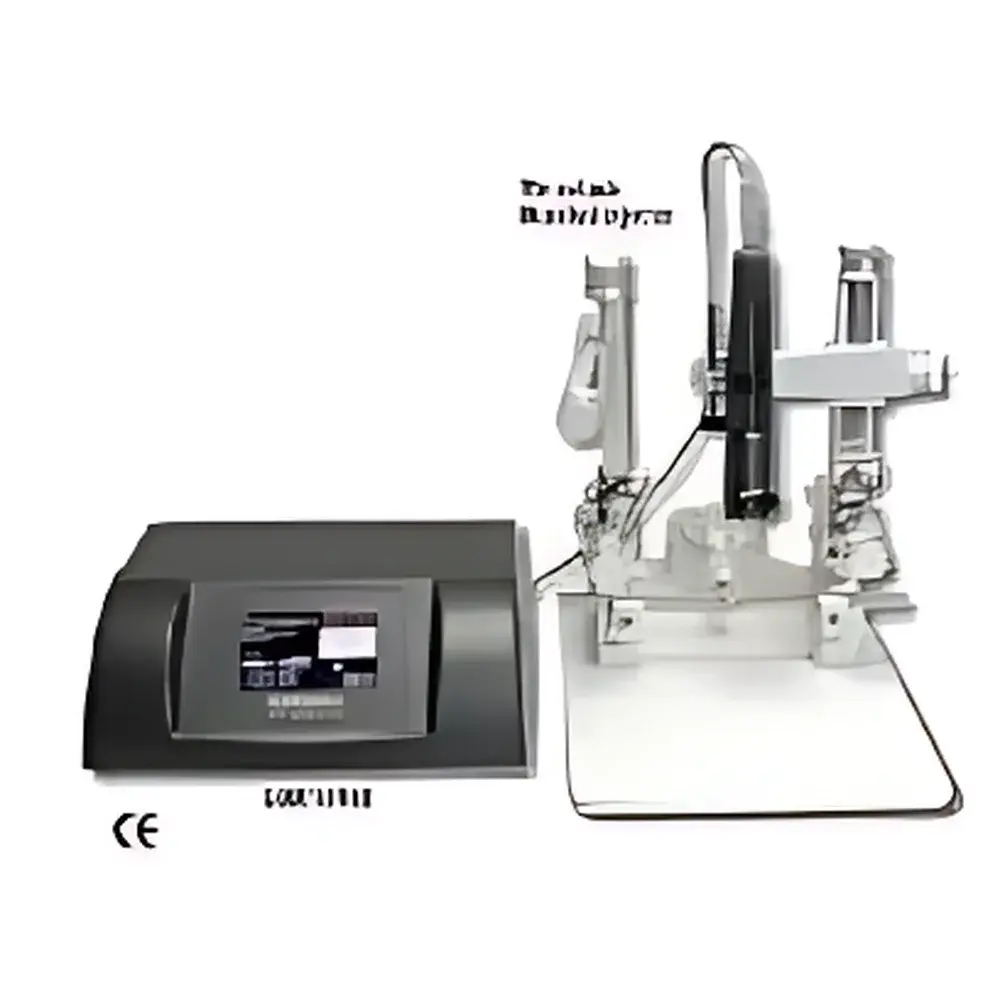
Harvard Apparatus PHD ULTRA Nanomite Single-Channel Programmable Infusion/Withdrawal Syringe Pump
| Brand | Harvard Apparatus |
|---|---|
| Origin | USA |
| Model | PHD ULTRA Nanomite |
| Flow Rate Range | 3.66 pL/min to 3.818 mL/min |
| Accuracy | ±0.5% |
| Repeatability | ±0.05% |
| Syringe Capacity | 0.5 µL–1 mL |
| Max Linear Force | 5 kg (11 lbs) |
| Step Resolution | 0.198 µm/µstep |
| Display | 4.3" WQVGA TFT Color Touchscreen |
| Interfaces | USB, RS-232 (optional), RS-485, TTL Digital I/O, Footswitch (9-pin D-Sub), IEEE-1394 Type B, Phono Jack |
| Compliance | CE, EU RoHS |
| Power | 100–240 VAC, 50/60 Hz, 75 W |
| Control Unit Dimensions | 30.5 × 21.6 × 11.1 cm |
| Weight | Control Unit 2.06 kg, Syringe Unit 0.458 kg |
Overview
The Harvard Apparatus PHD ULTRA Nanomite is a microprocessor-driven, single-channel programmable syringe pump engineered for ultra-precise fluid delivery and withdrawal in demanding life science and biomedical research environments. Unlike conventional manual or basic motorized pumps, the Nanomite operates on closed-loop stepper motor control with real-time position feedback, enabling sub-nanoliter dosing accuracy and exceptional volumetric reproducibility. Its core architecture leverages high-resolution microstepping (0.198 µm per microstep) and digitally adjustable linear force (up to 5 kg), allowing stable, pulseless flow across an exceptionally wide dynamic range—from picoliter-per-minute infusion for intracellular microinjection to milliliter-per-minute delivery for in vivo pharmacokinetic studies. Designed specifically for integration into stereotaxic rigs, patch-clamp setups, organ-on-chip platforms, and regenerative medicine workflows, the Nanomite eliminates dependency on external computers while maintaining full programmability—making it suitable for GLP-compliant protocol execution in regulated preclinical labs.
Key Features
- Self-contained operation: Create, store, and execute >50 user-defined protocols directly via intuitive 4.3″ WQVGA color touchscreen GUI—no PC required.
- Ultra-broad flow range: 3.66 pL/min to 3.818 mL/min, supporting applications from single-cell injection to bulk reagent dispensing.
- High-fidelity mechanical control: ±0.05% repeatability and ±0.5% volumetric accuracy over full syringe range (0.5 µL–1 mL glass/plastic syringes).
- Modular hardware interface suite: Standard USB 2.0, RS-485 (for daisy-chaining multiple pumps), TTL-level digital I/O (for synchronization with electrophysiology or imaging systems), and 9-pin D-sub footswitch input.
- Optional RS-232 (RJ-11) port available for legacy system integration; IEEE-1394 Type B and phono jack support auxiliary timing or analog triggering.
- Compact, low-mass design: Syringe unit weighs only 458 g—optimized for mounting on micromanipulators or stereotaxic arms without introducing vibration or positional drift.
Sample Compatibility & Compliance
The PHD ULTRA Nanomite accommodates standard Luer-lock syringes ranging from 0.5 µL microcapillaries to 1 mL borosilicate glass or polypropylene barrels. Its force-tunable drive mechanism ensures consistent plunger advancement regardless of syringe material compliance or fluid viscosity (tested with aqueous buffers, viscous hydrogels, and cell-laden bioinks). The system complies with CE marking requirements and EU RoHS Directive 2011/65/EU for hazardous substance restrictions. While not inherently 21 CFR Part 11–certified, its deterministic firmware architecture, non-volatile program storage, and audit-ready parameter logging (via optional USB data export) support validation under GxP frameworks when deployed within documented laboratory procedures.
Software & Data Management
No proprietary software installation is required for basic operation; all configuration, scheduling, and real-time monitoring occur through the onboard touch interface. For advanced integration, Harvard Apparatus provides open-command-set documentation (ASCII-based serial protocol) compatible with LabVIEW, MATLAB, Python (PySerial), and custom C++ applications. Logged run metadata—including timestamp, syringe ID, target volume, actual delivered volume, and error flags—is exportable as CSV via USB mass-storage mode. Firmware updates are performed offline using signed binary files, ensuring integrity and traceability in regulated environments.
Applications
- Intracellular and nuclear microinjection in embryology and CRISPR editing workflows.
- Stereotactic delivery of viral vectors, stem cells, or neurochemicals into rodent brain regions.
- Controlled perfusion in microfluidic organ-chips and blood-brain barrier models.
- Automated drug administration in awake-behaving rodent studies using tethered or wireless trigger interfaces.
- Precise aspiration during oocyte enucleation or blastomere biopsy in assisted reproductive technology (ART) labs.
- Calibration and validation of biosensors requiring known analyte concentration gradients.
FAQ
Can the Nanomite operate independently without a computer?
Yes—the pump includes embedded firmware and a full-featured touchscreen interface that supports program creation, storage, and execution without any external computing device.
Is syringe calibration required before each use?
No; the system uses absolute position encoding and factory-trimmed step-to-volume mapping. However, users may perform optional syringe-specific calibration using the built-in “Calibrate Volume” utility if switching between syringe types or after extended maintenance.
What safety features prevent over-pressurization or syringe breakage?
The Nanomite continuously monitors motor current draw and automatically halts motion if resistance exceeds user-defined force thresholds. It also includes mechanical end-stop detection and thermal shutdown protection.
Does the pump support bidirectional flow (infusion + withdrawal) within a single program?
Yes—each program step can be individually configured for infusion, withdrawal, or hold, enabling complex multi-phase delivery sequences such as priming, dosing, and washout.
How is firmware updated, and is version history maintained?
Firmware updates are applied via USB using Harvard Apparatus–signed binaries. The system logs firmware version, update timestamp, and operator ID (if entered) in internal non-volatile memory for audit purposes.



