
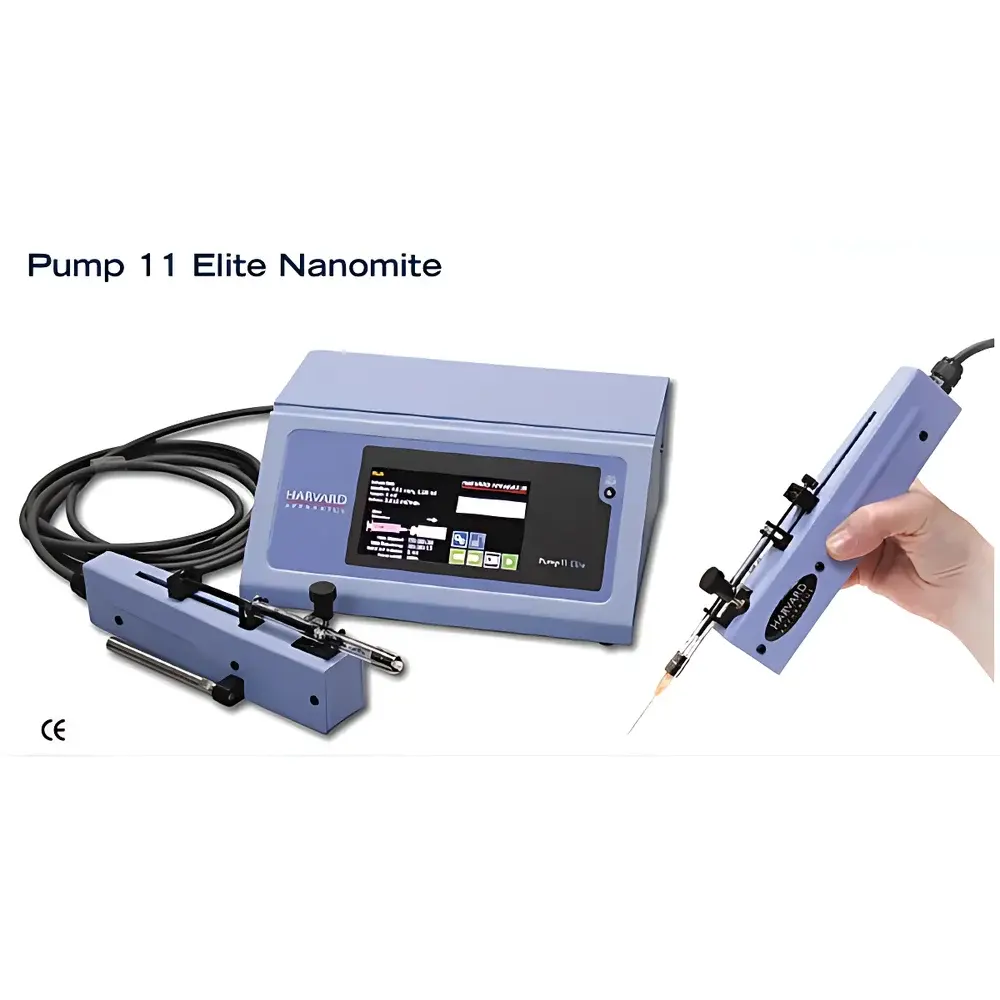
Harvard Apparatus Pump 11 Elite Nanomite Syringe Pump
| Brand | Harvard Apparatus |
|---|---|
| Origin | USA |
| Model | Pump 11 Elite Nanomite |
| Syringe Capacity | 0.5 µL – 1 mL |
| Flow Rate Range | 3.66 pL/min – 3.82 mL/min |
| Max Linear Force | 5 kg |
| Interface | USB and RS-232 serial |
Overview
The Harvard Apparatus Pump 11 Elite Nanomite Syringe Pump is an ultra-precise, micro-volume infusion device engineered for demanding laboratory applications requiring nanoliter-to-milliliter scale fluid delivery with exceptional resolution and reproducibility. Based on a high-resolution stepper motor-driven linear actuation system, it operates via positive displacement using standard glass or plastic syringes—eliminating pulsation and ensuring laminar, pulseless flow essential for sensitive biological, electrochemical, and microfluidic experiments. Unlike peristaltic or diaphragm-based pumps, the Pump 11 Elite Nanomite delivers true volumetric control independent of fluid viscosity or backpressure up to its mechanical force limit (5 kg), making it suitable for high-resistance microcapillary systems, patch-clamp perfusion, and closed-loop dosing in preclinical pharmacokinetic studies.
Key Features
- Sub-picoliter per minute resolution: Achieves minimum programmable flow rates as low as 3.66 pL/min when paired with a 0.5 µL syringe—enabling precise delivery in single-cell electrophysiology, nanoinjection, and microdialysis calibration.
- Wide dynamic range: Covers six orders of magnitude in flow rate (pL/min to mL/min) without hardware reconfiguration, supporting both ultra-slow continuous infusions and rapid bolus delivery.
- Dual communication interface: Native support for both USB 2.0 and RS-232 serial protocols ensures seamless integration into legacy and modern lab environments—including compatibility with LabVIEW, MATLAB, Python (via PySerial), and custom C++ control suites.
- Robust mechanical architecture: Precision-ground lead screw and hardened stainless-steel pusher block deliver consistent linear force up to 5 kg, maintaining accuracy under variable load conditions typical in microfluidic chip interfacing or high-viscosity solvent delivery.
- Calibration traceability: Supports user-defined syringe calibration routines with stored profiles for up to 10 different syringe types; all calibration parameters are retained in non-volatile memory and can be exported for GLP documentation.
Sample Compatibility & Compliance
The Pump 11 Elite Nanomite accommodates Luer-lock and Luer-slip syringes ranging from 0.5 µL to 1 mL, including borosilicate glass, polypropylene, and fluoropolymer-lined variants. It is compatible with aqueous buffers, organic solvents (e.g., DMSO, ethanol, acetonitrile), and viscous solutions up to ~500 cP when operated within torque limits. The device complies with IEC 61010-1:2010 for electrical safety in laboratory equipment and meets FCC Part 15 Class B emission standards. While not inherently 21 CFR Part 11–compliant as a standalone unit, its audit-trail-capable software interface (when used with Harvard’s PumpControl v4.2 or later) supports electronic signature, user access control, and immutable event logging—facilitating alignment with GxP workflows in regulated research environments.
Software & Data Management
Harvard Apparatus’ PumpControl software (Windows-based, version 4.2+) provides full graphical programming of multi-step protocols—including ramped flows, timed pauses, conditional triggers, and synchronized multi-pump operation. All pump events—start/stop timestamps, flow rate changes, error codes, and syringe calibration metadata—are logged in CSV and XML formats with millisecond-level time stamps. Raw data exports include absolute volume delivered, elapsed time, and motor step count, enabling post-hoc verification against analytical measurements (e.g., HPLC peak area, fluorescence intensity). Remote monitoring via TCP/IP (with optional Ethernet adapter) allows integration into centralized lab automation platforms compliant with ASTM E1578-22 (Standard Guide for Laboratory Automation).
Applications
- Neuroscience: Stable, low-noise drug or dye infusion during in vivo two-photon imaging or optogenetic experiments.
- Microfluidics: Precise reagent metering in droplet generation, organ-on-chip perfusion, and digital PCR partitioning.
- Electrochemistry: Controlled electrolyte delivery in scanning electrochemical microscopy (SECM) and rotating ring-disk electrode (RRDE) cells.
- Preclinical PK/PD: Subcutaneous or intravenous bolus + maintenance dosing in rodent models with real-time dose logging for exposure modeling.
- Materials science: Nanoparticle dispersion injection into TEM sample holders or controlled precursor delivery in CVD precursor lines.
FAQ
What syringe sizes are supported?
The Pump 11 Elite Nanomite accepts syringes from 0.5 µL to 1 mL capacity, including custom micro-syringes with Luer fittings.
Can it operate independently without a computer?
Yes—it features front-panel keypad control and internal memory for storing up to 10 pre-programmed protocols, enabling standalone operation.
Is it compatible with corrosive or high-viscosity fluids?
It is compatible with most common solvents and buffers; however, prolonged use with strong acids, halogenated solvents, or fluids >500 cP requires evaluation of syringe barrel and plunger seal compatibility.
Does it support regulatory-compliant data integrity?
When used with PumpControl v4.2+ and configured with role-based user accounts and enabled audit trail, it satisfies core ALCOA+ principles for raw data recording in non-clinical GLP studies.
How is calibration verified and documented?
Users perform volumetric calibration using gravimetric or fluorometric methods; calibration coefficients and validation reports can be saved, timestamped, and exported for inclusion in lab notebooks or quality records.



