
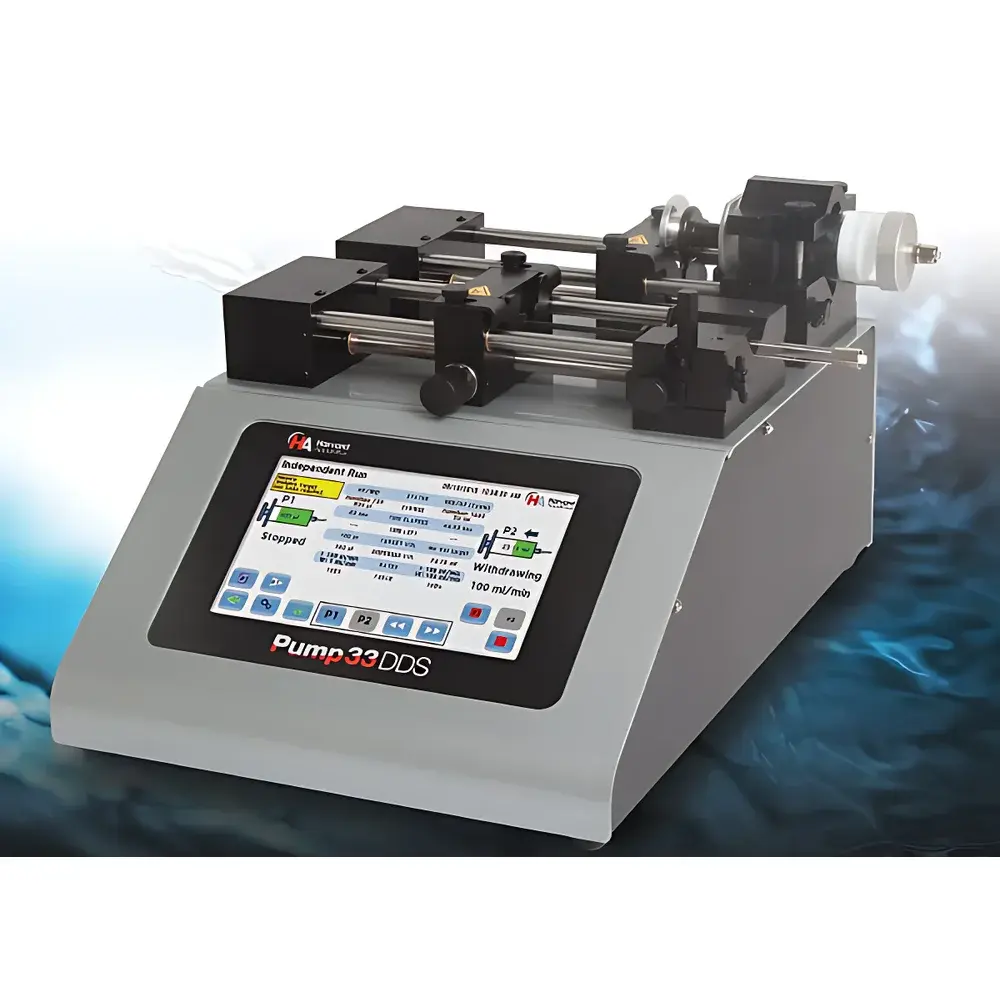
Harvard Apparatus Pump 33 DDS Dual-Drive Syringe Pump
| Brand | Harvard Apparatus |
|---|---|
| Origin | USA |
| Model | Pump 33 DDS |
| Flow Rate Range | 1.02 pL/min – 106 mL/min |
| Syringe Volume Compatibility | 0.5 µL – 60 mL |
| Drive System | Dual independent stepper motor drives |
| Control Interface | Integrated capacitive touchscreen |
| Compliance | Designed for GLP/GMP environments with audit-trail-ready operation (FDA 21 CFR Part 11–compatible software optional) |
Overview
The Harvard Apparatus Pump 33 DDS (Dual-Drive Syringe Pump) is a precision fluid delivery instrument engineered for high-reproducibility, low-volume to mid-volume infusion and withdrawal applications in life science research, pharmaceutical development, and analytical instrumentation integration. Operating on a dual-stepper-motor architecture, the Pump 33 DDS decouples mechanical control of two syringes—enabling true independent regulation of flow rate, direction, volume, and acceleration profiles for each channel without cross-interference. Its core mechanism employs microstepping motor control with closed-loop feedback monitoring (via integrated position sensing), minimizing step loss and ensuring volumetric accuracy traceable to NIST-calibrated syringe geometry. Unlike single-drive systems constrained by mechanical coupling or shared torque distribution, the DDS architecture maintains consistent force delivery across the full syringe volume range—critical for applications involving viscous media, pulsation-sensitive assays, or sequential multi-reagent dosing.
Key Features
- Dual independent drive trains: Each channel features a dedicated high-resolution stepper motor, lead screw, and force-sensing load path—eliminating mechanical crosstalk and enabling asynchronous or synchronized operation.
- Ultra-broad flow range: Programmable from 1.02 picoliters per minute (pL/min) to 106 milliliters per minute (mL/min), supporting nanoliter-scale microinjection through macro-scale perfusion protocols.
- Wide syringe compatibility: Securely accommodates glass or plastic syringes from 0.5 µL (e.g., Hamilton 700 series) up to 60 mL (e.g., BD Plastipak), with automatic detection of syringe barrel diameter via optical encoder calibration routine.
- Capacitive touchscreen interface: 5.7-inch VGA display with intuitive graphical workflow navigation; supports parameter entry via numeric keypad, slider adjustment, and preset protocol recall.
- Programmable multi-step protocols: Up to 100 user-defined steps per channel—including ramped acceleration/deceleration, pause intervals, volume-triggered transitions, and bidirectional flow switching.
- Robust mechanical design: Anodized aluminum frame, stainless-steel lead screws, and self-aligning syringe clamp with dual-point lateral stabilization ensure long-term positional repeatability (< ±0.1% of full scale over 10,000 cycles).
Sample Compatibility & Compliance
The Pump 33 DDS delivers chemically inert fluid handling when paired with compatible syringe materials (e.g., borosilicate glass, polypropylene, or PTFE-coated barrels) and luer-lock or integrated tubing interfaces. It supports aqueous buffers, organic solvents (with appropriate wetted material selection), cell suspensions, and polymer solutions—provided viscosity remains within the motor torque envelope (up to ~5000 cP at low flow rates). The system complies with electrical safety standards IEC 61010-1 and EMC directive 2014/30/EU. When operated with Harvard’s optional PumpControl™ software (v5.2+), it supports 21 CFR Part 11–compliant electronic records—including user authentication, audit trail logging, and electronic signature capture—making it suitable for regulated environments governed by FDA, EMA, or PMDA requirements. All firmware updates are digitally signed and version-locked to maintain validation integrity.
Software & Data Management
PumpControl™ software (Windows-based, USB/RS-232/Ethernet connectivity) provides full remote configuration, real-time monitoring, and automated data export (CSV, XML, or HDF5). The software enables protocol synchronization across multiple Pump 33 DDS units, time-stamped event logging, and dynamic flow profile generation using mathematical functions (e.g., sine, exponential, or custom CSV-defined waveforms). Raw position encoder data (step count × resolution) is logged at up to 100 Hz, permitting post-hoc volumetric recalibration based on actual syringe geometry. Exported datasets include metadata headers compliant with MIAME/MINSEQE conventions, facilitating integration into LIMS or ELN platforms. Firmware updates preserve user-configured defaults and retain historical calibration coefficients.
Applications
- Neuroscience: Intracerebral microinfusion of tracers, viral vectors, or pharmacological agents in rodent stereotaxic surgery.
- Organ-on-a-chip: Continuous perfusion of endothelialized microfluidic channels under physiological shear stress conditions.
- Chromatography sample introduction: Precise gradient elution or loop injection in HPLC/UHPLC systems.
- Cell culture bioreactors: Automated feed-and-bleed nutrient supplementation with programmable diurnal cycling.
- Material science: Controlled deposition of nanomaterial inks or hydrogel precursors during 3D bioprinting workflows.
- IVF & reproductive biology: Oocyte micromanipulation media exchange and cryoprotectant stepwise addition.
FAQ
Can Pump 33 DDS operate in withdrawal mode only?
Yes—each channel supports independent forward, reverse, or alternating direction modes, with real-time reversal capability without pausing the protocol.
Is syringe calibration required before every experiment?
No—once calibrated for a specific syringe model and barrel material, the system retains the geometric parameters; however, recalibration is recommended after syringe batch changes or after extended high-torque operation.
Does the pump support TTL or analog input/output for external device synchronization?
Yes—dedicated BNC ports provide configurable TTL triggers for start/stop/pause, as well as 0–5 V analog output reflecting real-time flow rate or motor position.
What maintenance intervals are recommended for long-term reliability?
Lead screw lubrication every 6 months (using Dow Corning® Molykote® BR2 Plus), visual inspection of syringe clamp elastomer integrity every 3 months, and annual verification of encoder linearity using NIST-traceable test weights.



