
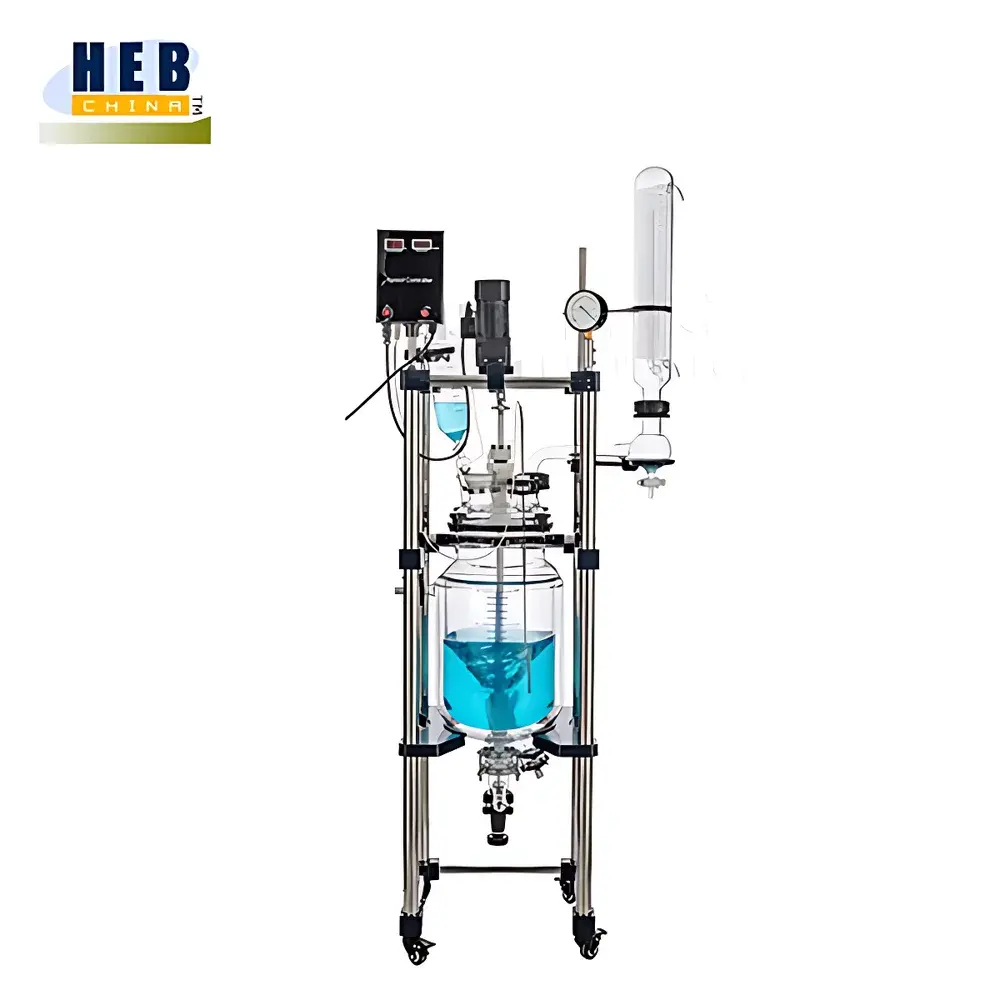
HEB-10L Dual-Jacketed Borosilicate Glass Reactor (GG-17) by Jihepu
| Key | Brand: Jihepu |
|---|---|
| Origin | Shandong, China |
| Model | HEB-10L |
| Capacity | 10 L |
| Working Pressure | Low-pressure (up to 0.098 MPa vacuum) |
| Jacket Volume | 6 L |
| Temperature Range | −80 °C to +250 °C |
| Stirring Speed | 0–450 rpm |
| Motor Power | 90 W |
| Voltage/Frequency | 220 V / 50 Hz |
| Stirrer Shaft Diameter | 12 mm |
| Discharge Port Height | 450 mm |
| Overall Dimensions (L×W×H) | 520 × 520 × 2000 mm |
| Net Weight | 68 kg |
| Material | GG-17 borosilicate glass body, stainless steel & aluminum alloy frame, PTFE-coated stirrer, ceramic bearing & mechanical seal |
Overview
The HEB-10L Dual-Jacketed Borosilicate Glass Reactor is an engineered laboratory-scale reaction system designed for controlled synthesis, distillation, reflux, concentration, and phase separation under precise thermal and mechanical conditions. Its core architecture employs a double-walled GG-17 borosilicate glass vessel — conforming to ISO 3585 specifications for high thermal shock resistance (ΔT ≥ 120 °C), low coefficient of thermal expansion (3.3 × 10⁻⁶/K), and exceptional chemical inertness against acids, alkalis, and organic solvents. The annular jacket enables external temperature regulation via circulating heat transfer fluids (e.g., silicone oil, ethylene glycol/water mixtures, or cryogenic coolants), supporting both exothermic and endothermic processes across a broad operational envelope (−80 °C to +250 °C). Integrated variable-speed stirring—driven by an explosion-proof AC motor with torque-stable output—ensures homogeneous mixing and reproducible mass/heat transfer characteristics essential for kinetic studies, catalyst screening, and scalable process development.
Key Features
- GG-17 glass reactor body (DIN/ISO-compliant) with full optical transparency for real-time visual monitoring of reaction progress, phase separation, crystallization, or emulsion formation.
- Robust structural frame combining 304 stainless steel load-bearing components and anodized aluminum alloy for corrosion resistance, dimensional stability, and long-term mechanical integrity in humid or solvent-rich environments.
- PTFE-sheathed stainless steel stirring shaft and impeller assembly, chemically resistant to halogenated solvents, strong acids (e.g., HNO₃, H₂SO₄), and bases (e.g., NaOH, KOH), eliminating metal ion leaching.
- Hermetic mechanical seal incorporating ceramic stationary and rotating faces with PTFE secondary sealing elements—rated for continuous operation at ≤0.098 MPa absolute vacuum and compatible with ASTM E2910-17 leak rate requirements for low-pressure reactors.
- Dual-digital display controller showing real-time stir speed (0–450 rpm) and internal bath temperature (via integrated PT100 sensor), enabling closed-loop parameter tracking during extended runs.
- Modular six-port lid configuration (standard NS29/32 or NS45/50 ground-glass joints) accommodating condensers, dropping funnels, thermometers, inert gas inlets, pH probes, or sampling valves without disassembly.
- Zero-dead-volume PTFE-lined discharge valve with inclined seat geometry ensures complete material evacuation and minimizes residue accumulation—critical for GMP-aligned batch transfers and cross-contamination control.
- Integrated casters with locking brakes facilitate safe repositioning within fume hoods or between synthesis stations while maintaining level alignment per ISO 2768-1 general tolerances.
Sample Compatibility & Compliance
The HEB-10L supports liquid-phase, slurry, and heterogeneous catalytic reactions involving organic, inorganic, and organometallic systems. It is routinely deployed in academic laboratories (ACS, RSC protocols), pilot-scale API synthesis (aligned with ICH Q5A/Q7), and polymerization trials requiring strict oxygen/moisture exclusion (via N₂ or Ar purging through dedicated inlet ports). All wetted surfaces meet USP Class VI biocompatibility criteria; the glass conforms to DIN 12331 for laboratory glassware and passes hydrolytic resistance test Type HGB per ISO 719. Vacuum performance (≤0.098 MPa absolute) satisfies ASTM D2879 for boiling point elevation measurements and low-pressure distillations. Mechanical design adheres to CE machinery directive 2006/42/EC (with appropriate risk assessment documentation available upon request).
Software & Data Management
While the base unit operates via analog/manual controls, optional digital upgrade kits support RS485 Modbus RTU communication for integration into centralized lab automation platforms (e.g., LabVantage, STARLIMS). When paired with third-party data loggers, the PT100 sensor and tachometer outputs enable time-stamped acquisition of temperature/stir speed profiles compliant with FDA 21 CFR Part 11 Annex 11 audit trail requirements. All calibration records—including stir motor linearity verification (per ISO 5725-2) and temperature probe NIST-traceable certification—are maintained in accordance with GLP principles (OECD Series No. 1, Section 5).
Applications
- Small-molecule synthesis under reflux or reduced pressure (e.g., esterifications, amidations, Suzuki couplings).
- Thermal degradation studies of polymers and battery electrolytes at elevated temperatures.
- Extraction and purification workflows using Soxhlet-compatible setups or fractional distillation trains.
- Enzymatic biotransformations requiring strict temperature control and anaerobic conditions.
- Development of nanomaterials (e.g., quantum dots, MOFs) via solvothermal routes with in situ nucleation monitoring.
- Educational demonstrations of reaction kinetics, vapor–liquid equilibrium, and heat transfer fundamentals.
FAQ
What is the maximum allowable working pressure for this reactor?
The HEB-10L is rated for low-pressure operation only, with a maximum vacuum rating of 0.098 MPa absolute (≈20 mbar). It is not designed for positive pressure applications beyond atmospheric.
Can the reactor be used with aggressive fluorinated solvents such as HFIP or DCM?
Yes—the GG-17 glass body and PTFE-sealed joints exhibit excellent resistance to chlorinated and fluorinated hydrocarbons. However, prolonged exposure to anhydrous HF or molten alkali metals must be avoided.
Is the PT100 temperature probe calibrated and traceable to NIST standards?
The factory-installed PT100 sensor is supplied with a certificate of conformance. Optional NIST-traceable calibration (±0.1 °C at 25 °C and 100 °C) is available as a configurable add-on.
What cooling/heating circulators are compatible with the jacket ports?
The 16 mm quick-connect jacket ports accept standard DN15 fittings and are dimensionally compatible with Julabo, Huber, and LAUDA PRESTO series circulation baths operating across −90 °C to +250 °C.
Does the mechanical seal require periodic maintenance or lubrication?
No—this is a dry-running, non-contact ceramic face seal requiring no lubricants. Routine inspection every 500 operational hours is recommended per ISO 20816-1 vibration-based condition monitoring guidelines.



