
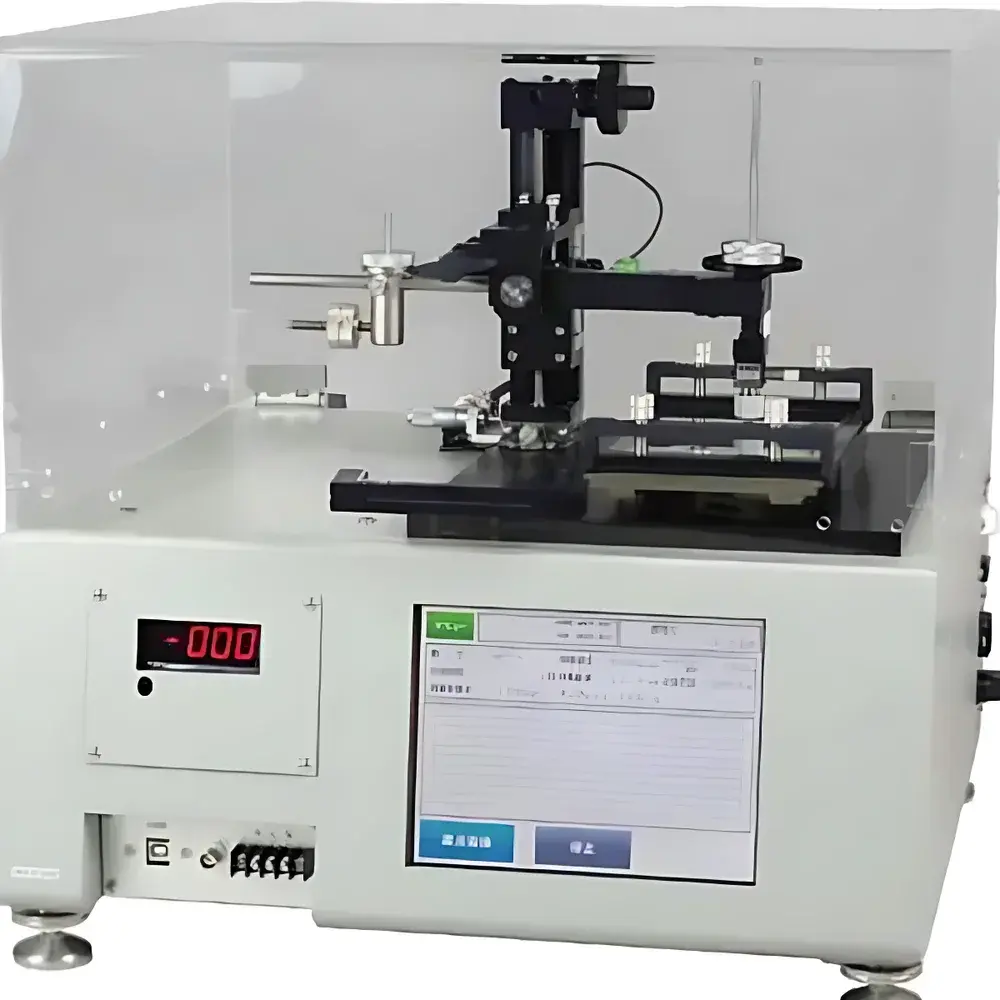
Heidon TYPE40 Reciprocating Tribological Tester
| Brand | Heidon |
|---|---|
| Origin | Japan |
| Model | TYPE40 |
| Instrument Type | Reciprocating Tribometer |
| Compliance Standards | JIS K 5600, ASTM D 1894, JIS K 7125, JIS P 8147 |
| Load Cell Capacity | 9.807 N |
| Displacement Stage | Y-axis motorized |
| Measurement Principle | Orthogonal balanced-beam friction force sensing |
| Software | Integrated tribology analysis & control platform |
| Enclosure | Large reversible acrylic lid with sealing function |
| Optional Accessories | Pencil holder (sold separately), ASTM flat-ended indenter (standard) |
Overview
The Heidon TYPE40 Reciprocating Tribological Tester is an engineered precision instrument designed for quantitative evaluation of frictional behavior, wear resistance, and surface durability under controlled reciprocating motion. It operates on the orthogonal balanced-beam principle—a mechanically decoupled force-sensing architecture that isolates lateral friction force from normal load interference, thereby delivering high reproducibility in coefficient-of-friction (COF) measurements across diverse material systems. The system is purpose-built for laboratory-scale tribological characterization of thin films, polymer coatings, paper substrates, plastic sheets, and lubricated interfaces. Its reciprocating kinematics simulate real-world sliding conditions encountered in packaging, display technologies, biomedical device surfaces, and protective coating development. Unlike rotary or pin-on-disk configurations, the TYPE40’s linear back-and-forth motion enables direct assessment of directional dependence, stick-slip phenomena, and progressive degradation mechanisms such as film delamination, micro-scratching, and transfer layer formation—all monitored in real time via analog output from the calibrated load cell.
Key Features
- Orthogonal balanced-beam transduction system for high-fidelity friction force measurement with minimized crosstalk between normal and tangential load components
- Motorized Y-axis displacement stage enabling precise positioning and repeatable stroke-length definition (adjustable from 1 mm to 100 mm)
- Integrated real-time data acquisition synchronized with motion control—friction force, cycle count, and elapsed time are continuously logged at user-defined sampling intervals
- Large reversible acrylic enclosure providing optical access, environmental containment, and operator safety during testing
- Modular test head design accommodating interchangeable indenters—including standard ASTM flat-ended probe and optional pencil-holder fixture for hardness-related abrasion protocols
- Calibrated 9.807 N (1 kgf) load cell with analog output scaled to 5.00 V ±0.03 V at full scale, traceable to NIST-equivalent reference standards
Sample Compatibility & Compliance
The TYPE40 supports rigid and semi-rigid planar specimens up to 100 mm × 100 mm in footprint and ≤25 mm in thickness. It is routinely deployed for qualification testing per internationally recognized methods including ASTM D 1894 (static and kinetic COF of plastic film), JIS K 7125 (sliding resistance of plastics), JIS K 5600 (coating adhesion and abrasion resistance), and JIS P 8147 (surface friction of paper and board). Each standard specifies defined normal loads (200 g–880 g), stroke velocities (10–100 mm/min), and minimum travel distances (60–100 mm), all programmable via the instrument’s control interface. The system’s mechanical rigidity, thermal stability, and low-vibration base ensure compliance with GLP-aligned test execution—critical for QC laboratories supporting ISO/IEC 17025 accreditation or FDA-regulated product development.
Software & Data Management
The proprietary Heidon TriboControl software provides a deterministic, script-driven environment for test method definition, real-time visualization of friction force profiles, and post-test statistical analysis. Raw voltage outputs from the load cell are digitized at ≥1 kHz and converted to Newton-scale force values using factory-applied calibration coefficients stored in non-volatile memory. All acquired datasets include embedded metadata: timestamp, operator ID, sample ID, test parameters, and hardware configuration version. Audit trails record parameter changes, software updates, and calibration events—supporting 21 CFR Part 11 compliance when deployed in regulated environments. Export formats include CSV, MATLAB (.mat), and PDF report templates aligned with internal SOPs or external regulatory submissions.
Applications
- Quantitative ranking of anti-scratch performance in automotive clear coats and smartphone display overlays
- Evaluation of lubricity additives in inkjet media and thermal transfer ribbons
- Accelerated wear screening of biomedical polymer coatings under simulated joint articulation cycles
- Friction hysteresis analysis of pressure-sensitive adhesives during peel initiation
- Correlation of COF evolution with surface roughness (Ra/Rz) measured pre- and post-test via profilometry
- Development validation of low-friction packaging films for high-speed filling lines
FAQ
What standards does the Heidon TYPE40 support out of the box?
ASTM D 1894, JIS K 7125, and JIS K 5600 test configurations are pre-programmed in firmware; JIS P 8147 requires manual load and speed adjustment but remains fully executable.
Is the load cell calibrated and traceable?
Yes—the 9.807 N sensor is factory-calibrated against reference deadweights, with output linearity verified across 0–100% FS using Fluke 8808A digital multimeter verification per ISO 376 guidelines.
Can the system operate unattended for extended duration tests?
Yes—cycle counting logic triggers automatic test termination upon reaching user-defined thresholds (e.g., COF increase >15% or abrupt drop indicating coating failure), with event logging preserved in non-volatile memory.
What maintenance is required for long-term accuracy?
Annual verification of beam alignment and load cell zero-drift is recommended; no routine lubrication or mechanical recalibration is needed due to the passive, frictionless flexure design of the balanced-beam mechanism.
Is third-party software integration supported?
The instrument provides RS-232 and USB CDC virtual COM port interfaces, enabling direct command-line control and data streaming into LabVIEW, Python (PySerial), or MATLAB environments via ASCII protocol documentation supplied with the system.



