
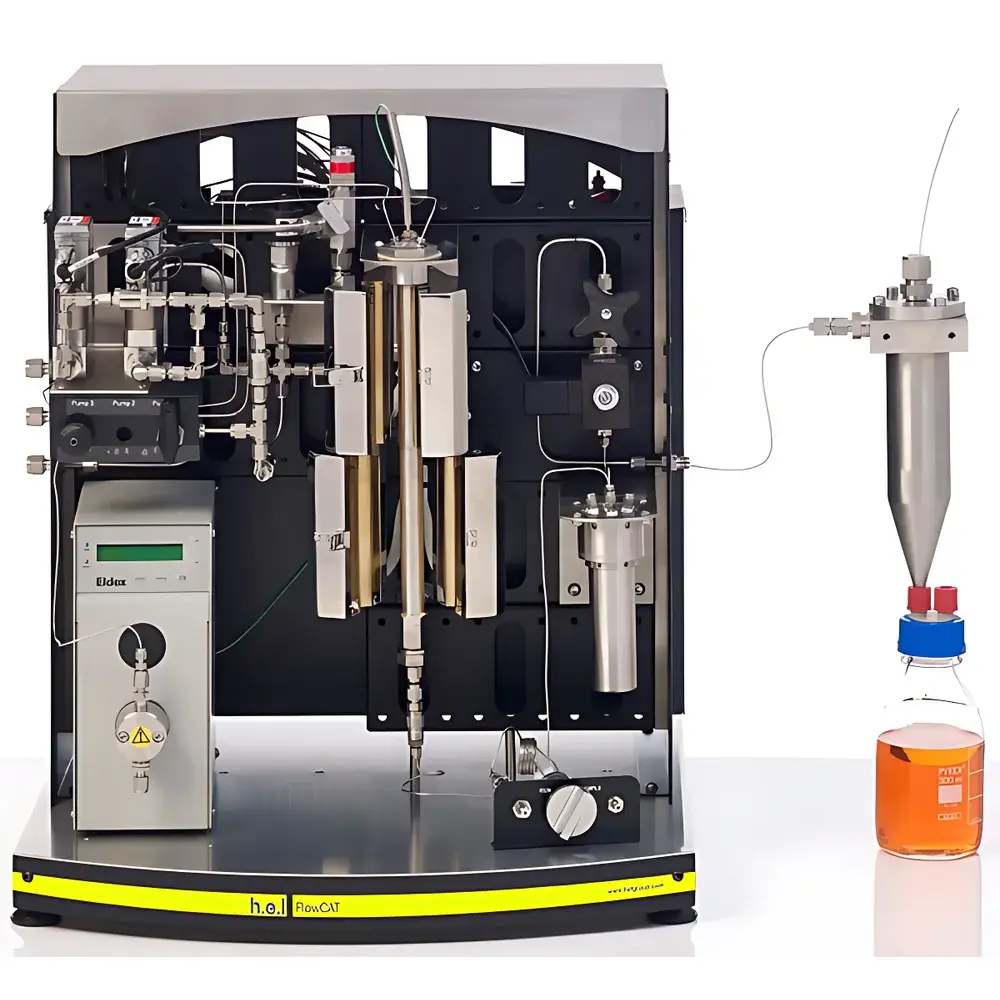
HEL FlowCAT & FlowCAT Custom Automated High-Pressure Catalyst Screening Platform
| Brand | HEL |
|---|---|
| Origin | United Kingdom |
| Model | FlowCAT & FlowCAT Custom |
| Operating Pressure | 200 bar |
| Operating Temperature | 550 °C |
| Catalyst Bed Volume | 30 mL |
| Reactor Materials | 316 Stainless Steel or Hastelloy |
| Standard Reactor Internal Diameter | 6 mm (¼") or 12 mm (½") |
| Active Heating Zone Length | 10 cm |
| Liquid Feed Rate Range | 0.001–10 mL/min or 0.01–50 mL/min |
| Gas Feed Control | Mass Flow Controllers (e.g., H₂) |
| Flow Modes | Trickle-Bed, Bubble-Column, Fixed-Bed Continuous Flow |
| Optional Configurations | Single or Parallel Reactor Systems |
| Compliance | Designed for GLP/GMP-aligned operation with audit-trail-capable software |
Overview
The HEL FlowCAT and FlowCAT Custom are fully integrated, automated high-pressure continuous-flow catalyst screening platforms engineered for rigorous kinetic evaluation, reaction optimization, and catalyst validation under industrially relevant process conditions. Based on fixed-bed and trickle-bed reactor principles, the system implements precise Couette-type flow dynamics and controlled mass/heat transfer regimes to replicate real-world catalytic process environments—including hydrogenation, oxidation, carbonylation, polymerization, Fischer–Tropsch synthesis, and biofuel upgrading. Its core architecture supports both single-reactor method development and parallel multi-reactor throughput expansion, enabling systematic variation of temperature (up to 550 °C), pressure (up to 200 bar), residence time, feed composition, and catalyst loading—while maintaining strict reproducibility across hundreds of sequential experimental runs.
Key Features
- Automated high-pressure liquid and gas dosing via calibrated mass flow controllers (MFCs) and precision syringe pumps, supporting simultaneous multi-component feed with programmable stoichiometric ratios.
- Modular reactor assembly with interchangeable configurations: standard tubular fixed-bed (6 mm or 12 mm ID), trickle-bed, and bubble-column variants; active heating zone precisely maintained over 10 cm with external heat tracing and optional cooling jacket integration.
- Real-time method editing capability—users may adjust temperature ramps, pressure setpoints, feed rates, or sampling triggers during ongoing experiments without interrupting hardware operation.
- Integrated automated sampling system with timed, pressure-balanced withdrawal into sealed vials; compatible with direct injection into GC, GC-MS, HPLC, or IC systems via standardized interfaces.
- Robust mechanical construction using ASTM-certified 316 stainless steel or Hastelloy C-276 reactors, rated for long-term exposure to corrosive feeds (e.g., H₂S, Cl⁻, organic acids) at elevated T/P.
- Full digital logging of all process parameters (T, P, flow rates, valve states, thermocouple readings) with timestamped metadata, compliant with 21 CFR Part 11 requirements when configured with electronic signature modules.
Sample Compatibility & Compliance
The FlowCAT platform accommodates heterogeneous catalysts (pellets, extrudates, monoliths) and homogeneous catalytic systems (dissolved metal complexes, ionic liquids) within defined bed volumes (2–30 mL). Reactor geometry and internal surface finish are optimized to minimize wall effects and ensure plug-flow behavior validated per ISO 10428 and ASTM D7213 guidelines for catalytic testing. All fluid-contact components meet ASME B31.3 process piping standards for high-pressure service. System design supports compliance with laboratory quality frameworks including ISO/IEC 17025, GLP (OECD Series 1998), and GMP Annex 11 when paired with validated software configurations and change-controlled documentation packages.
Software & Data Management
Control and data acquisition are managed through HEL’s proprietary ReactionLab™ software, a Windows-based platform featuring intuitive workflow scripting, dynamic method sequencing, and integrated chromatographic data overlay (via vendor-neutral .cdf or .uoi import). The software provides full audit trail functionality—including user login tracking, parameter modification history, and electronic signature support—meeting FDA 21 CFR Part 11 and EU Annex 11 expectations. Raw sensor data is stored in HDF5 format for traceability, while processed outputs (conversion, selectivity, TOF) are exportable to CSV, Excel, or MATLAB for multivariate analysis. Remote monitoring and secure cloud backup options are available via optional HEL Connect™ gateway modules.
Applications
- Accelerated screening of novel heterogeneous catalysts for low-temperature hydrogenation of nitroarenes or unsaturated fatty acids.
- Residence time distribution (RTD) studies and kinetic modeling of exothermic oxidation reactions under autothermal conditions.
- Stability assessment of supported Ni-, Co-, or Fe-based Fischer–Tropsch catalysts under syngas (H₂/CO) at 220–300 °C and 20–50 bar.
- Optimization of trickle-bed hydrodesulfurization (HDS) performance using CoMo/Al₂O₃ under simulated refinery feedstock conditions.
- Quantitative structure–activity relationship (QSAR) development for ligand-modified Rh complexes in asymmetric hydroformylation.
- Scale-up parameter derivation—including space velocity (LHSV/GHSV), activation energy, and deactivation rate constants—for transition from lab-scale screening to pilot-plant demonstration.
FAQ
What reactor materials are available for corrosive reaction environments?
Standard reactors are constructed from 316 stainless steel; Hastelloy C-276 is available as an option for applications involving halides, strong acids, or sulfur-containing feeds.
Can the system operate in true continuous mode with product removal and catalyst regeneration cycles?
Yes—the FlowCAT supports uninterrupted continuous-flow operation with integrated quench loops, back-pressure regulation, and optional in-line separators; catalyst regeneration protocols (e.g., oxidative burn-off) can be scheduled via custom method scripts.
Is third-party analytical instrument integration (e.g., Agilent GC, Waters UPLC) supported out-of-the-box?
All major chromatography data systems (CDS) are supported via standard Ethernet or RS-232 communication; HEL provides documented API libraries and driver templates for seamless synchronization.
How is temperature uniformity verified across the active reaction zone?
Each reactor is factory-calibrated using embedded multi-point thermocouples; users receive a NIST-traceable thermal profile report confirming ±1.5 °C axial uniformity over the 10 cm hot zone at maximum operating temperature.
Does the platform support DOE (Design of Experiments) workflows?
ReactionLab™ includes built-in DOE module compatibility with JMP, Design-Expert, and Python-based statsmodels libraries—enabling automated execution of fractional factorial, central composite, or D-optimal experimental designs.



