
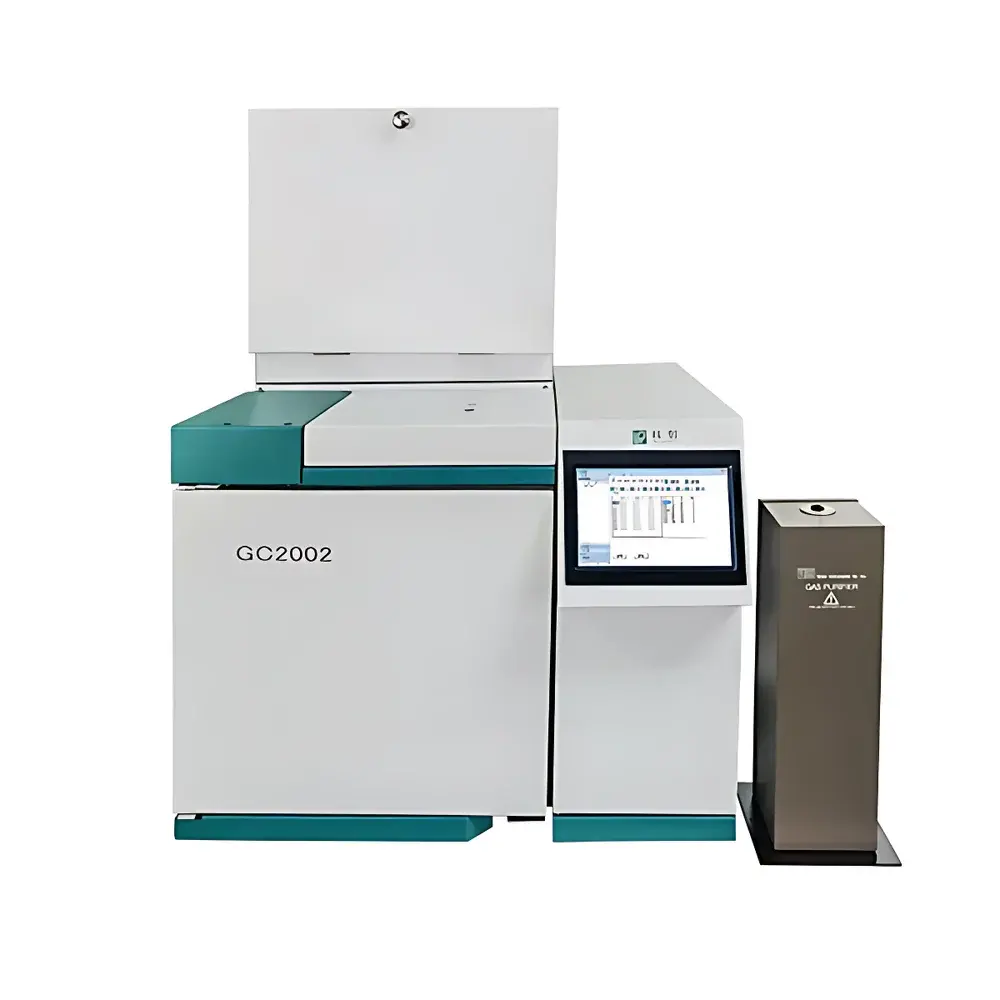
Helium Ionization Detector (HID) Gas Chromatograph for Trace Krypton and Xenon Analysis
| Brand | Kechuang |
|---|---|
| Model | GC2002 |
| Detector Type | Pulsed Discharge Helium Ionization Detector (PDHID) |
| Configuration | Laboratory-Scale Gas Chromatograph |
| Origin | Shanghai, China |
| Intended Use | Universal gas-phase trace noble gas analysis |
| Compliance | Designed for ISO 17025-compliant laboratories |
| Detection Capability | Sub-ppm quantification of Kr and Xe in multi-component gas matrices |
| Carrier Gas | High-purity helium (≥99.999%) |
| Column Compatibility | Capillary columns with porous layer open tubular (PLOT) or molecular sieve stationary phases |
| Operating Temperature Range | Oven: 30–250 °C |
| Detector | 150–350 °C |
| Data Acquisition | Digital signal processing with 24-bit ADC resolution |
| Software Interface | PC-based chromatography data system (CDS) with audit trail and electronic signature support per FDA 21 CFR Part 11 |
Overview
The GC2002 is a laboratory-grade gas chromatograph engineered specifically for high-sensitivity detection and quantification of trace noble gases—particularly krypton (Kr) and xenon (Xe)—in complex gaseous mixtures. Unlike conventional thermal conductivity (TCD) or flame ionization (FID) detectors, the GC2002 integrates a pulsed discharge helium ionization detector (PDHID), which operates on the principle of metastable helium atom-induced ionization. In this mode, high-energy helium metastables (He*) collide with analyte molecules possessing ionization potentials below ~24.6 eV—enabling efficient, non-destructive ionization of Kr (IP = 13.99 eV) and Xe (IP = 12.13 eV) while remaining inert toward common matrix gases such as O₂, N₂, CH₄, and CO₂. This selective ionization yields exceptional signal-to-noise ratios and enables reliable detection at sub-parts-per-trillion (ppt) levels under optimized conditions. The instrument is configured for routine operation in environmental monitoring labs, nuclear fuel cycle facilities, rare gas purification plants, and metrology institutes requiring trace-level Kr/Xe characterization in air, stack emissions, cryogenic distillation streams, or geological gas samples.
Key Features
- Integrated PDHID with stable helium plasma generation and low-background noise design, achieving baseline stability <0.5 pA over 8-hour continuous operation
- Programmable temperature-controlled oven with ±0.1 °C isothermal precision and ramp rates from 0.1 to 40 °C/min
- Dual independent detector ports supporting simultaneous PDHID and optional TCD or ECD configurations for method flexibility
- Robust pneumatic control system with electronic pressure/flow regulation (EPC/EFC) for carrier and makeup gas streams
- Modular column compartment accommodating up to two 30–60 m capillary columns or packed PLOT columns with backflush capability
- Compliance-ready architecture: firmware and software support GLP/GMP workflows, including user access levels, method validation logs, and raw data immutability
Sample Compatibility & Compliance
The GC2002 accepts gaseous samples delivered via gas-tight syringes, automated gas sampling valves (e.g., 10-port Valco valves), or direct line integration with process streams using heated transfer lines. It demonstrates quantitative linearity (R² > 0.9998) across Kr and Xe concentration ranges from 10 ppt to 100 ppm when calibrated against NIST-traceable standard gas mixtures. The system meets analytical requirements specified in ASTM D1945 (Analysis of Natural Gas by Gas Chromatography), ISO 6974-2 (Natural gas — Determination of composition — Part 2: Gas-chromatographic method for nitrogen, carbon dioxide and hydrocarbons up to C₅), and supports validation protocols aligned with USP Analytical Instrument Qualification. All hardware and software components are designed for compatibility with ISO/IEC 17025:2017 accreditation requirements, including documented instrument performance verification (IPV), system suitability testing (SST), and calibration traceability to SI units.
Software & Data Management
The GC2002 is operated via a Windows-based Chromatography Data System (CDS) compliant with FDA 21 CFR Part 11. The software provides full audit trail functionality—including timestamped records of method edits, integration parameter changes, and reprocessing events—with role-based electronic signatures. Raw chromatographic data are stored in vendor-neutral .cdf format (Anders’ format), ensuring long-term readability and third-party software interoperability. Peak identification and quantitation leverage retention time locking (RTL) and spectral deconvolution algorithms to resolve co-eluting Kr/Xe peaks in mixed noble gas standards. Automated report generation includes ICH M4-compliant summary tables, calibration curves, precision/repeatability statistics (RSD ≤ 1.2% for Kr at 1 ppm), and uncertainty budgets per GUM (JCGM 100:2008).
Applications
- Quantitative analysis of Kr-85 and Xe-133 in nuclear facility stack emissions for regulatory reporting (EPA Method IP-1A)
- High-purity argon/xenon production QC: detection of Kr impurities at ≤50 ppt in semiconductor-grade feedstock gases
- Geological fluid studies: Kr/Xe isotopic ratio pre-concentration support prior to MC-ICP-MS analysis
- Leak detection in ultra-high-vacuum systems using Kr tracer gas and PDHID response mapping
- Atmospheric science: measurement of anthropogenic Kr/Xe anomalies in background air monitoring networks
- Calibration gas manufacturing: certification of Kr/Xe reference standards with certified uncertainties ≤3%
FAQ
What makes PDHID superior to TCD for Kr and Xe detection?
PDHID delivers 10³–10⁴× higher sensitivity than TCD for noble gases due to its ionization-based detection mechanism, enabling sub-ppq detection limits without cryogenic preconcentration.
Can the GC2002 analyze other noble gases like He, Ne, or Ar?
Yes—the PDHID responds to all noble gases except helium itself; however, He requires alternative detection (e.g., TCD) due to its high ionization potential (24.59 eV).
Is helium purity critical for PDHID operation?
Absolutely: impurities >1 ppm H₂O or O₂ quench metastable He* formation and degrade sensitivity; Grade 5.7 (99.9997%) He is recommended.
Does the system support unattended overnight operation?
Yes—equipped with auto-shutdown, leak detection alarms, and scheduled run sequences validated for 72-hour continuous operation.
How is detector contamination managed during long-term Kr/Xe analysis?
The PDHID features a removable, cleanable discharge cell and bake-out protocol (up to 350 °C under He purge) to restore baseline performance after extended use.





