
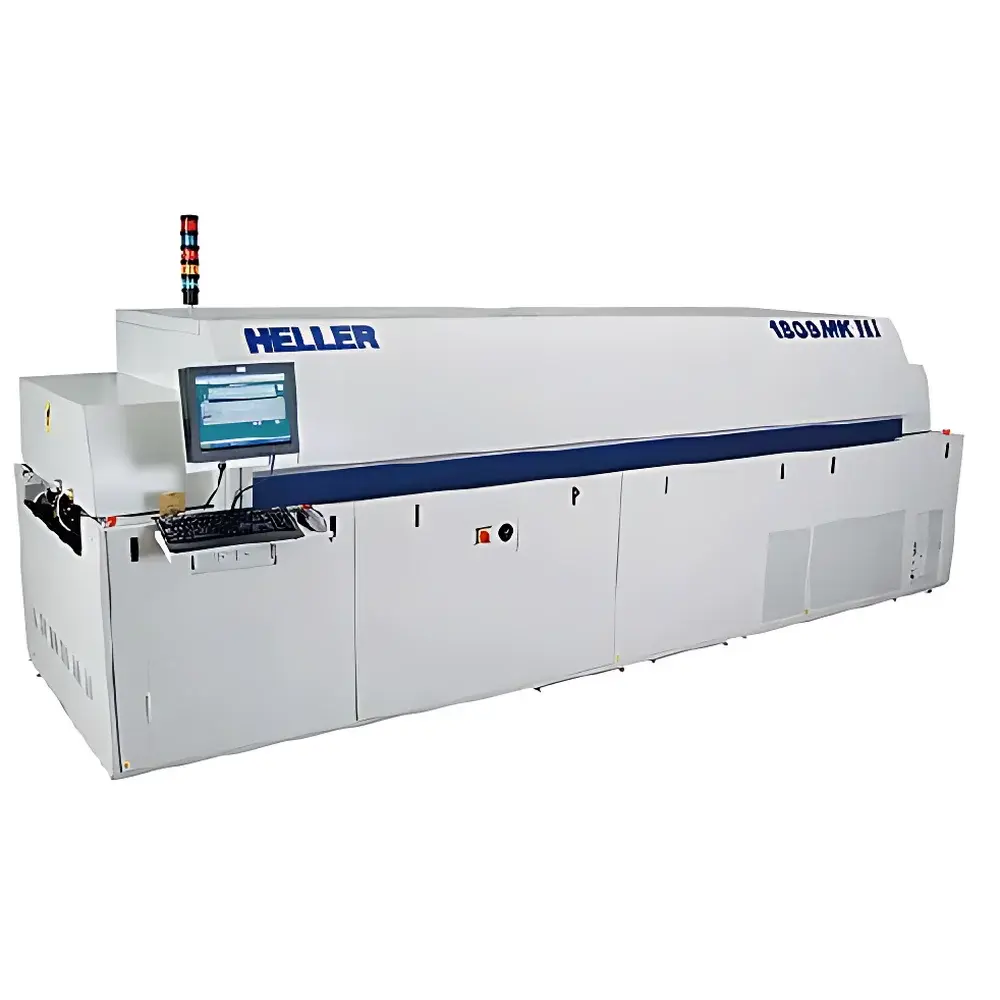
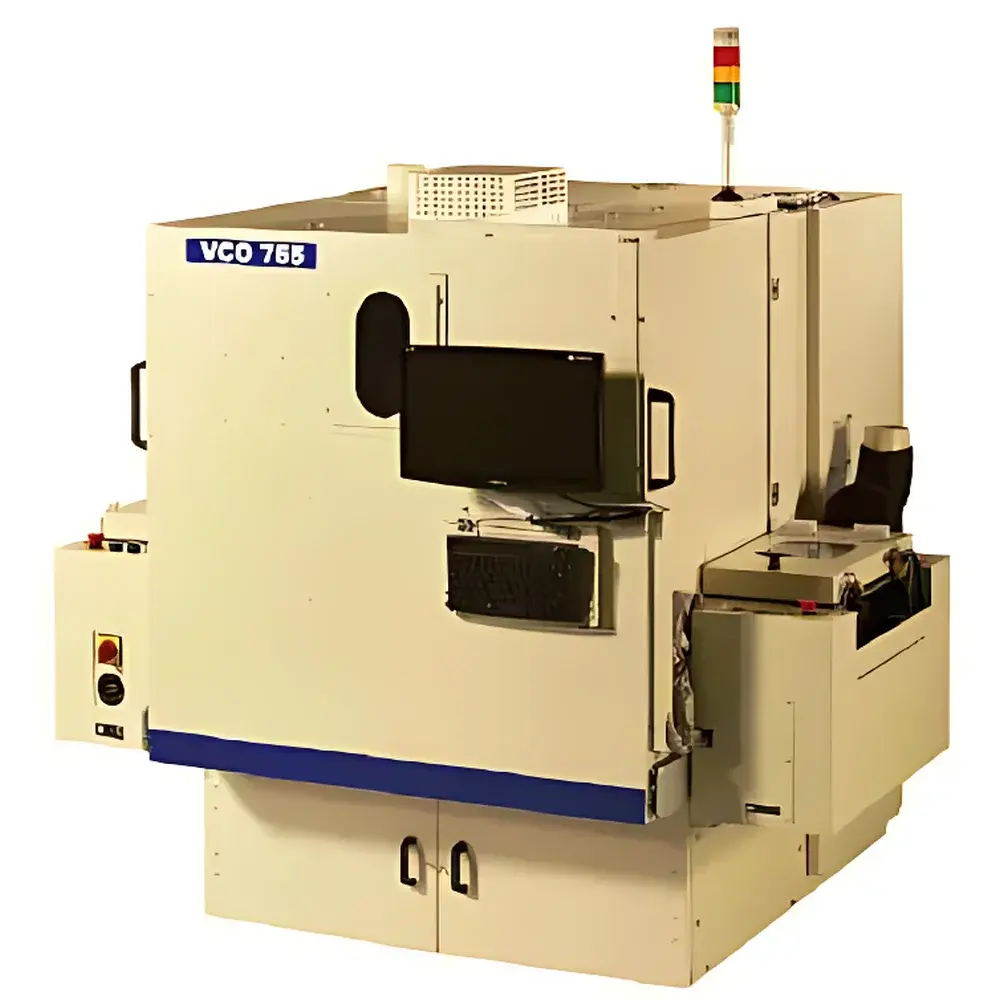

Heller Mark III Vertical Reflow & Curing Oven
| Brand | Heller |
|---|---|
| Origin | USA |
| Model | Mark III |
| Instrument Type | Box-type Reflow/Curing Oven |
| Max Temperature | 400 °C |
| Temperature Control Accuracy | ±1 °C |
| Max Power | 2500 W |
| Heating Rate to Max Temp | 15 min |
| Heating Method | Resistive Wire Heating |
| Internal Chamber Dimensions | 450 × 150 × 180 mm |
| Compliance | SMEMA-compatible |
| Cooling | Water-cooled BlowThru Module |
| Flux Recovery | Integrated Drain Tube with Collection Jar |
| Vacuum Option | Optional Vacuum Module (Model 755 compatible) |
| Nitrogen Atmosphere | Optional |
| Conveyor Width Range | 75–250 mm |
| Cycle Time Range | 7.5 min to several hours |
Overview
The Heller Mark III Vertical Reflow & Curing Oven is a precision-engineered thermal processing system designed for high-reliability surface-mount technology (SMT) reflow soldering and advanced packaging curing applications. Built upon Heller Industries’ legacy as the pioneer of forced-convection reflow technology since the 1980s, the Mark III platform integrates thermally optimized vertical architecture with modular process control to deliver repeatable, GMP-aligned thermal profiles across low-volume R&D, pilot-line production, and qualification testing environments. Unlike conventional horizontal conveyor ovens, its vertical orientation minimizes floor space while enabling uniform laminar airflow through the heated zone—critical for achieving consistent ΔT across small-area PCBs, die-attach substrates, and flip-chip assemblies. The system operates on resistive wire heating with real-time PID-controlled feedback, supporting both air and nitrogen ambient configurations (with optional N₂ purge integration), and is fully compatible with industry-standard SMEMA electrical and mechanical interfaces for seamless lab or pilot-line integration.
Key Features
- Vertical convection architecture with compact footprint (height: 185 cm) and configurable internal chamber (450 × 150 × 180 mm)
- High-stability temperature control: ±1 °C accuracy across full 30–400 °C operating range
- Energy-optimized heating module: achieves 400 °C in ≤15 minutes with peak power draw limited to 2500 W
- Water-cooled BlowThru cooling module with adjustable ramp rate and hold capability
- Integrated, maintenance-free flux recovery system featuring drain tube and sealed collection jar—enabling continuous operation without process interruption
- Optional vacuum-assisted reflow module (compatible with Model 755 interface) reduces voiding by >99% in high-reliability solder joints (e.g., SnAgCu, AuSn)
- Intuitive touchscreen HMI with embedded CPK statistical process control software for real-time thermal profile validation and SPC reporting
- Modular heater core design allows field-replaceable heating elements without oven disassembly
Sample Compatibility & Compliance
The Mark III supports a broad spectrum of substrate geometries and material systems common in microelectronics packaging labs, including FR-4, polyimide, ceramic, silicon interposers, and flexible circuits. Its variable conveyor width (75–250 mm) and programmable dwell time (7.5 min to multi-hour cycles) accommodate die attach, underfill cure, COB encapsulation, and flip-chip reflow processes per IPC-J-STD-020, IPC-7095, and JEDEC JESD22-A108 standards. The system meets UL 61010-1 and CE machinery directive requirements. Optional nitrogen atmosphere operation complies with IPC-A-610 Class 3 and MIL-STD-2000A moisture sensitivity level (MSL) handling protocols. All firmware logs—including temperature setpoints, actual readings, alarm events, and user actions—are timestamped and exportable for GLP/GMP audit trails; optional 21 CFR Part 11-compliant electronic signature module available upon request.
Software & Data Management
The embedded CPK software provides real-time thermal profiling, statistical process capability analysis (Cp, Cpk, Pp, Ppk), and automated report generation in PDF/CSV formats. Profiles are stored with metadata (operator ID, date/time, recipe name, chamber ID) and support version-controlled recipe libraries. Data export interfaces include USB 2.0 and Ethernet TCP/IP (Modbus TCP and HTTP REST API available). Audit trail functionality records all parameter changes, calibration events, and user logins with immutable timestamps—fully traceable for ISO 9001:2015 and IATF 16949 quality system compliance. Firmware updates are performed via secure signed package installation with rollback capability.
Applications
- Low-volume SMT reflow qualification and DOE studies for lead-free (SAC305, SAC405) and high-melting-point alloys (AuSn, SnSb)
- Die-attach epoxy and silver-sinter curing under inert or vacuum conditions
- Flip-chip underfill polymerization with precise Tg ramp control
- COB (chip-on-board) glob-top encapsulation with controlled post-cure dwell
- Reliability test sample preparation requiring repeatable thermal stress cycling
- Materials research involving thermal degradation kinetics of adhesives, underfills, and molding compounds
FAQ
Is the Mark III certified for use in regulated environments (e.g., medical device manufacturing)?
Yes—the base configuration meets UL 61010-1 and CE requirements. With optional 21 CFR Part 11 firmware and audit-trail logging enabled, it supports FDA-regulated R&D and pilot-scale production under QSR guidelines.
Can the vacuum module be retrofitted to an existing Mark III unit?
Yes—vacuum integration uses standardized mechanical and pneumatic interfaces aligned with Heller’s Model 755 vacuum subsystem; retrofit requires factory calibration and firmware update.
What is the expected mean time between maintenance (MTBM) for the flux recovery system?
The sealed collection jar and passive separation design enables ≥6 months of uninterrupted operation under typical lab usage (≤8 hrs/day, moderate flux load); jar replacement is tool-free and takes <90 seconds.
Does the system support custom thermal profile scripting beyond preset templates?
Yes—users may define up to 99-zone profiles with independent ramp rates, soak times, and cooling parameters via the HMI or exported CSV import.
Is nitrogen consumption monitored and logged during operation?
Yes—integrated mass flow sensor (optional add-on) feeds real-time N₂ usage data into CPK reports and supports consumption-based cost-of-ownership (CoO) analysis.



