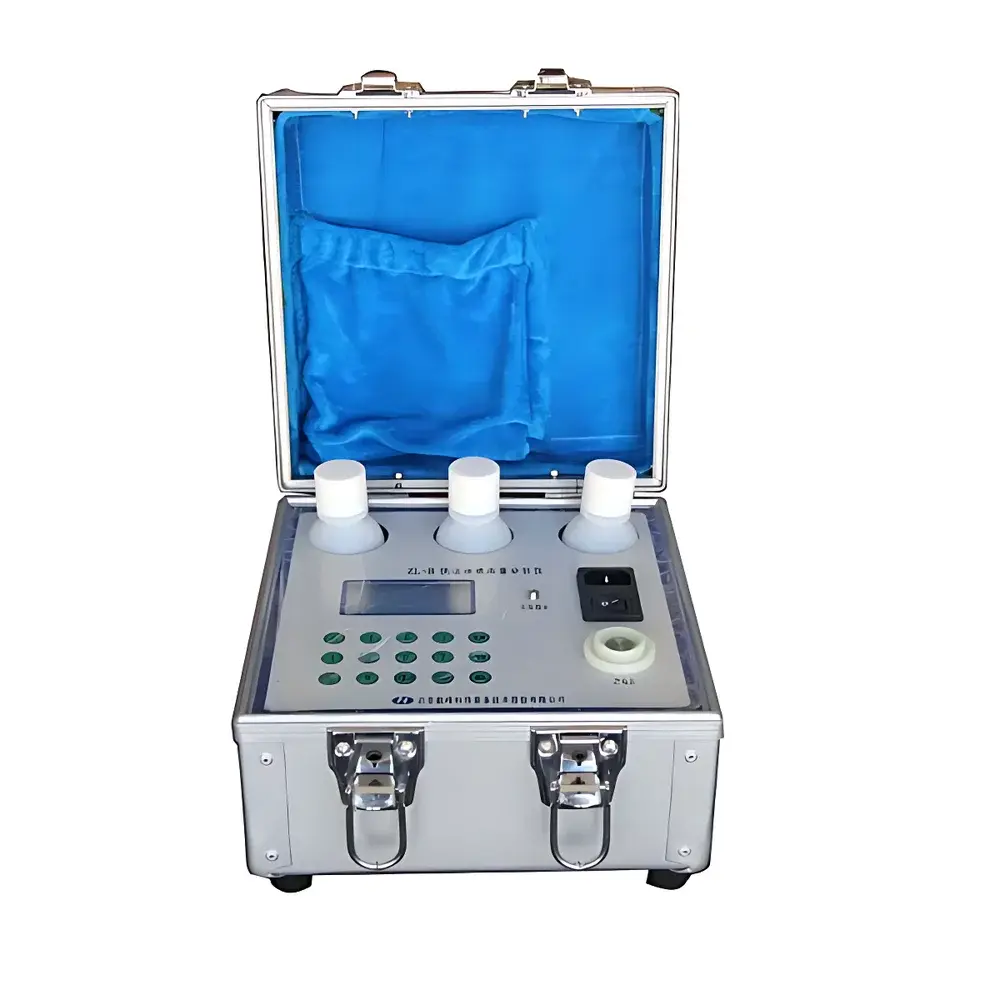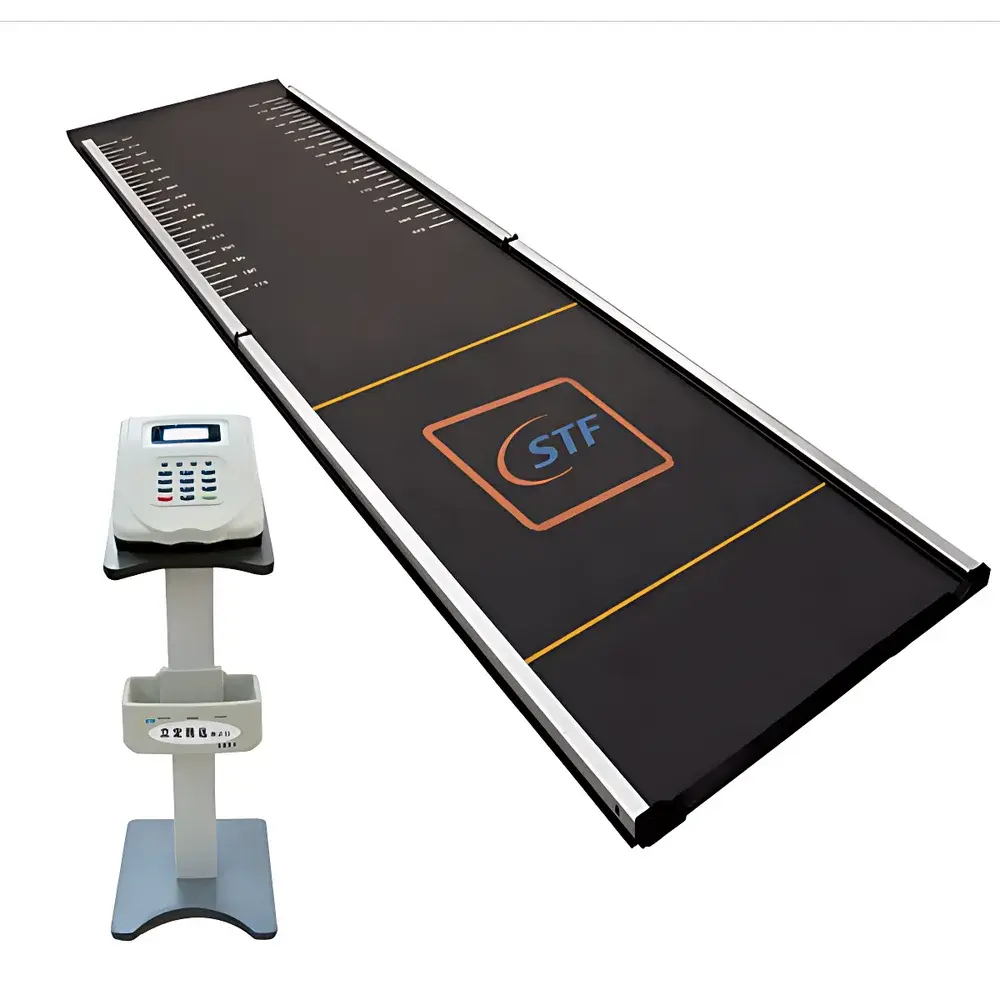
Hengao De TFB-CSTF-TY Standing Long Jump Tester
| Brand | Hengao De |
|---|---|
| Origin | Beijing, China |
| Manufacturer Type | Authorized Distributor |
| Country of Origin | China |
| Model | TFB-CSTF-TY |
| Price | USD 92 (based on ¥650 at 1:7.07 exchange rate) |
Overview
The Hengao De TFB-CSTF-TY Standing Long Jump Tester is a standardized physical fitness assessment instrument engineered for objective, repeatable measurement of lower-limb explosive power and whole-body coordination in educational, athletic, and occupational health settings. It operates on infrared photoelectric sensing principles: dual-axis infrared emitter–receiver pairs are precisely aligned across the take-off line and landing zone to detect the exact moment of foot departure and heel/toe contact. The system calculates jump distance by measuring the spatial displacement between these two synchronized events, with automatic zero-point calibration prior to each trial. Designed for compliance with national physical education testing protocols (e.g., China’s National Student Physical Health Standard), it delivers traceable, operator-independent results without manual tape measurement or subjective judgment.
Key Features
- Fault-detection logic integrated into firmware: automatically identifies and flags invalid attempts including premature take-off, double-foot landing, or backward movement — compliant with standardized test administration guidelines.
- High-sensitivity infrared detection array: 1 cm spatial resolution with ±1 cm measurement accuracy across full 90–300 cm range; response latency < 20 ms ensures temporal fidelity during rapid ballistic motion.
- Non-slip textured rubber mat surface: ASTM F1637-compliant traction coefficient (>0.5) tested under dry and damp conditions; abrasion-resistant EPDM compound rated for >10,000 test cycles.
- Sequential auto-numbering and voice-guided operation: eliminates manual log entry errors; bilingual (English/Chinese) audio prompts confirm measurement range, unit, and pass/fail status per trial.
- Robust aluminum alloy frame with powder-coated steel base: IP54-rated enclosure protects internal electronics from dust and incidental moisture; operating temperature range: 5–40 °C.
Sample Compatibility & Compliance
The TFB-CSTF-TY is validated for use with subjects aged 6–65 years across diverse anthropometric profiles. Its 300 cm maximum range accommodates elite adolescent athletes while maintaining sub-centimeter resolution at low-end jumps (e.g., pediatric or rehabilitation assessments). The device meets ISO 20488:2016 requirements for human performance measurement instrumentation — specifically clauses addressing repeatability (CV ≤ 1.2% over 20 consecutive trials), linearity (R² ≥ 0.9998 across full scale), and environmental robustness. It is CE-marked for conformity with EU Machinery Directive 2006/42/EC and RoHS 2011/65/EU. No calibration certificate is required for routine classroom use; however, annual verification against NIST-traceable length standards is recommended for institutional accreditation (e.g., NASPE, EFSSA).
Software & Data Management
Data output is via USB-C interface supporting CDC ACM serial protocol (9600 baud, 8N1). Raw measurements export as CSV files containing timestamp, subject ID (auto-incremented), jump distance (cm), validity flag (0/1), and ambient temperature/humidity (via optional external sensor integration). The embedded firmware supports GLP-aligned audit trails: all configuration changes, firmware updates, and calibration events are logged with UTC timestamps and user-accessible via diagnostic mode. No proprietary software is required; data ingestion is compatible with common LIMS platforms (e.g., LabWare, Thermo Fisher SampleManager) and statistical analysis tools (MATLAB, R, Python pandas). Exported files include MD5 checksums for data integrity verification — satisfying FDA 21 CFR Part 11 electronic record requirements when deployed with appropriate organizational controls.
Applications
- Educational Assessment: Standardized administration of national physical fitness tests in primary, secondary, and tertiary institutions; automated reporting aligns with Ministry of Education data submission templates.
- Sports Science Research: Quantitative longitudinal tracking of neuromuscular adaptation during plyometric training programs; high temporal resolution enables correlation with force plate or EMG data.
- Occupational Health Screening: Pre-employment and periodic evaluation of lower-extremity functional capacity for roles requiring dynamic mobility (e.g., firefighting, construction, military).
- Clinical Rehabilitation: Objective monitoring of recovery progress post-ACL reconstruction or stroke rehabilitation; sensitivity to 1 cm changes detects subtle improvements missed by subjective scoring.
- Epidemiological Studies: Large-scale population surveys of musculoskeletal health; ruggedized design enables field deployment in resource-limited settings with minimal maintenance.
FAQ
Does the device require annual recalibration?
No formal recalibration is mandated; however, verification against a certified 1-meter gauge block every 12 months is recommended to maintain measurement traceability per ISO/IEC 17025:2017 Clause 6.5.2.
Can it be used outdoors?
Yes — its IP54 rating permits operation in covered outdoor environments (e.g., school gymnasiums, sports fields under awnings); direct sunlight exposure must be avoided to prevent infrared interference.
Is subject height or weight input required?
No — the measurement is purely kinematic and independent of anthropometric variables; raw distance data serves as the primary outcome metric per established test protocols.
What power source does it use?
Internal rechargeable lithium-ion battery (7.4 V, 2200 mAh) providing ≥8 hours continuous operation; AC adapter (100–240 V, 50/60 Hz) included for charging.
How is data security handled during transmission?
All USB data transfers occur in plaintext mode; encryption is implemented at the host-system level per organizational IT policy — no onboard cryptographic modules are present, consistent with Class I medical device regulatory guidance (FDA Guidance for Industry, 2022).