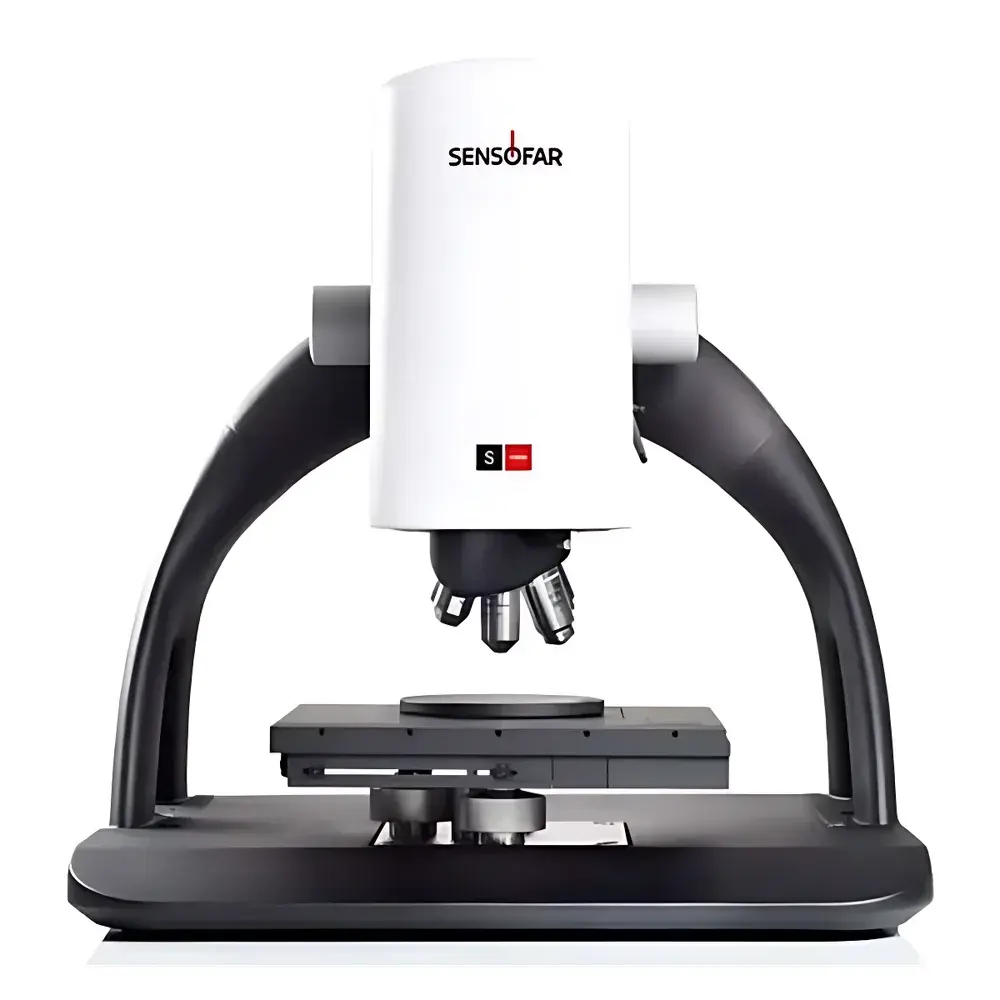
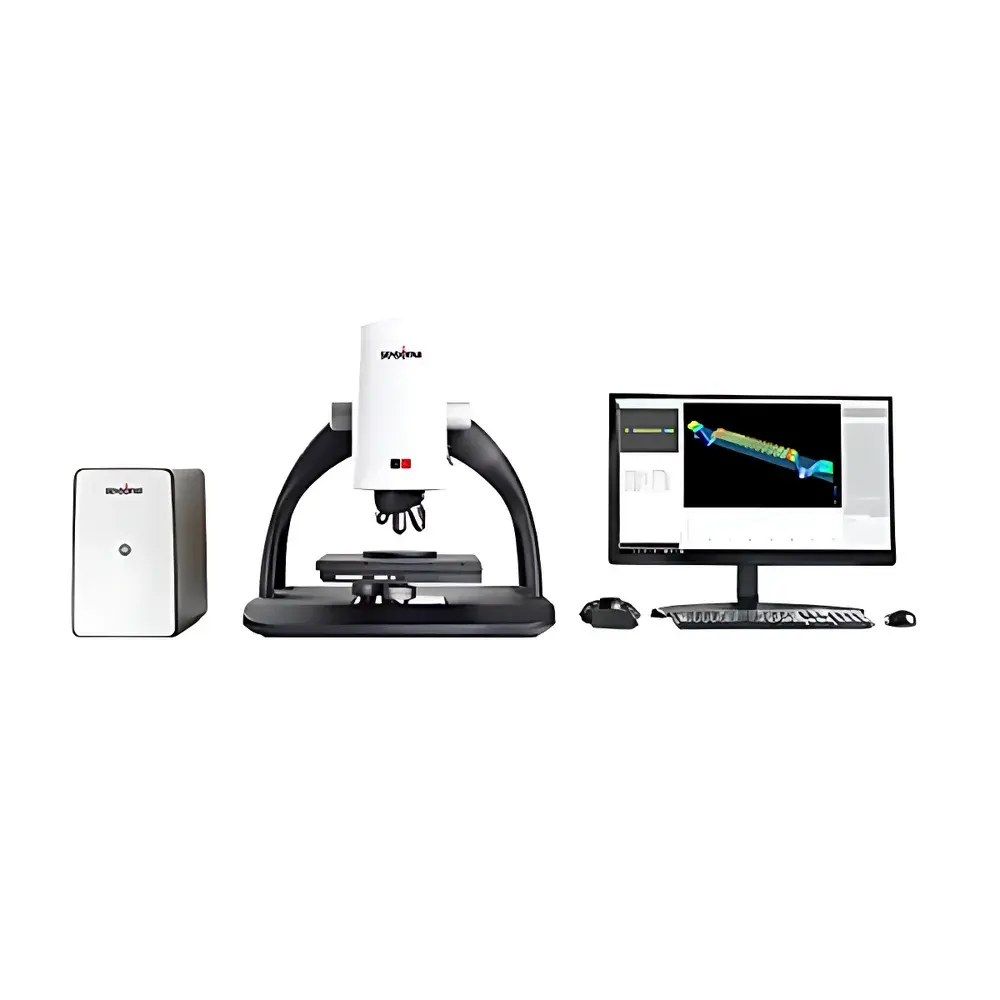
Sensofar S neox 3D Non-Contact Surface Profilometer & Roughness Analyzer
| Brand | Sensofar |
|---|---|
| Origin | Spain |
| Model | S neox |
| Measurement Principle | White-Light Interferometry (WLI) with Confocal and AI-Powered Multi-Focal Stacking |
| Product Type | Non-Contact 3D Optical Profilometer |
| Max Frame Rate | 180 fps |
| Lateral Resolution | Down to 0.14 µm |
| Vertical Repeatability | Sub-nanometer |
| Max Surface Slope | Up to 86° |
| Vertical Measurement Range | Up to several mm (configurable by objective) |
| Objective NA | Up to 0.95 |
| Max Magnification | 150× |
| Film Thickness Range | 50 nm – 1.5 µm (transparent layers) |
| Illumination | Multi-wavelength LED source (no laser speckle, 50,000 h lifetime) |
Overview
The Sensofar S neox is a high-performance, non-contact 3D optical profilometer engineered for precision surface topography and roughness analysis across R&D laboratories and industrial quality control environments. Built upon a tri-modal optical architecture—integrating white-light interferometry (WLI), confocal microscopy, and AI-enhanced multi-focal stacking—the S neox delivers adaptive measurement capability across an exceptionally broad surface regime: from ultra-smooth optics (<0.1 nm Ra) to highly structured, steep-slope engineering surfaces (up to 86°). Unlike conventional single-principle profilometers, the S neox dynamically selects the optimal acquisition modality in real time based on surface characteristics, eliminating manual mode switching and ensuring consistent metrological traceability per ISO 25178-2 and ISO 4287 standards. Its solid-state LED illumination eliminates laser speckle artifacts, ensures long-term photometric stability, and enables wavelength-selective optimization for diverse material reflectivity and transparency profiles.
Key Features
- Tri-modal optical sensing engine: Simultaneous hardware integration of white-light interferometry, confocal scanning, and AI-driven multi-focal stacking within a single sensor head.
- Real-time adaptive mode selection: One-click transition between measurement principles based on surface gradient, roughness, and optical properties—no reconfiguration required.
- High-speed acquisition: Up to 180 frames per second (fps) data capture; standard measurement throughput is 5× faster than prior-generation optical profilometers.
- Nanometric vertical repeatability: Achieved through proprietary confocal algorithms and thermally stabilized optical path design—validated under GLP-compliant calibration protocols.
- Extended slope capability: Reliable topographic reconstruction on surfaces with local inclinations up to 86°, enabled by active illumination and dynamic focus tracking.
- Multi-wavelength LED illumination: Three independently controllable LED channels (e.g., 470 nm, 530 nm, 630 nm) eliminate coherence noise and optimize signal-to-noise ratio across metallic, dielectric, and transparent substrates.
- Modular software architecture: SensoPRO platform supports role-based user permissions, audit-trail logging (21 CFR Part 11 compliant), and automated report generation with customizable templates.
Sample Compatibility & Compliance
The S neox accommodates samples ranging from 10 mm × 10 mm micro-optics to 300 mm wafers or large aerospace components (with optional motorized XY stages). It measures surfaces irrespective of material composition—including polished silicon, hardened steel, polymer coatings, biological tissues, and multilayer thin films—without risk of mechanical damage or contamination. All measurement routines comply with international standards including ISO 25178 (areal surface texture), ISO 4287 (profile roughness), ASTM E2923 (nanoscale dimensional measurements), and USP (surface characterization of pharmaceutical devices). The system supports full GMP/GLP documentation workflows, including electronic signatures, change control logs, and instrument qualification (IQ/OQ/PQ) templates.
Software & Data Management
SensoPRO v6.x provides a unified interface for acquisition, analysis, and reporting. Its modular plugin framework allows integration of custom algorithms (e.g., defect classification, grain boundary detection) via Python API. Raw interferograms and confocal stacks are stored in vendor-neutral HDF5 format with embedded metadata (timestamp, objective ID, environmental conditions). Batch processing pipelines support automated pass/fail evaluation against user-defined tolerance zones. Data export options include ISO-standardized .sdf files, CSV matrices, and PDF/HTML reports with embedded 3D renderings, cross-sections, and statistical summaries (Sa, Sq, Sz, Sdr, etc.). Audit trails record every parameter change, operator login, and report generation event—fully compliant with FDA 21 CFR Part 11 requirements.
Applications
- Aerospace & Automotive: Blade tip clearance mapping, turbine vane roughness validation, brake disc wear profiling, and EV battery electrode surface uniformity assessment.
- Medical Devices: Quantitative verification of micro-textured implant surfaces (e.g., dental abutments, orthopedic scaffolds) per ISO 14644 and ISO 10993-1.
- Semiconductors & Optics: Critical dimension (CD) metrology on EUV masks, aspheric lens form error analysis, and anti-reflective coating thickness mapping.
- Consumer Electronics: Haptic surface texture certification for smartphone glass, fingerprint sensor cavity depth verification, and foldable display hinge wear simulation.
- Academic Research: In situ corrosion evolution studies, additive manufacturing layer fidelity quantification, and biomimetic surface replication fidelity analysis.
FAQ
What surface roughness parameters does the S neox calculate in compliance with ISO 25178?
The system computes all primary areal parameters (Sa, Sq, Sz, Ssk, Sku, Sdr, Vmp, Vmc, etc.) and secondary functional parameters (Spk, Sk, Svk) directly from calibrated 3D topography data—traceable to NIST SRM 2134c.
Can the S neox measure transparent thin films without sample preparation?
Yes. Using spectral reflectometry mode, it determines film thickness (50 nm–1.5 µm) and refractive index of single- or multi-layer dielectrics on silicon, glass, or metal substrates—non-destructively and without etching or sputtering.
Is the system suitable for 24/7 automated QC deployment?
Absolutely. With programmable measurement sequences, barcode-triggered job loading, and remote monitoring via REST API, the S neox operates unattended in production-line environments under validated SOPs.
How does AI-powered multi-focal stacking improve measurement of high-slope surfaces?
It combines real-time focus variation with adaptive illumination intensity and z-step prediction algorithms—enabling robust height reconstruction on surfaces where conventional WLI fails due to coherence loss or shadowing.
What calibration standards are supported for routine verification?
NIST-traceable step-height standards (e.g., Veeco TG series), roughness standards (ISO 25178 reference specimens), and certified flatness references (e.g., Zygo PZ-300) are fully integrated into the calibration workflow with auto-recognition and drift compensation.