
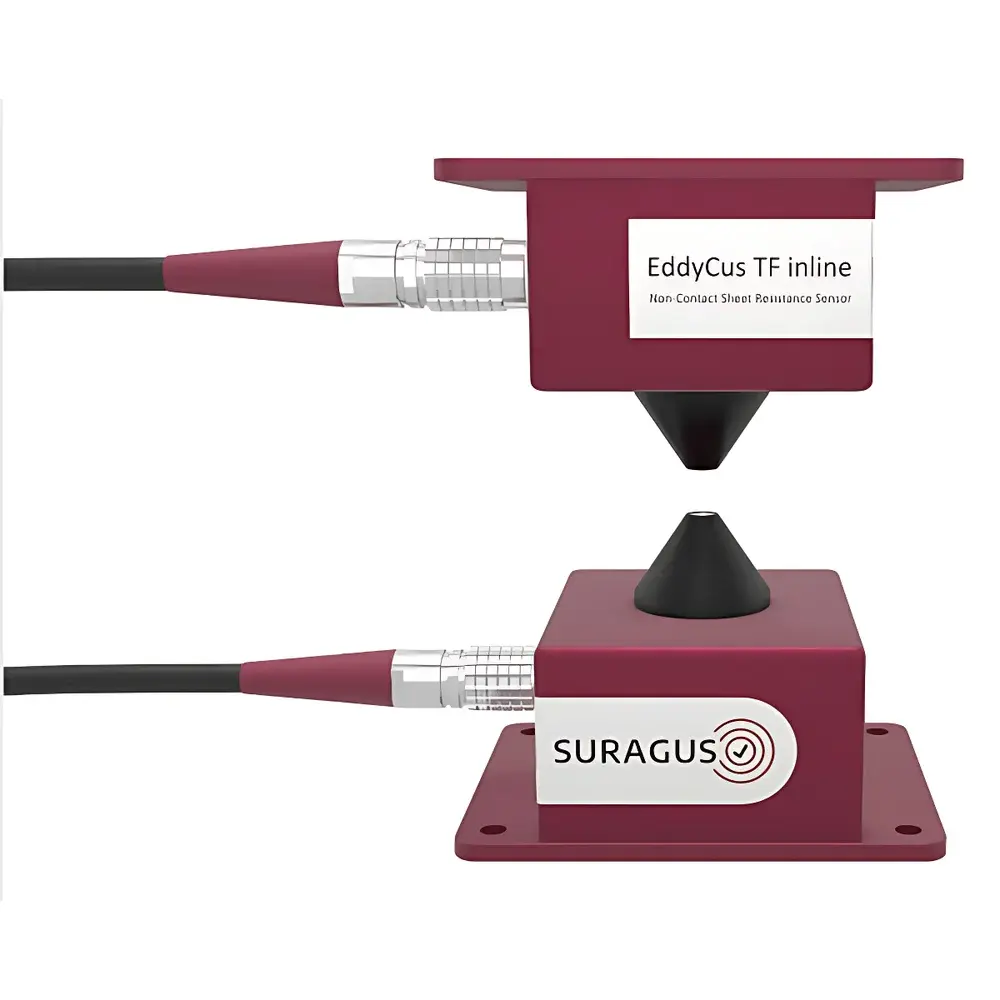
SURAGUS EddyCus TF inline Online Sheet Resistance and Thin-Film Thickness Metrology System
| Brand | SURAGUS |
|---|---|
| Origin | Germany |
| Model | EddyCus TF inline |
| Measurement Principle | Non-contact eddy current metrology |
| Sample Environment | In-air and vacuum-compatible (up to 90 °C) |
| Sensor Configurations | Single- to 99-channel modular array |
| Sampling Rate | Up to 1000 Hz |
| Output Interfaces | UDP, TCP, Modbus, .NET libraries, analog/digital I/O |
| Thickness Range (metallic layers) | 2 nm – 2 mm |
| Sheet Resistance Range | 0.0001 – 100,000 Ω/□ (with accuracy 2–8% depending on range) |
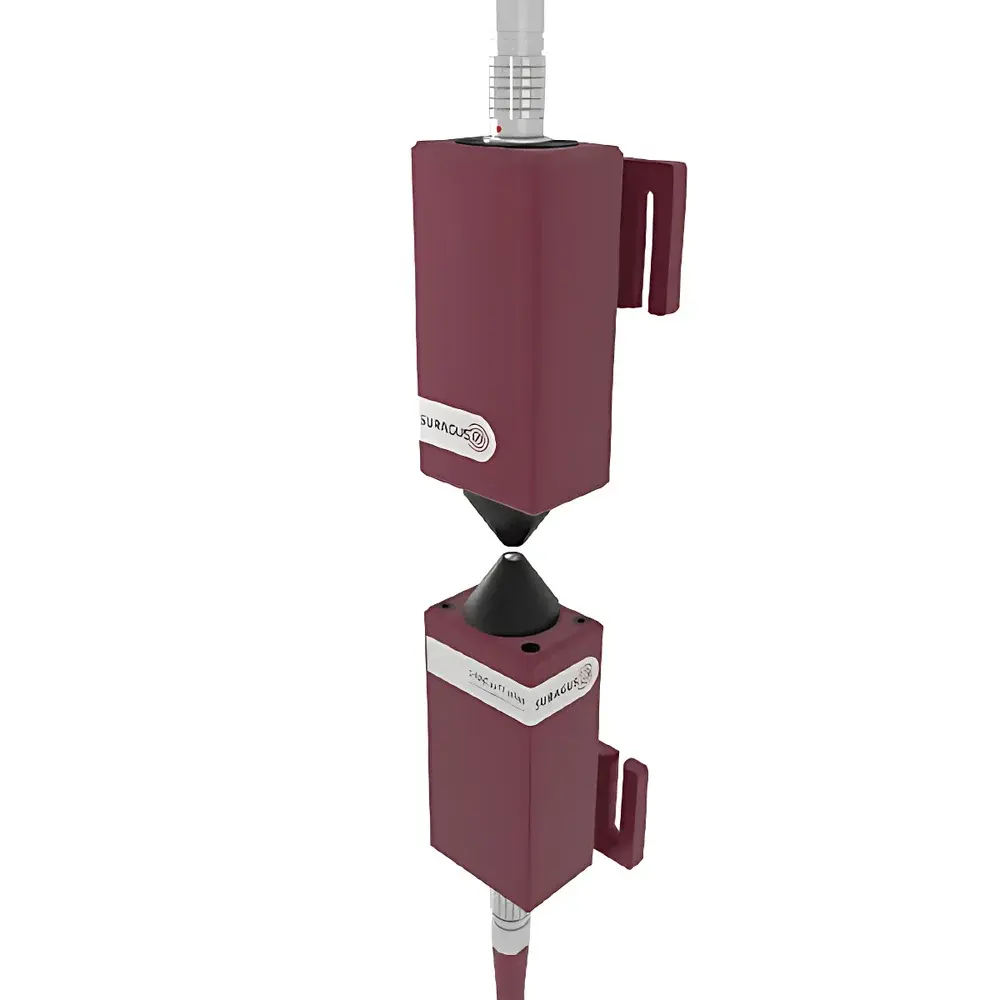
| Sensor Options | M-type (80 × 100 × 66 mm), S-type (34 × 48 × 117 mm) |
| Gap Distance | 5 / 10 / 15 / 25 / 50 / 75 mm |
| Compliance | Designed for ISO/IEC 17025-aligned calibration workflows |
Overview
The SURAGUS EddyCus TF inline is a high-precision, non-contact metrology system engineered for real-time, in-line monitoring of sheet resistance (Rs) and metallic thin-film thickness during continuous manufacturing processes. Based on calibrated eddy current induction principles, the system measures changes in electromagnetic coupling between a high-frequency sensor coil and conductive layers deposited on non-conductive or semi-conductive substrates—including glass, polymer foils, silicon wafers, and flexible films. Unlike optical or four-point probe methods, eddy current metrology requires no physical contact, eliminates wear-related drift, and operates reliably under varying ambient conditions—including controlled vacuum environments (<90 °C). Its dual-parameter capability—simultaneous Rs and thickness derivation—enables closed-loop process control in roll-to-roll (R2R), sputtering, evaporation, and inkjet-printed electronics lines. The system is not a generic thickness gauge; it is a physics-based resistivity-thickness correlator optimized for conductive thin films where electrical performance directly governs functional behavior.
Key Features
- Real-time, non-contact measurement at up to 1000 Hz sampling rate—enabling sub-millimeter spatial resolution along moving webs or conveyor paths
- Modular sensor architecture supporting single-point validation or multi-zone line-scan configurations (1–99 independent channels)
- Vacuum-rated variants available for integration into PVD/CVD cluster tools, with thermal stability certified up to 90 °C
- Configurable gap distances (5–75 mm) accommodate diverse substrate geometries—from rigid 200 mm wafers to low-tension polymer webs
- Multi-range Rs calibration modes: high-sensitivity (0.0001–10 Ω/□), standard (0.01–1,000 Ω/□), and high-resistivity (10–100,000 Ω/□), each with traceable accuracy specifications
- Simultaneous estimation of metal layer thickness (e.g., Al, Ag, Mo, Ag paste) from Rs and bulk conductivity assumptions—validated against XRF and cross-sectional SEM references
- Industrial-grade I/O suite including UDP/TCP sockets, Modbus RTU/TCP, programmable .NET libraries, and isolated analog/digital triggers for PLC synchronization
Sample Compatibility & Compliance
The EddyCus TF inline is validated for use across a broad spectrum of conductive thin-film systems: sputtered ITO/IZO, evaporated Ag grids, inkjet-printed Ag nanowire networks, CNT/polymer composites, PEDOT:PSS coatings, graphene transfer films, and laser-patterned metal meshes. Substrates include soda-lime glass, borosilicate, PET/PEN foils, quartz, and silicon wafers. All measurements comply with fundamental electromagnetic theory (Lenz’s law and skin-depth modeling) and are traceable to NIST-traceable reference standards. The system architecture supports GLP/GMP-aligned operation: time-stamped raw data streams, user-access logs, electronic signatures, and audit trails—fully compatible with FDA 21 CFR Part 11 when deployed with validated third-party SCADA or MES platforms. It meets mechanical and EMC requirements per EN 61326-1 for industrial measurement equipment.
Software & Data Management
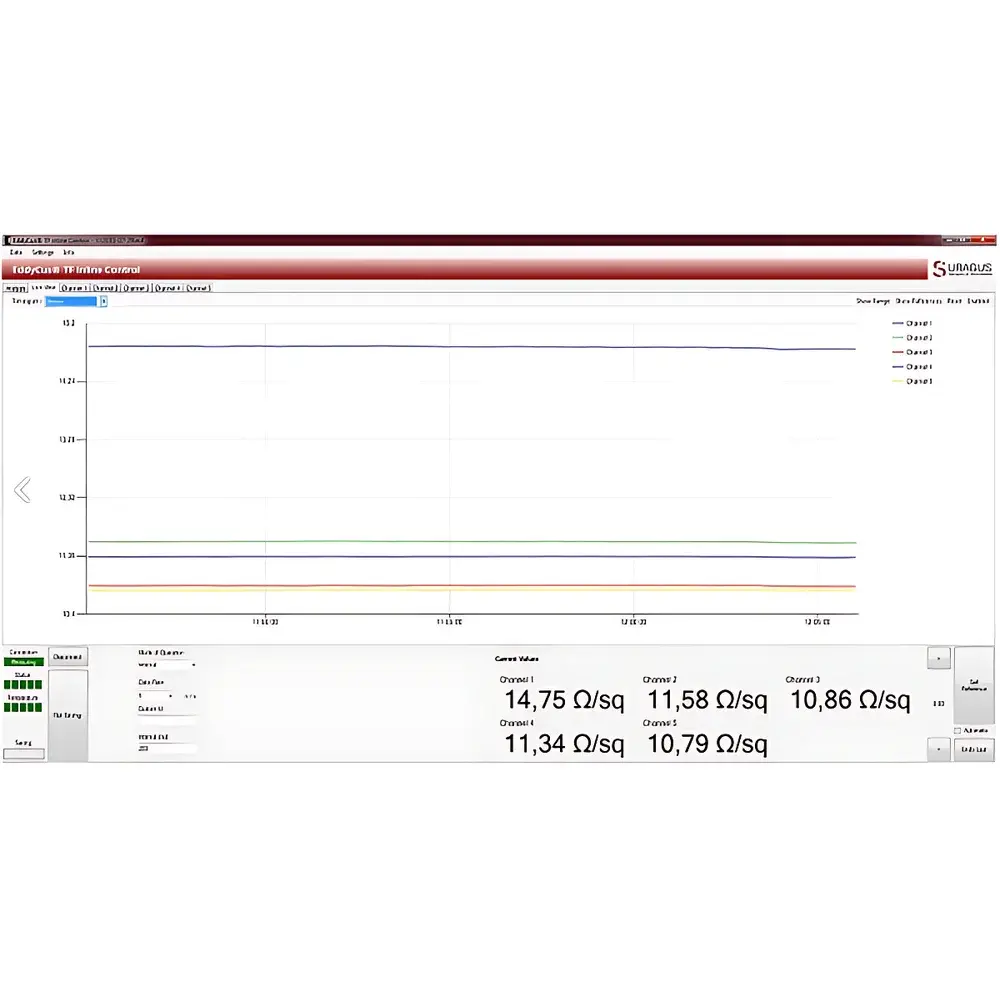
SURAGUS provides the EddyControl software suite as a configurable framework—not a black-box GUI. It delivers raw sensor voltage waveforms, demodulated amplitude/phase outputs, and derived Rs/thickness values via open APIs. Users may implement custom calibration models (e.g., incorporating temperature compensation or multi-layer correction factors) using Python or C# extensions. Data export formats include CSV, HDF5, and memory-mapped binary for integration with MATLAB, Python pandas, or LabVIEW. All measurement sessions are timestamped with microsecond precision and support hardware-triggered acquisition synchronized to encoder pulses or PLC strobes. Optional add-ons include statistical process control (SPC) dashboards with Cp/Cpk calculation, real-time deviation mapping, and alarm thresholds tied to ISO 9001-defined control limits.
Applications
- Architectural smart glass production: monitoring low-emissivity (Low-E) coating uniformity on float glass lines
- Touch sensor manufacturing: verifying Ag grid continuity and Rs homogeneity across 10+ inch panels prior to lamination
- OLED encapsulation: quantifying thin Al or Mg:Ag cathode thickness in inert-gas gloveboxes
- Photovoltaic transparent electrodes: in-line Rs/transmittance trade-off optimization for perovskite top cells
- Flexible heating films: ensuring consistent NiCr or carbon-black ink thickness on PET substrates for automotive defrosting elements
- Fuel cell bipolar plates: validating TiN or stainless-steel coating integrity post-PVD on graphite substrates
- EMI shielding packaging: rapid screening of vapor-deposited Al layers on pharmaceutical blister foils
FAQ
Can the EddyCus TF inline measure non-metallic conductive films like ITO or PEDOT:PSS?
Yes—provided the film exhibits sufficient electrical conductivity (>10−3 S/cm) and resides on a non-conductive substrate. Calibration requires reference samples with known Rs measured by accredited four-point probe.
Is vacuum compatibility standard or optional?
Vacuum-rated sensors (KF40 or CF flange options) and feedthrough cabling are available as factory-configured options. Standard units operate in ambient air or dry nitrogen environments.
How is thickness accuracy affected by substrate curvature or surface roughness?
Eddy current response is sensitive to lift-off variation. For curved or textured surfaces, gap distance must be stabilized via mechanical guides or active focus tracking. Surface roughness >10% of skin depth introduces measurable uncertainty and should be characterized separately.
Does the system support automated pass/fail classification based on user-defined Rs tolerances?
Yes—via programmable logic in EddyControl or external PLC integration. Binary output signals (OK/NOK) can drive reject mechanisms or log events to MES databases.
What documentation is provided for regulatory validation?
SURAGUS supplies IQ/OQ templates, sensor calibration certificates (traceable to PTB or NIST), uncertainty budgets per GUM guidelines, and interface protocol specifications—all required for FDA/EU MDR submissions.



