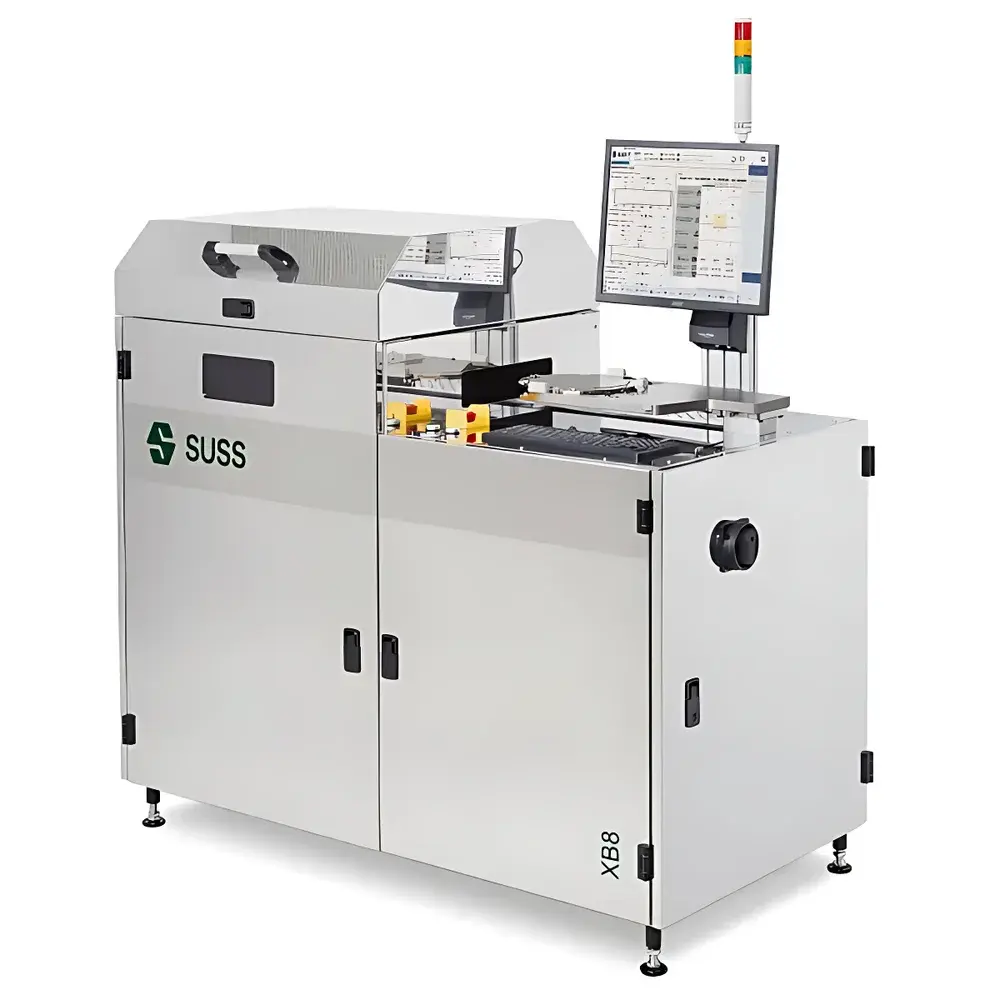
SUSS XB8 Wafer Bonding System
| Brand | SUSS MicroTec |
|---|---|
| Origin | Germany |
| Model | XB8 |
| Maximum Wafer Size | 200 mm |
| Bonding Temperature Range | Up to 500 °C |
| Heating Rate | Up to 30 K/min |
| Vacuum Capability | Down to 5×10⁻⁵ mbar (abs) |
| Bond Force Control | Triple-Zone Precision Force Application |
| Chamber Atmosphere | N₂-purged, Programmable Pressure Control |
| Heating Architecture | Dual-Zone Ceramic Heaters with Active Air Cooling |
| Spacer Removal | Sequential Spacer Release (SSR) |
| Automation Level | Semi-Automated with Recipe-Driven Process Control |
Overview
The SUSS XB8 Wafer Bonding System is a semi-automated, high-precision bonding platform engineered for research, development, and high-mix production environments in MEMS, advanced packaging, 3D integration, and engineered substrate manufacturing. Based on thermocompression, anodic, and direct wafer bonding principles, the XB8 delivers reproducible, contamination-controlled interfaces through tightly regulated thermal, mechanical, and environmental parameters. Its modular chamber architecture supports process flexibility across diverse material systems—including silicon, glass, SiC, GaN, and low-k dielectrics—while maintaining strict adherence to cleanroom-compatible operational protocols. Designed and manufactured in Germany, the system integrates metrology-grade thermal uniformity, vacuum integrity, and force resolution to meet the stringent requirements of sub-micron alignment retention and interfacial defect minimization.
Key Features
- Dual-Zone Ceramic Heating System: Independent top and bottom ceramic heaters with active air cooling enable precise, symmetric thermal profiling across the full 200 mm wafer area. Temperature uniformity is maintained within ±1.5 °C over the active bonding zone (100 mm diameter), minimizing thermal stress-induced misalignment.
- Triple-Zone Bond Force Control: Force is applied only where mechanical support exists—targeting the central 100 mm region while actively decoupling pressure from the unsupported 50 mm peripheral edge. This prevents wafer warpage and ensures nanoscale contact conformity during bond initiation.
- Sequential Spacer Release (SSR): Fully programmable spacer removal via recipe-defined timing and sequence eliminates clamping-induced lateral displacement. Each spacer is retracted individually under real-time force monitoring, preserving pre-bond alignment accuracy to <±0.5 µm.
- High-Vacuum Bonding Environment: Integrated turbomolecular pumping achieves base pressures down to 5×10⁻⁵ mbar (abs) within five minutes. Pressure ramping profiles are fully programmable—from atmospheric (3000 mbar abs) to ultra-high vacuum—enabling oxide-free direct bonding and low-contamination anodic processes.
- N₂-Purged Closed Process Chamber: Automated wafer loading occurs under continuous nitrogen purge, maintaining particle counts below ISO Class 4 (≤352 particles/m³ ≥0.5 µm) throughout chamber access cycles.
- Recipe-Driven Process Management: All critical parameters—including temperature ramp rates (up to 30 K/min), dwell times, force profiles, pressure transitions, and SSR sequencing—are stored, versioned, and executed as validated process recipes compliant with GLP/GMP documentation standards.
Sample Compatibility & Compliance
The XB8 accommodates wafers up to 200 mm in diameter with thicknesses ranging from 100 µm to 1.5 mm, including handled and unhandled substrates. It supports bonded pairs with thickness asymmetry ≤20% and total stack warpage <20 µm. The system is compatible with standard SEMI-compliant FOUPs and aligner-integrated load ports. From a regulatory standpoint, its data logging architecture meets FDA 21 CFR Part 11 requirements for electronic records and signatures, with audit-trail-enabled parameter tracking, user access controls, and recipe change history. All vacuum, thermal, and force sensors are traceably calibrated per ISO/IEC 17025-accredited procedures, supporting qualification under ASTM F2629 (Standard Guide for Wafer Bonding Process Characterization) and ISO 17025-based internal validation protocols.
Software & Data Management
The XB8 operates under SUSS’s proprietary BOND-OS™ control software, a Windows-based platform featuring intuitive recipe editor, real-time multi-parameter trending, and automated pass/fail decision logic based on user-defined thresholds. Process data—including temperature gradients, force transients, vacuum evolution, and SSR event timestamps—is logged at 100 Hz resolution and exported in CSV or HDF5 format for offline analysis. Integration with factory MES systems is supported via SECS/GEM protocol. Software updates and calibration certificates are managed through SUSS’s secure cloud portal, ensuring version control and compliance traceability across global installations.
Applications
- MEMS encapsulation using silicon-glass anodic bonding
- 3D TSV stacking with Cu-Cu thermocompression bonding
- Heterogeneous integration of compound semiconductors (e.g., GaN-on-Si)
- SOI and engineered substrate fabrication via direct wafer bonding
- Low-temperature hybrid bonding for advanced interconnects
- R&D of novel bonding interfaces requiring ultra-clean, high-vacuum environments
FAQ
What wafer sizes does the XB8 support?
The XB8 is configured for 100 mm, 150 mm, and 200 mm wafers; tooling and alignment fixtures are swappable without hardware modification.
Does the system support in-situ alignment verification?
No—the XB8 is a bonding-only platform; it requires upstream alignment via compatible mask aligners or stepper systems. However, SSR and triple-zone force control preserve alignment fidelity post-transfer.
Is remote diagnostics available?
Yes—via encrypted VNC connection and SUSS Remote Support Portal, enabling real-time troubleshooting and predictive maintenance alerts based on subsystem health metrics.
Can the XB8 be integrated into a cluster tool environment?
Yes—through standard front-end interface modules (FEIF) and SECS/GEM communication, allowing seamless handoff between lithography, etch, and bonding stations.
What calibration intervals are recommended?
Thermal sensors: annually; vacuum gauges: every six months; force transducers: after 500 bonding cycles or annually—whichever occurs first—per SUSS Calibration Protocol CP-XB8-01.