
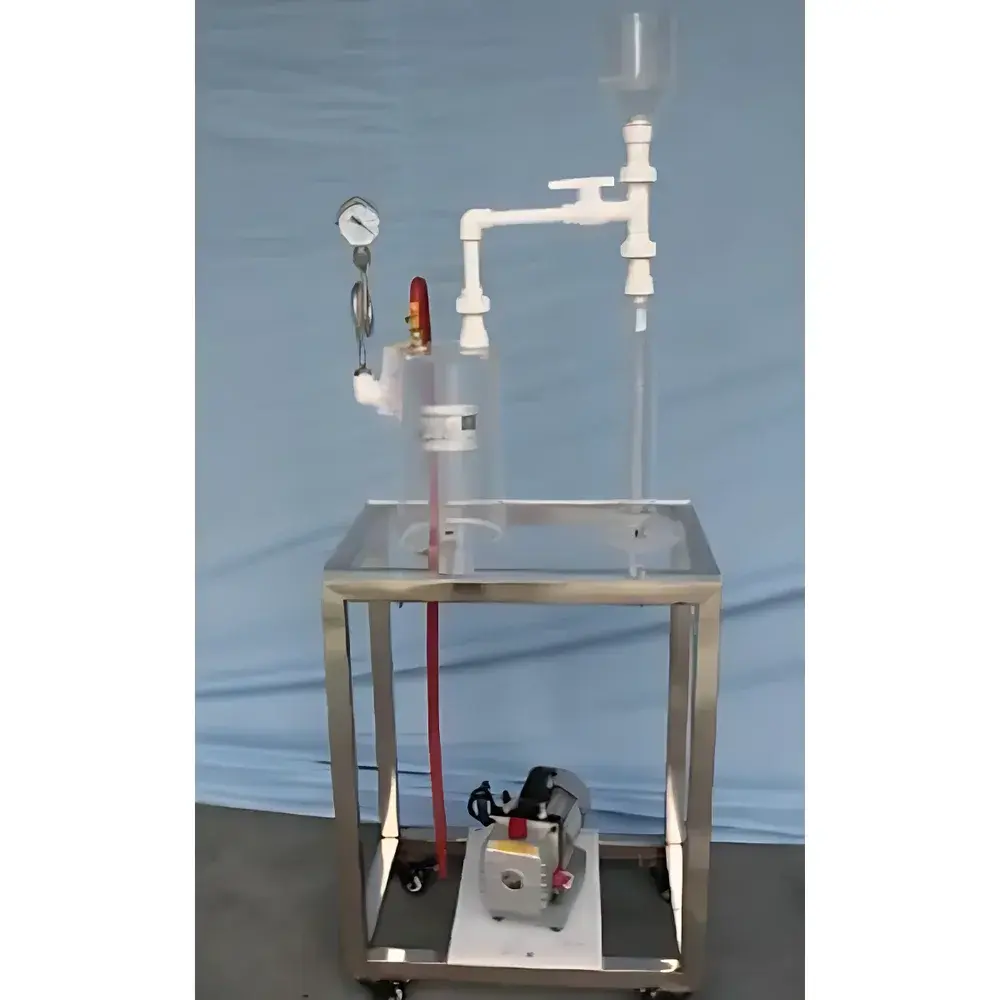
HengaoDe HAD-TG-250 Dual-Station Sludge Specific Resistance Tester for Academic Laboratories
| Brand | HengaoDe |
|---|---|
| Origin | Beijing, China |
| Manufacturer Type | Authorized Distributor |
| Country of Origin | China |
| Model | HAD-TG-250 |
| Price | USD 28.50 (FOB) |
| Filtration Cylinder Dimensions | Ø150 × 250 mm |
| Overall Dimensions | 500 × 350 × 1300 mm |
| Power Supply | 220 V AC, 50 Hz |
| Rated Power | 200 W |
| Vacuum Gauge | Analog, 0–0.1 MPa |
| Filtration Units | 2 × Buchner funnels (Ø100 mm, acrylic) |
| Graduated Cylinders | 2 × 300 mL |
| Flow Control | Bleed valve & leak valve |
| Frame Material | Stainless steel |
Overview
The HengaoDe HAD-TG-250 Dual-Station Sludge Specific Resistance Tester is an educational-grade instrument engineered for quantitative assessment of dewaterability in municipal and industrial wastewater sludges. It operates on the fundamental principle of constant-pressure vacuum filtration, where sludge is subjected to a controlled negative pressure across a standardized filter medium, and the time-dependent filtrate volume is recorded to calculate specific resistance (α, in m/kg). This parameter—defined per ASTM D2087 and widely referenced in ISO 16269-6 and EN 12255-4—is critical for evaluating conditioning efficiency, selecting dewatering equipment (e.g., belt presses or centrifuges), and optimizing polymer dosage in academic water treatment laboratories. Designed explicitly for university teaching labs and undergraduate environmental engineering courses, the HAD-TG-250 features dual parallel filtration stations to enable comparative experiments (e.g., conditioned vs. unconditioned sludge), reproducible geometry, and transparent acrylic construction for real-time process observation.
Key Features
- Dual independent filtration channels with identical Ø100 mm acrylic Buchner funnels and matched 300 mL graduated collection cylinders—enabling side-by-side experimental replication and statistical validation.
- Vacuum system integrated with a maintenance-free diaphragm pump (rated ultimate vacuum ≤ −90 kPa), calibrated analog vacuum gauge (0–0.1 MPa), and precision bleed/leak valves for stable, adjustable suction control.
- Modular acrylic filtration cylinder (Ø150 × 250 mm) fabricated from optical-grade polymethyl methacrylate (PMMA) for chemical resistance to common coagulants (e.g., FeCl₃, Al₂(SO₄)₃) and ease of cleaning between runs.
- Stainless steel load-bearing frame (AISI 304) with anti-corrosion surface treatment, ensuring long-term dimensional stability and compliance with laboratory safety standards (IEC 61010-1).
- No external water aspirator or compressed air source required—fully self-contained operation powered solely by standard 220 V AC supply.
Sample Compatibility & Compliance
The HAD-TG-250 accommodates raw, digested, chemically conditioned, or thermally treated sludges with total solids (TS) content ranging from 0.5% to 8%. Filter media compatibility includes standard qualitative ashless filter paper (e.g., Whatman Grade 41, Ø11 cm) and synthetic membranes (e.g., polyethersulfone, pore size 0.45 µm), provided they conform to the ASTM D2087-defined support geometry. All wetted components meet USP Class VI biocompatibility requirements. The apparatus supports GLP-aligned documentation workflows: filtration time, vacuum level, and filtrate volume are manually logged in accordance with ISO/IEC 17025 clause 7.7 (recording of raw data), and calibration certificates for the vacuum gauge and volumetric cylinders can be supplied upon request.
Software & Data Management
While the HAD-TG-250 is a benchtop manual instrument without embedded microprocessors, it is fully compatible with digital lab data capture systems. Users may integrate it into LIMS or ELN platforms via standardized templates for sludge characterization (e.g., ASTM D2087 Annex A1 calculation sheet). Optional accessories include USB-connected digital timers (±0.1 s accuracy) and certified Class A volumetric glassware sets traceable to NIST SRM 2192. For regulatory submissions (e.g., EPA Method 1680), raw data sheets generated using this instrument satisfy FDA 21 CFR Part 11 requirements when paired with electronic signatures and audit-trail-enabled software.
Applications
- Undergraduate laboratory instruction in environmental engineering curricula: hands-on determination of specific resistance, capillary suction time (CST), and bound water content.
- Research on polymer selection and dosing optimization for sludge conditioning—comparing cationic, anionic, and non-ionic flocculants under controlled shear and pH conditions.
- Validation of pilot-scale dewatering performance: correlating α-values with belt press throughput or centrifuge cake solids concentration.
- Comparative studies of thermal hydrolysis, ozonation, or enzymatic pretreatment on sludge filterability.
- Accreditation testing for ISO/IEC 17025-compliant environmental testing laboratories requiring traceable, low-cost reference instrumentation.
FAQ
Is the HAD-TG-250 compliant with ASTM D2087?
Yes—the geometry, vacuum control range, and filtration timing methodology strictly adhere to the procedural requirements outlined in ASTM D2087-22, including specified funnel diameter, pressure differential, and data recording intervals.
Can it be used with activated carbon–amended sludges?
Yes; the acrylic construction resists abrasion from particulate additives, and the Ø100 mm funnel accommodates standard filter papers saturated with carbon slurries without channeling.
What maintenance does the vacuum pump require?
The included diaphragm pump is oil-free and maintenance-free for ≥5,000 hours of intermittent operation; only periodic inspection of inlet filters and replacement of worn diaphragms (every 2–3 years under typical academic use) is recommended.
Is calibration documentation available?
Factory calibration reports for the vacuum gauge (traceable to CNAS-accredited metrology lab) and optional NIST-traceable volumetric cylinder certification are available at additional cost.
Does it support automated data logging?
Not natively—but its analog outputs and mechanical repeatability make it ideal for integration with third-party DAQ systems (e.g., National Instruments USB-6009) using custom LabVIEW or Python scripts.





