
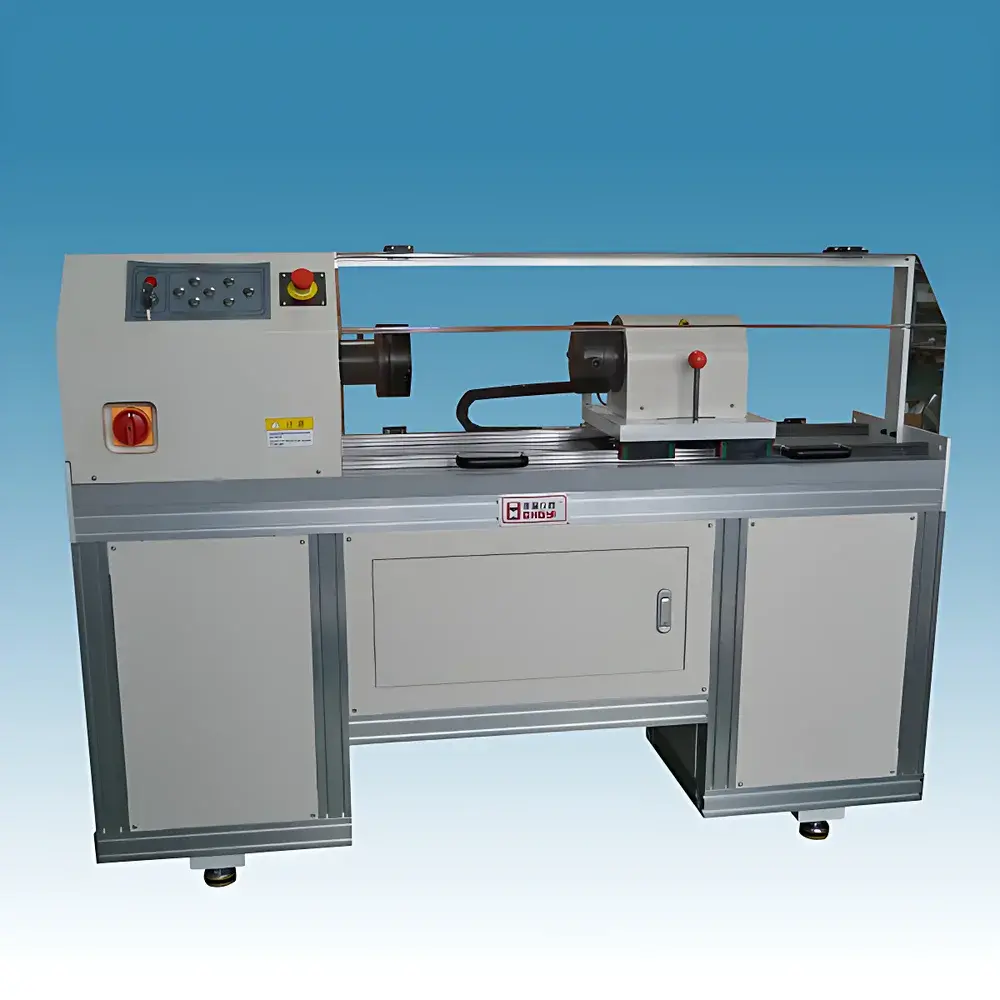
Hengyi HY-1000N·m Computer-Controlled Electronic Torsion Testing Machine
| Brand | Hengyi / Hengyitest |
|---|---|
| Origin | Shanghai, China |
| Manufacturer Type | Direct Manufacturer |
| Regional Classification | Domestic (China) |
| Model | HY-1000NMPD |
| Price Range | USD 2,800 – 7,000 (FOB Shanghai) |
| Max Torque | 1000 N·m |
| Torque Measurement Range | 1–1000 N·m |
| Torque Resolution | 0.001 N·m |
| Torsional Angle Measurement Range | 0–100,000° (or continuous rotation) |
| Motor Power | 1.5 kW |
| Torque Accuracy | ±0.5% FS |
| Angular Position Accuracy | ±0.5% FS |
| Angular Velocity Accuracy | ±0.5% |
| Gauge Length Adjustment Range | 550 mm |
| Torsion Speed Range | 0–1000°/min |
| Specimen Clamping Diameter | Φ6–Φ32 mm |
| Overall Dimensions (L×W×H) | ≈1500×420×1250 mm |
| Weight | 500 kg |
Overview
The Hengyi HY-1000N·m Computer-Controlled Electronic Torsion Testing Machine is a precision-engineered, horizontal-axis torsion testing system designed for static and quasi-static mechanical characterization of metallic wires, rods, shafts, fasteners, composite laminates, and structural components under pure torsional loading. It operates on the principle of controlled angular displacement actuation coupled with high-fidelity torque transduction, enabling direct measurement of torsional stiffness, yield torque (τy), ultimate torque (τu), plastic deformation behavior, and—when integrated with optional high-resolution angular metrology—calculation of shear modulus (G) and non-proportional shear stress (τp). The system conforms to fundamental torsion mechanics theory as defined in ISO 7800, ASTM E143, and GB/T 10128, supporting both single-cycle monotonic twist-to-failure tests and multi-cycle fatigue-relevant protocols with programmable dwell, reversal, and step-load sequences.
Key Features
- Robust horizontal frame architecture with high-rigidity welded steel base and powder-coated enclosure for long-term dimensional stability and operator safety;
- High-dynamic Japanese Panasonic AC servo motor paired with precision cycloidal pinwheel reducer (Tianjin XWECS58165B), delivering smooth, low-backlash torque transmission across 0–1000°/min speed range;
- 1000 N·m capacity high-accuracy torque transducer (West Sensor brand), calibrated to ±0.5% full-scale error, featuring temperature-compensated strain-gauge technology and IP65 environmental rating;
- Imported optical encoder with 0.001° angular resolution and real-time feedback loop, enabling sub-degree repeatability in position control and dynamic angle tracking;
- Dual-closed-loop digital control system based on 32-bit ARM microprocessor (ARM7TDMI core, 56 MIPS), supporting 100 Hz sampling rate, 115.2 kbps serial communication, and 1:2,000,000 speed regulation ratio;
- Modular fixture system accommodating specimens from Φ6 mm to Φ32 mm diameter; adjustable gauge length up to 550 mm with precision linear scale verification;
- Compliance-ready software architecture supporting audit trails, electronic signatures, and test method versioning—aligned with GLP/GMP documentation requirements and FDA 21 CFR Part 11 principles when deployed with validated IT infrastructure.
Sample Compatibility & Compliance
The HY-1000NMPD accommodates solid cylindrical specimens (e.g., steel rods, aluminum wires, titanium fasteners), hollow tubes, and engineered polymer or fiber-reinforced composite shafts. Its clamping mechanism ensures uniform radial load distribution without slippage or localized yielding at the grip interface. The system supports standardized test execution per ISO 7800 (metallic materials — torsion test), ASTM E143 (shear modulus determination), JIS Z 2241 (tensile and torsion testing of metallic materials), DIN 50114 (torsional testing of round bars), and Chinese national standard GB/T 10128 (metallic materials — tensile and torsion testing). All calibration certificates are traceable to CNAS-accredited primary standards, and raw data files retain unalterable timestamps, user IDs, and instrument configuration metadata for regulatory review.
Software & Data Management
The included Windows-based testing software (compatible with Windows 10/11, 64-bit) provides intuitive test definition, real-time curve plotting (torque vs. angle, torque vs. time, angle vs. time), and post-test parameter extraction—including maximum torque, proof torque at specified angular offset, torsional modulus, plastic angle of twist, and hysteresis area. Each test session generates an XML+CSV dual-format report containing full waveform data, statistical summaries, and compliance flags against user-defined pass/fail thresholds. Data export supports direct integration into LIMS environments via ODBC drivers, and raw binary logs can be reprocessed offline using the same algorithmic kernel to ensure result reproducibility across laboratories.
Applications
- Quality assurance of automotive drive shafts, steering columns, and suspension linkages;
- R&D evaluation of torsional fatigue life in biomedical implant alloys (e.g., Ti-6Al-4V, CoCrMo);
- Shear modulus validation for aerospace-grade carbon-fiber composites under ISO 14129;
- Mechanical certification of threaded fasteners per ISO 898-1 and SAE J429;
- Educational mechanics labs conducting torsion-based elasticity experiments (e.g., G-modulus derivation from slope of linear region);
- Third-party testing laboratories performing accredited torsion testing for ISO/IEC 17025 scope expansion.
FAQ
What standards does this machine support out-of-the-box?
The HY-1000NMPD includes preloaded test templates for ISO 7800, ASTM E143, GB/T 10128, JIS Z 2241, and DIN 50114. Custom method development is supported via editable script modules.
Can it measure shear modulus (G) automatically?
Yes—when configured with the optional high-precision angular measurement module (sub-0.01° resolution), the software computes G directly from the linear slope of the torque–angle curve in the elastic region, per ASTM E143 Annex A1.
Is the system compatible with networked lab environments?
It supports TCP/IP-based remote monitoring and file transfer. For full LIMS integration, API documentation and HL7/ODBC connectors are available upon request.
What maintenance is required for long-term accuracy?
Annual recalibration of the torque sensor and encoder is recommended. The servo motor and reducer require no scheduled lubrication; all critical components carry CE and RoHS declarations.
Does the software meet FDA 21 CFR Part 11 requirements?
The software provides role-based access control, electronic signature capture, and immutable audit logs. Full Part 11 compliance requires customer-side validation per internal SOPs and infrastructure controls.



