
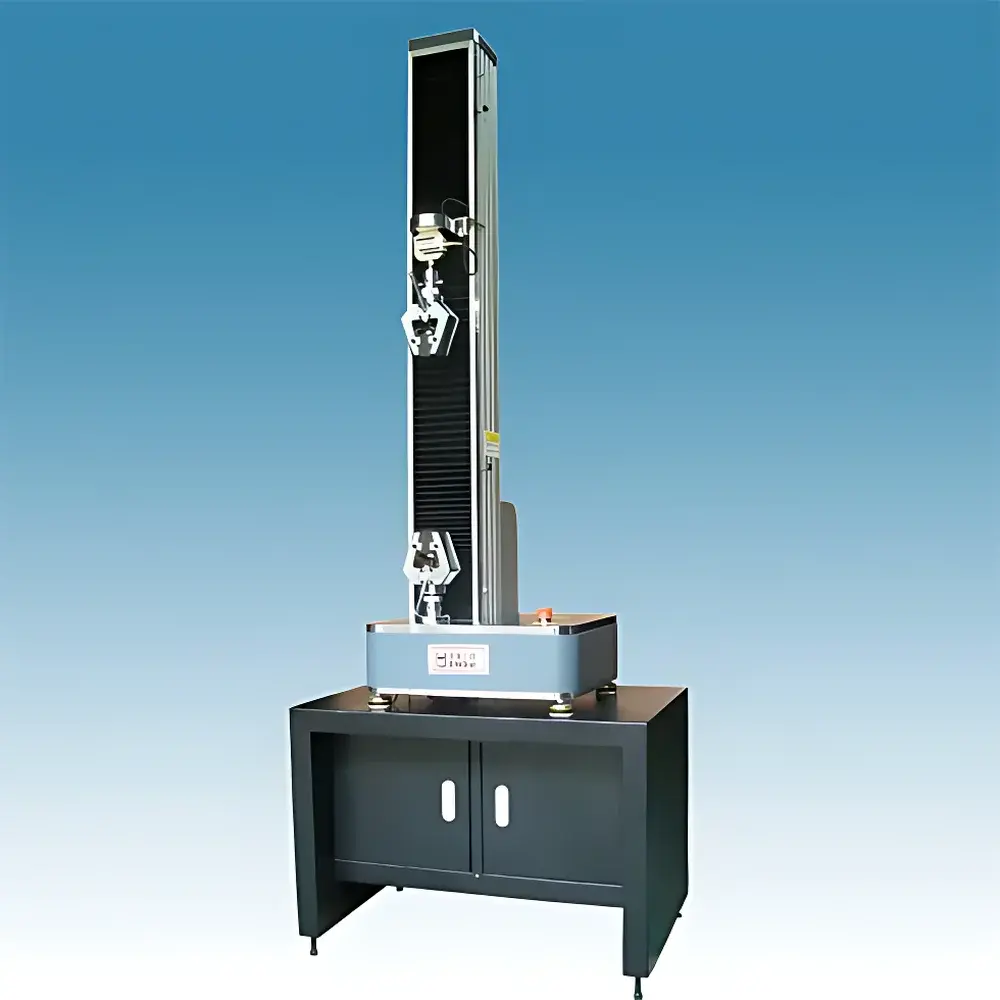
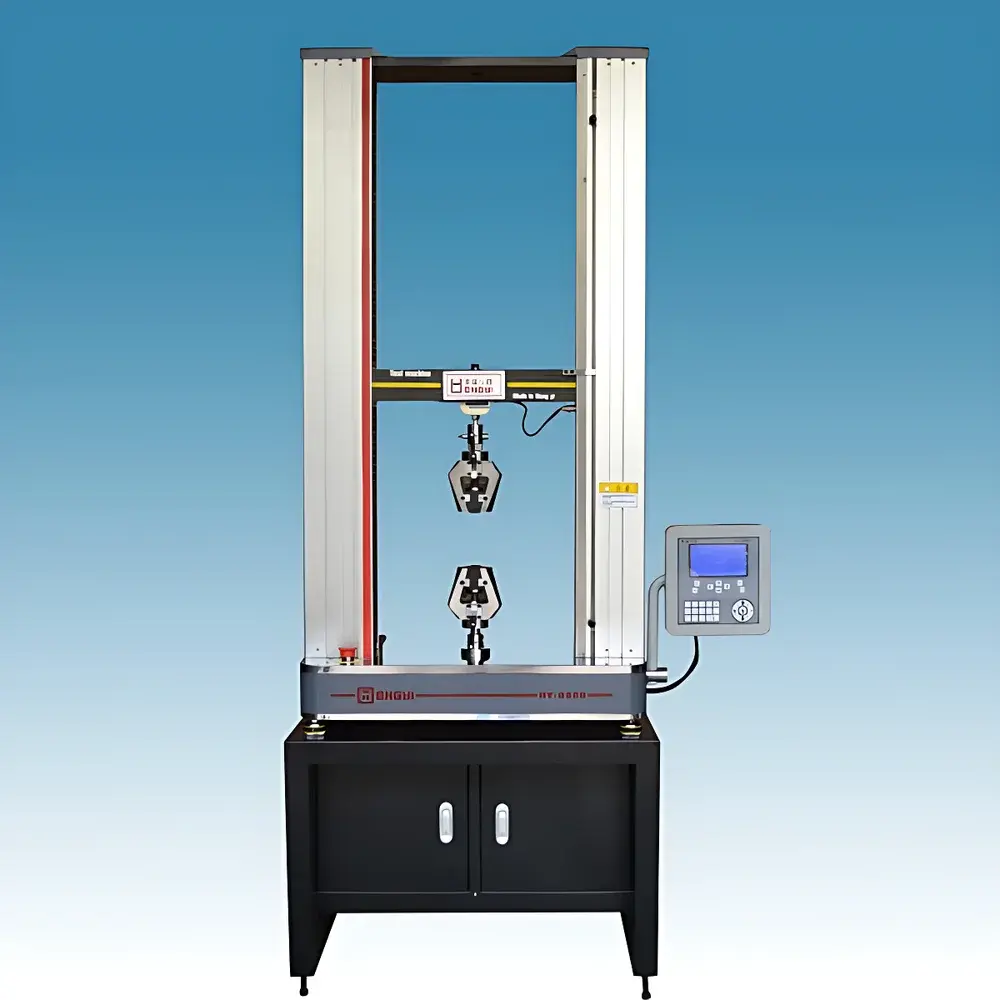
Hengyi HY-0580 5000N Electromechanical Universal Tensile Testing Machine
| Brand | Hengyi |
|---|---|
| Origin | Shanghai, China |
| Manufacturer Type | Direct Manufacturer |
| Model | HY-0580–5000N |
| Load Capacity | 1 N to 5000 N (multi-range configurable) |
| Accuracy Class | ≤0.5% |
| Effective Test Width | 120 mm |
| Vertical Test Space | 800 mm |
| Speed Range | 0.001–500 mm/min |
| Speed Accuracy | ±0.5% of indicated value |
| Force Resolution | ±500,000 counts (full-scale, no range switching) |
| Displacement & Strain Accuracy | ±0.5% of indicated value |
| Stress/Strain Control Rate Range | 0.002–6% FS/s |
| Power Supply | 220 V AC, 750 W |
| Net Weight | 95 kg |
| Dimensions (W×D×H) | 470 × 400 × 1510 mm |
Overview
The Hengyi HY-0580 5000N Electromechanical Universal Tensile Testing Machine is a precision-engineered static mechanical tester designed for uniaxial tensile, compression, flexure, shear, peel, tear, and cyclic loading applications. Built upon a rigid single-column load frame architecture, it employs closed-loop electromechanical actuation—driven by a high-torque, maintenance-free Panasonic servo motor and digital servo controller—to deliver repeatable force application and displacement control across its full 5000 N capacity range. The system conforms to fundamental principles of quasi-static mechanical testing as defined in ISO 6892-1 (metallic materials), ISO 527-1 (plastics), ASTM D638/D3039/D790/D1876, and GB/T 228.1, enabling standardized determination of mechanical properties including ultimate tensile strength, yield strength (0.2% offset or non-proportional), Young’s modulus, elongation at break, compressive strength, flexural modulus, and peel adhesion energy. Its modular design supports both routine QC verification and R&D-grade material characterization under controlled ambient conditions.
Key Features
- Rigid single-column steel frame with preloaded high-precision ground ball screw (imported) for minimal deflection and long-term dimensional stability.
- High-resolution bidirectional load cell (U.S.-sourced, calibrated to ±0.5% accuracy) with automatic transducer recognition and thermal drift compensation.
- Digital controller supporting open-loop speed control and closed-loop stress/strain/displacement rate control—configurable in SI or imperial units with multilingual UI (English, German, French, Spanish, Chinese).
- Integrated safety architecture: electronic limit switches, overload protection (110% FS cut-off), real-time diagnostic monitoring of drive voltage/current/temperature, and emergency stop circuit compliant with IEC 60204-1.
- Ergonomic handheld remote control for jog-mode positioning, rapid return, and test initiation—reducing operator fatigue during high-throughput lab workflows.
- Motorized crosshead with dual-speed (fast/slow) adjustment and precise point-to-point positioning capability for accurate specimen alignment and preload application.
Sample Compatibility & Compliance
The HY-0580 accommodates a broad spectrum of specimen geometries and material classes without hardware modification. Standard test specimens include polymer films (e.g., PET, PE, BOPP), elastomeric strips (natural rubber, silicone), thin metallic foils (Cu, Al), photovoltaic interconnect ribbons, biomedical tubing (PVC, polyurethane), suture materials, orthopedic fixation components, packaging laminates, corrugated board, wood veneers, fiber-reinforced composites, and pharmaceutical blister sealants. All夹具 (fixtures) — tensile grips, compression platens, three/four-point bend fixtures, peel bars, and shear adapters — are manufactured to ISO 2041 and ASTM E4 traceable tolerances. Optional extensometers (contact and non-contact) and large-strain measurement systems extend compliance to ISO 9513 (extensometer classification) and ASTM E83 (verification of extensometer systems). The instrument meets electromagnetic compatibility (EMC) requirements per EN 61326-1 and carries CE marking for use within the European Economic Area.
Software & Data Management
The HY-0580 operates with Hengyi’s proprietary TestMaster Pro software (v4.2+), a Windows-based platform supporting GLP-compliant data acquisition, real-time curve plotting (force vs. displacement, stress vs. strain), and automated report generation in PDF/XLSX formats. Software features include multi-curve overlay, statistical batch analysis (mean, SD, CV%), pass/fail threshold logic, and audit trail logging (user ID, timestamp, parameter changes, calibration events) satisfying FDA 21 CFR Part 11 requirements when deployed with Windows domain authentication and electronic signature modules. Raw data export is supported in ASCII CSV format for third-party analysis in MATLAB, Python (NumPy/Pandas), or Minitab. Calibration certificates—including traceability to NIM (National Institute of Metrology, China) or UKAS-accredited labs—are provided with each shipment and digitally archived within the software’s calibration management module.
Applications
This system serves as a core mechanical testing platform across regulated and non-regulated sectors. In medical device manufacturing, it validates tensile integrity of sutures, balloon catheters, and implantable mesh materials per ISO 10993-12 and USP . In photovoltaics, it quantifies ribbon pull strength and solder joint reliability under thermal cycling preconditioning. Packaging engineers use it to assess seal peel strength (ASTM F88), puncture resistance (ASTM D3776), and delamination energy of flexible laminates. Polymer R&D labs rely on its high-resolution strain control to map viscoelastic transitions in thermoplastics and hydrogels. Quality assurance teams in automotive supply chains deploy it for fastener proof loading (ISO 898-1), gasket compression set (ASTM D395), and composite laminate interlaminar shear strength (ASTM D2344). Its versatility makes it suitable for ISO/IEC 17025-accredited laboratories performing accredited mechanical testing services.
FAQ
What standards does the HY-0580 comply with for calibration and verification?
It complies with ISO 7500-1 (static calibration of force-proving instruments), ISO 9513 (extensometer verification), and JJG 475 (Chinese national verification regulation for universal testing machines). Factory calibration includes NIST-traceable load cell verification.
Can the system be integrated into an existing LIMS or MES environment?
Yes—via TCP/IP or RS232 serial protocol using Modbus RTU or custom API integration; sample drivers and documentation are provided upon request.
Is ASTM E4-compliant verification possible with standard accessories?
Yes—the base configuration includes reference load cells and alignment tools required for E4 verification; optional verification kits include certified reference standards and procedure checklists.
What is the recommended maintenance schedule?
Biannual inspection of ball screw lubrication, load cell zero drift, and encoder linearity is advised; annual recalibration is recommended for GLP/GMP environments.
Are validation documents (IQ/OQ/PQ) available for regulated industries?
Yes—Hengyi provides customizable IQ/OQ protocols aligned with Annex 11 and GAMP5 guidelines; PQ execution support is available through authorized service partners.
Related Products



