
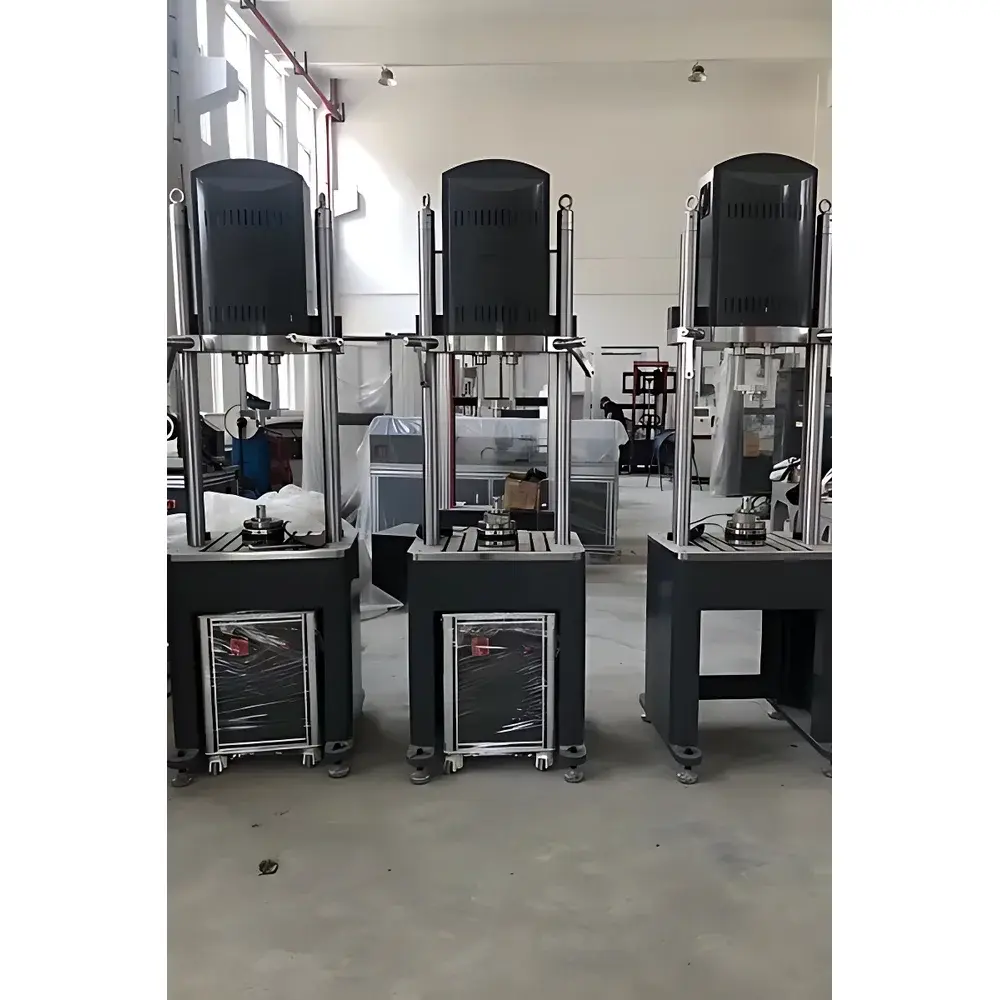
Hengyi HY(DP)502005 Electromechanical Dynamic Tension-Torsion Combined Fatigue Testing Machine
| Brand | Hengyi |
|---|---|
| Origin | Shanghai, China |
| Manufacturer Type | Direct Manufacturer |
| Country of Origin | China |
| Model | HY(DP)502005 |
| Instrument Type | High-Frequency Fatigue Testing Machine |
| Maximum Test Load | ±5000 N |
| Maximum Torque Capacity | ±50 N·m |
| Force Resolution | 0.01 N / 0.01 N·m |
| Force Accuracy | Class 1 (±1% FS) |
| Displacement Accuracy | Class 1 |
| Displacement Range | 0–200 mm (or ±100 mm), Angular Stroke: 0–1000° |
| Displacement Resolution | 0.01 mm |
| Frequency Range | 0–50 Hz |
| Waveform Options | Sine, Cosine, Square, Triangle, Sawtooth |
| Test Space (Tension/Compression) | 300 mm / 500 mm |
| Horizontal Clearance (Left–Right) | 450 mm |
| Vertical Test Height | 500 mm |
| Overall Dimensions (L×W×H) | ≈680 × 700 × 2500 mm |
| Power Supply | 380 V AC, 8 kW |
| Weight | 850 kg |
Overview
The Hengyi HY(DP)502005 Electromechanical Dynamic Tension-Torsion Combined Fatigue Testing Machine is a precision-engineered servo-electric fatigue system designed for controlled, multi-axial mechanical loading of metallic, polymeric, composite, and biomedical specimens under dynamic cyclic conditions. Unlike hydraulic fatigue testers, this electromechanical platform eliminates fluid leakage, noise, and maintenance overhead while delivering high-fidelity force and torque control via closed-loop digital servo drives. It operates on the principle of synchronous actuation of linear and rotary motion modules—enabling independent or coupled tension-compression and torsional loading in real time. The system is calibrated to ISO 7500-1 (static force measurement) and ISO 4965 (dynamic force calibration) standards, supporting both R&D validation and quality assurance workflows in materials science laboratories, automotive component testing centers, and orthopedic device development facilities.
Key Features
- Integrated dual-axis actuation architecture: Linear actuator (±200 mm stroke) and rotary actuator (0–1000° angular displacement) operate synchronously or independently under unified controller coordination.
- High-resolution force and torque sensing: Dual-load cells with ±5000 N axial capacity and ±50 N·m torsional capacity; resolution of 0.01 N and 0.01 N·m ensures detection of micro-scale degradation onset in fatigue life studies.
- Programmable waveform generation: Supports sine, cosine, square, triangle, and sawtooth waveforms at frequencies up to 50 Hz—critical for simulating service loads such as engine vibrations, joint articulation, or gear meshing cycles.
- Class 1 accuracy per ISO 7500-1: Force measurement uncertainty ≤ ±1% of full scale across 1–100% FS range; displacement repeatability ≤ ±1% of set value with 0.01 mm resolution.
- Rigid structural frame: 850 kg mass and reinforced steel base provide exceptional modal stability, minimizing resonance interference during high-frequency testing (≥30 Hz).
- Modular test space design: Standard vertical clearance of 500 mm and horizontal gap of 450 mm accommodate custom fixtures; tensile/compressive working zones are configurable (300 mm / 500 mm) to match specimen geometry and grip requirements.
Sample Compatibility & Compliance
The HY(DP)502005 accommodates standardized specimens per ASTM E466 (axial fatigue), ASTM E606 (strain-controlled fatigue), ISO 1099 (metallic materials), and ISO 14801 (dental implant fatigue). Its open-frame configuration allows integration of environmental chambers (−70°C to +300°C), extensometers (contact/non-contact), and acoustic emission sensors. All force, torque, displacement, and angle data channels comply with ISO/IEC 17025 documentation traceability requirements. System firmware supports audit trail logging and user access control—facilitating GLP/GMP-aligned validation protocols where required.
Software & Data Management
Control and analysis are performed via Hengyi’s proprietary Windows-based software suite, compliant with FDA 21 CFR Part 11 for electronic records and signatures. The interface enables real-time parameter mapping (e.g., stress vs. strain hysteresis loops), cycle counting (Miner’s rule implementation), and automatic termination upon predefined failure criteria (load drop >5%, displacement drift >2%). Raw data exports to CSV, MATLAB (.mat), and universal HDF5 formats; metadata includes timestamp, operator ID, calibration certificate ID, and environmental ambient readings (if external sensors are connected).
Applications
- Biomedical: Fatigue evaluation of spinal fixation rods, dental abutments, and suture anchors under combined bending-torsion loads per ISO 14801.
- Automotive: Durability validation of suspension bushings, CV joint boots, and elastomeric engine mounts subjected to multi-axial road-induced excitations.
- Aerospace: Qualification of titanium alloy fasteners and composite laminates under spectrum loading profiles replicating flight-cycle stresses.
- Academic research: Investigation of crack initiation thresholds in additively manufactured alloys using variable-amplitude tension-torsion sequences.
- Quality control: Batch verification of spring wire fatigue resistance per DIN EN 10270-3, including relaxation and permanent set analysis.
FAQ
What standards does the HY(DP)502005 support for calibration and reporting?
It conforms to ISO 7500-1 (static force), ISO 4965 (dynamic force), and ASTM E466 for test method validation. Calibration certificates include as-found/as-left data, uncertainty budgets, and traceability to NIM (National Institute of Metrology, China).
Can the system perform fully decoupled tension and torsion loading simultaneously?
Yes—the dual-servo architecture allows independent trajectory definition for axial and angular axes, enabling true biaxial stress state simulation with phase-shifted waveforms.
Is third-party software integration possible (e.g., LabVIEW or Python)?
The system provides TCP/IP and DLL-based API interfaces, enabling direct communication with LabVIEW, MATLAB, or Python-based automation frameworks for custom test sequencing and AI-driven anomaly detection.
What is the typical lead time for factory acceptance testing (FAT) and installation support?
Standard FAT duration is 5 business days onsite; remote commissioning with video-assisted alignment is available. Installation requires level concrete foundation (≥C30 grade) and dedicated 380 V / 8 kW three-phase supply with earth resistance <4 Ω.
Does the machine support high-cycle fatigue (HCF) testing above 10⁷ cycles?
Within its 0–50 Hz operational envelope, the system is optimized for low-to-medium cycle fatigue (LCF/MCF: 10²–10⁶ cycles); extended HCF campaigns require optional thermal management upgrades to maintain actuator coil temperature stability.



