
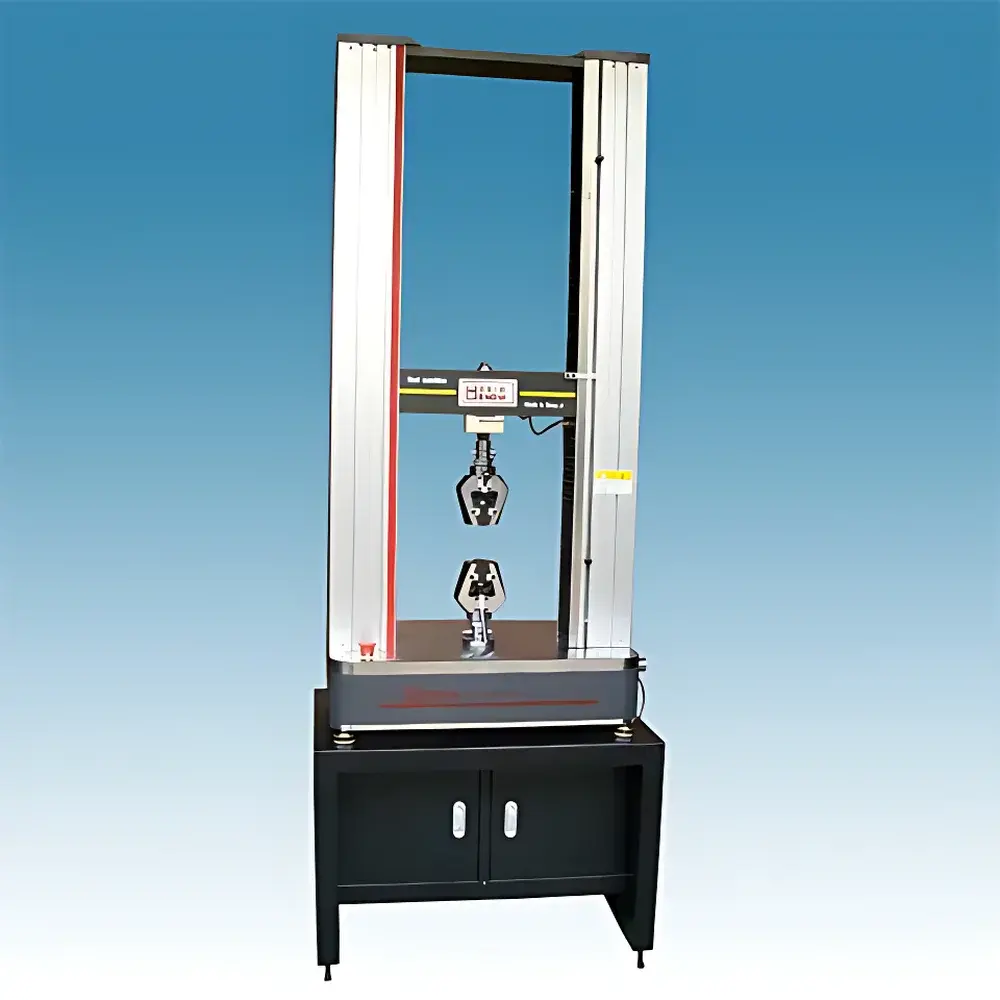
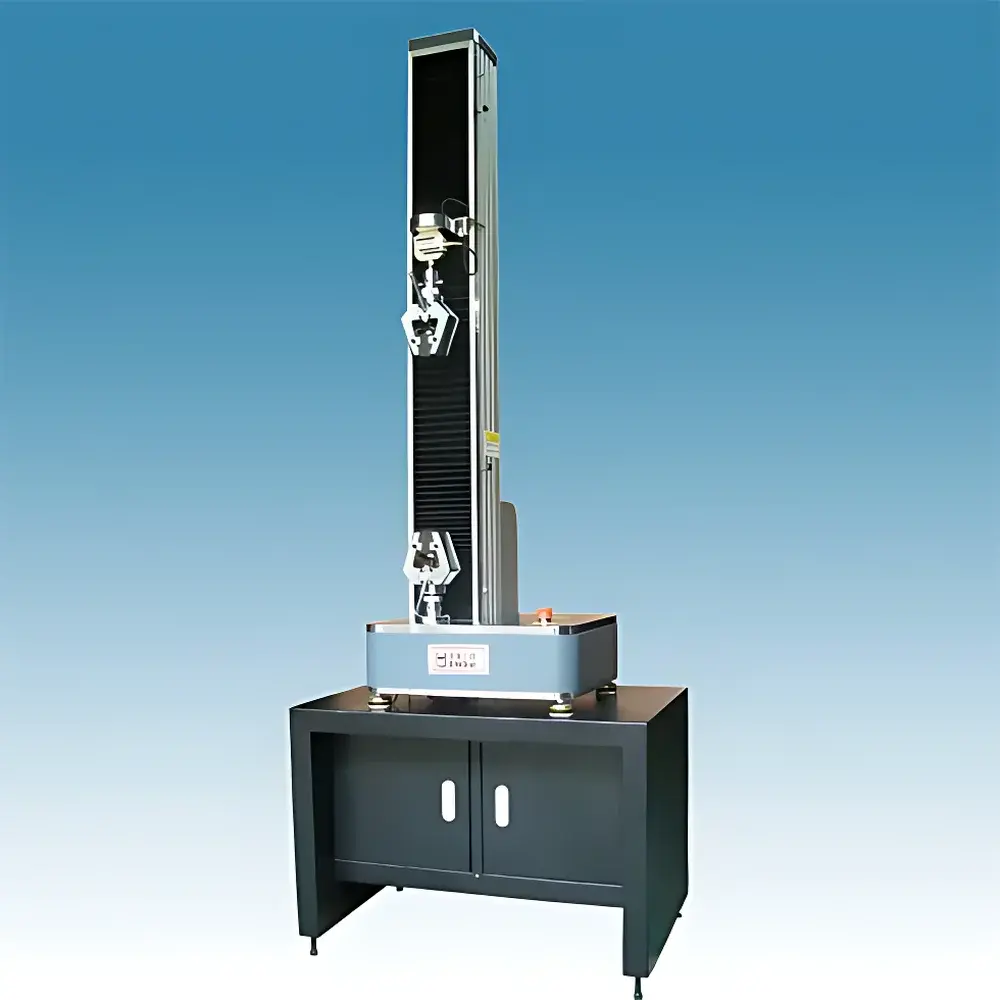
Hengyi HY-0580 Ultra-Light Composite Tensile Testing Machine
| Brand | Hengyi |
|---|---|
| Origin | Shanghai, China |
| Manufacturer Type | Direct Manufacturer |
| Regional Classification | Domestic (China) |
| Model | HY-0580NNGF |
| Instrument Type | Electromechanical Universal Testing Machine |
| Load Capacity Options | 1 N to 5000 N (interchangeable load cells) |
| Force Accuracy | ≤0.5% of reading |
| Effective Test Width | 120 mm |
| Effective Vertical Travel | 800 mm |
| Speed Range | 0.001–500 mm/min |
| Speed Accuracy | ±0.5% of set value |
| Displacement & Strain Measurement Accuracy | ±0.5% of reading |
| Force Resolution | ±500,000 counts (full-scale, no range switching) |
| Power Supply | 220 V AC, 750 W |
| Host Dimensions | 470 × 400 × 1510 mm |
| Net Weight | 120 kg |
Overview
The Hengyi HY-0580 Ultra-Light Composite Tensile Testing Machine is an electromechanical universal testing system engineered for high-fidelity mechanical characterization of advanced lightweight composite structures—particularly carbon fiber-reinforced polymer (CFRP) airfoils, winglets, and structural laminates. Designed around a single-column, servo-controlled architecture, the system implements precise force-displacement control via closed-loop digital feedback, enabling accurate execution of quasi-static tensile, compression, flexural (three-point bending), peel, and shear tests per ASTM D3039, ISO 527-4, ASTM D7264, and GB/T 1447. Its modular load cell configuration (1 N to 5000 N) supports both micro-scale specimen evaluation (e.g., prepreg tow bundles) and full-scale subcomponent validation (e.g., 23-inch-span wing sections under combined central loading and tip torque). The machine’s kinematic design ensures minimal parasitic moments during loading, critical for maintaining pure axial stress states in orthotropic composites.
Key Features
- High-resolution force measurement with ±500,000-count A/D conversion and no internal range switching—ensuring consistent resolution across the entire dynamic range.
- Variable-speed actuation (0.001–500 mm/min) with ±0.5% speed fidelity, supporting both slow-rate creep compliance assessment and rapid failure envelope mapping.
- Dual-mode control architecture: stress-rate (0.005–6% FS/s) and strain-rate (0.002–6% FS/s) modes, each with calibrated accuracy thresholds aligned to ISO 5893 and GB/T 16852.1.
- Integrated electronic limit protection, overload cutoff (110% FS), and real-time self-diagnostic monitoring of drive voltage, current, and load cell signal integrity.
- Motorized crosshead with dual-speed jog control (fast return + fine positioning), programmable auto-return, and user-defined stop conditions (load-, displacement-, or time-triggered).
- Rigid aluminum-alloy frame with precision-ground linear guides and preloaded ball screws—designed to minimize deflection and maintain alignment under off-axis loads typical in winglet torsion testing.
Sample Compatibility & Compliance
The HY-0580 accommodates specimens up to 120 mm wide and 800 mm vertically accessible, making it suitable for standardized coupons (e.g., ASTM D3039 Type I, ISO 527-4 Type 1A) as well as custom geometries such as tapered CFRP spars, honeycomb-core sandwich panels, and hybrid metal-composite joints. Its test space allows implementation of three-point bending fixtures with 23-inch support span and 1-inch-wide loading anvils—directly replicating aerospace structural qualification protocols. The system complies with GB/T 2611-2007 (General Technical Requirements for Testing Machines), GB/T 16491-2008 (Electronic Universal Testing Machines), and GB/T 16852.1-2008 (Verification of Static Uniaxial Testing Machines). Calibration traceability follows ISO/IEC 17025 requirements, and mechanical verification adheres to ASTM E4 and ISO 7500-1 Class 0.5 criteria.
Software & Data Management
The embedded control software provides real-time graphical display of force–displacement, stress–strain, and modulus evolution curves, with configurable sampling rates up to 1 kHz. Test sequences are programmable via step-based scripting—including ramp-hold-relax cycles, cyclic loading profiles, and multi-stage rate transitions. All raw data are stored in ASCII CSV format with metadata headers (test ID, operator, timestamp, environmental notes), ensuring compatibility with third-party analysis platforms (MATLAB, Python Pandas, Minitab). Audit trails record all parameter modifications, calibration events, and user logins—supporting GLP/GMP-aligned documentation workflows. Optional FDA 21 CFR Part 11 compliance packages include electronic signatures, role-based access control, and immutable data archiving.
Applications
- Mechanical validation of aerospace-grade CFRP winglets under combined bending and torsional loading per SAE AIR 4934.
- Tensile property mapping of thermoplastic matrix composites (e.g., PEKK, PEEK) across processing variables (autoclave vs. OoA cure).
- Interlaminar shear strength (ILSS) testing of stitched or Z-pinned laminates using short-beam shear (ASTM D2344).
- Peel resistance quantification of adhesive bonds in hybrid aluminum-CFRP assemblies (ASTM D1876).
- Creep and stress relaxation behavior of bio-based fiber composites (flax, hemp) under controlled humidity environments.
- Educational use in university materials science labs for hands-on instruction on anisotropic constitutive modeling and failure mode analysis.
FAQ
What load cell options are available for the HY-0580, and can multiple cells be swapped without recalibration?
The system supports interchangeable load cells from 1 N to 5000 N. Each cell is factory-calibrated with individual coefficient tables stored in non-volatile memory; swapping requires only selection via software—no manual recalibration needed.
Does the machine meet international standards for traceable force calibration?
Yes—force transducers are certified to ISO 376 Class 0.5 and traceable to NIM (National Institute of Metrology, China) or equivalent national metrology institutes via accredited calibration laboratories.
Can the HY-0580 perform constant strain-rate tests on viscoelastic polymer composites?
Yes—its strain-rate control mode maintains set rates within ±0.5% accuracy above 0.05% FS/s, validated per ISO 5893 Annex B for polymeric systems.
Is third-party software integration supported (e.g., LabVIEW, Python APIs)?
Yes—RS-232 and Ethernet interfaces provide SCPI-compatible command sets; DLL libraries and TCP/IP socket protocols enable direct integration with custom automation frameworks.
What safety mechanisms prevent damage during overtravel or specimen rupture?
Hardware-level electronic limits, software-configurable stroke boundaries, 110% overload cut-off, and instantaneous emergency stop triggering ensure mechanical integrity during unanticipated failure events.



