
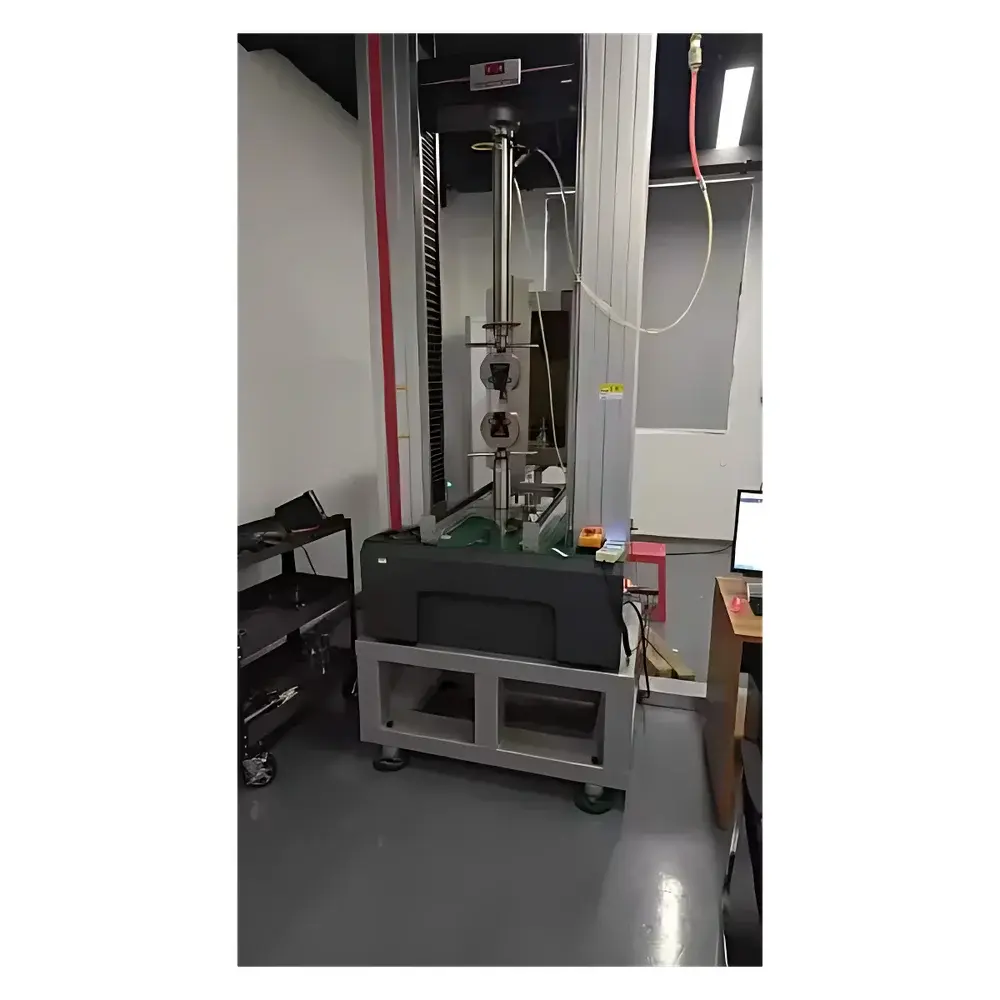
Hengyi HY-0580(CG) High-Temperature Atmosphere-Controlled Miniaturized Disk Bend (Spherical Indentation) Creep and Durability Testing System for Nuclear Service Materials
| Brand | Hengyi |
|---|---|
| Origin | Shanghai, China |
| Manufacturer Type | Direct Manufacturer |
| Country of Origin | China |
| Model | HY-0580(CG) |
| Instrument Type | Electromechanical Universal Testing Machine |
| Load Capacity | 5000 N |
| Force Accuracy | Class 0.5 |
| Force Resolution | ±500000 counts (full-scale, no range switching) |
| Displacement Resolution | 0.0001 mm |
| Strain/Deformation Resolution | 0.0001 mm |
| Effective Test Width | 380 mm |
| Vertical Test Space | 800 mm |
| Speed Range | 0.001–500 mm/min (programmable) |
| Speed Accuracy | ±0.5% of indicated value |
| Displacement Measurement Accuracy | ±0.5% of indicated value |
| Deformation Measurement Accuracy | ±0.5% of indicated value |
| Stress Control Rate Range | 0.005–6 %FS/s |
| Strain Control Rate Range | 0.002–6 %FS/s |
| Constant-Load/Displacement/Strain Hold Accuracy | ±1% (for setpoints <10% FS), ±0.1% (≥10% FS) |
| Temperature Range | 200–1000 °C (integrated high-temperature furnace with controlled atmosphere capability) |
| Compliance | GB/T 29459.2–2012, ASTM E2598, ISO 204, EN 10002-5 (applicable sections), supports GLP/GMP-aligned data audit trails |
Overview
The Hengyi HY-0580(CG) is a purpose-engineered electromechanical testing system designed for miniaturized mechanical characterization of nuclear structural materials under high-temperature, controlled-atmosphere conditions. It implements the standardized spherical indentation (miniaturized disk bend) test method—commonly referred to as the Small Punch Test (SPT)—to evaluate creep deformation, ductile-to-brittle transition temperature (DBTT), fracture toughness (JIC, KIC), yield strength, ultimate tensile strength, elongation at break, and reduction in area from sub-size specimens (typically 8–10 mm diameter × 0.25–0.5 mm thick disks). Unlike conventional uniaxial tensile testing, SPT enables mechanical property assessment where material availability is severely limited—such as irradiated fuel cladding, ODS (oxide dispersion strengthened) ferritic steels, or in-service reactor components—without requiring full-thickness coupons. The system integrates a precision-controlled high-temperature furnace capable of stable operation from 200 °C to 1000 °C under inert (Ar, He) or reducing (H2/Ar) atmospheres, ensuring representative thermo-mechanical response during long-duration creep and durability testing.
Key Features
- Class 0.5 force accuracy per ISO 7500-1 and ASTM E4, validated across full 5000 N load capacity with ±500000-count digital resolution—no internal range switching ensures consistent fidelity from 0.1% to 99.99% FS.
- Sub-micron displacement and strain resolution (0.0001 mm), enabling precise quantification of initial elastic deflection, plastic onset, creep strain accumulation, and final fracture displacement—even over multi-hour tests.
- Programmable test modes: constant-load creep, constant-displacement rate, stress/strain-controlled ramping, and multi-stage hold protocols—including automatic termination upon time, displacement, or load thresholds.
- Integrated high-temperature furnace with dual-zone thermal profiling, ±1 °C uniformity over specimen zone, and gas-tight chamber accommodating controlled purge gases (N2, Ar, H2/Ar mixtures) per ASTM E2921 requirements for oxidation-sensitive alloys.
- Robust mechanical architecture: 150 kg reinforced frame, 380 mm wide crosshead span, 800 mm vertical clearance, and dual-speed motorized crosshead (fast jog + fine positioning) with electronic limit protection and auto-return functionality.
- Real-time synchronized acquisition of load, center-point displacement, and optional extensometer-derived strain at up to 100 Hz sampling—ensuring high-fidelity capture of transient creep stages (primary, secondary, tertiary) and fracture events.
Sample Compatibility & Compliance
The HY-0580(CG) accommodates standard SPT specimens per GB/T 29459.2–2012 and ASTM E2598: circular disks (8.0 ± 0.05 mm diameter, 0.25–0.5 mm thickness), typically cut from rolled plates, tubes, or irradiated segments using EDM or precision milling. Specimen surface finish (Ra ≤ 0.8 µm) and edge chamfer (0.1–0.2 mm) are strictly maintained to minimize stress concentration artifacts. The system supports correlation studies between SPT-derived parameters (e.g., Pmax, δu, δf) and conventional tensile properties via empirical or physics-based models—validated for ODS ferritic steels, austenitic stainless steels (316L, 304), and Ni-based superalloys. Full compliance includes traceable calibration certificates (force, displacement, temperature), GLP-compliant audit trails (user login, parameter changes, test execution logs), and optional 21 CFR Part 11–compliant electronic signatures for regulated nuclear QA/QC environments.
Software & Data Management
The proprietary Hengyi TestMaster™ software provides ISO 17025–aligned test definition, real-time monitoring, and post-processing workflows. Users define multi-step thermal-mechanical profiles (e.g., ramp to 650 °C → soak 30 min → apply 1200 N → hold 100 h → record rupture time), with automated data annotation including specimen ID, heat treatment history, orientation, and surface condition. Raw load–displacement–time datasets are exported in ASCII (.txt) or HDF5 format for third-party analysis (MATLAB, Python, Minitab). Built-in curve-fitting modules calculate creep rate (dδ/dt), time-to-rupture (tr), DBTT via Charpy-SPT correlation, and JIC using the multiple-specimen resistance curve method per ASTM E1820. All data files embed metadata (timestamp, operator, calibration IDs, environmental logs) to satisfy nuclear-grade documentation requirements.
Applications
- Mechanical screening of irradiated nuclear fuel cladding (Zr-alloys, FeCrAl) and structural components after neutron exposure.
- DBTT mapping of ODS ferritic/martensitic steels (e.g., MA956, PM2000) across 200–800 °C to inform reactor design safety margins.
- Certification testing of additively manufactured (AM) nuclear alloys where bulk tensile specimens are unavailable.
- Accelerated creep life modeling for steam generator tubing (Inconel 600/690) under simulated PWR primary coolant chemistry.
- Qualification of repair welds and dissimilar metal joints in aging reactor pressure vessels using micro-scale specimens extracted via replica techniques.
FAQ
What specimen dimensions are supported for SPT testing?
Standard specimens are 8.0 ± 0.05 mm in diameter and 0.25–0.5 mm in thickness; custom geometries (e.g., 10 mm dia.) can be accommodated with fixture adaptation.
Does the system support inert or reducing atmospheres during high-temperature testing?
Yes—the integrated furnace chamber features gas inlet/outlet ports, pressure regulation (±0.02 MPa), and leak-tested seals compatible with Ar, He, N2, and H2/Ar mixtures up to 1000 °C.
How is traceability ensured for nuclear regulatory submissions?
All calibrations follow ISO/IEC 17025 procedures; software enforces electronic audit trails, user authentication, and immutable test records compliant with ASME NQA-1 and IAEA NS-G-1.10 requirements.
Can SPT data be correlated to ASTM E8 tensile properties?
Yes—correlation protocols per GB/T 29459.2–2012 and published literature (e.g., Kim et al., Journal of Nuclear Materials, 2018) are implemented in TestMaster™ for yield strength, UTS, and elongation estimation.
What maintenance intervals are recommended for long-term creep testing reliability?
Preventive maintenance is scheduled every 500 operational hours or annually—covering load cell verification, furnace thermocouple calibration, crosshead lubrication, and encoder alignment checks per OEM service manual.



