
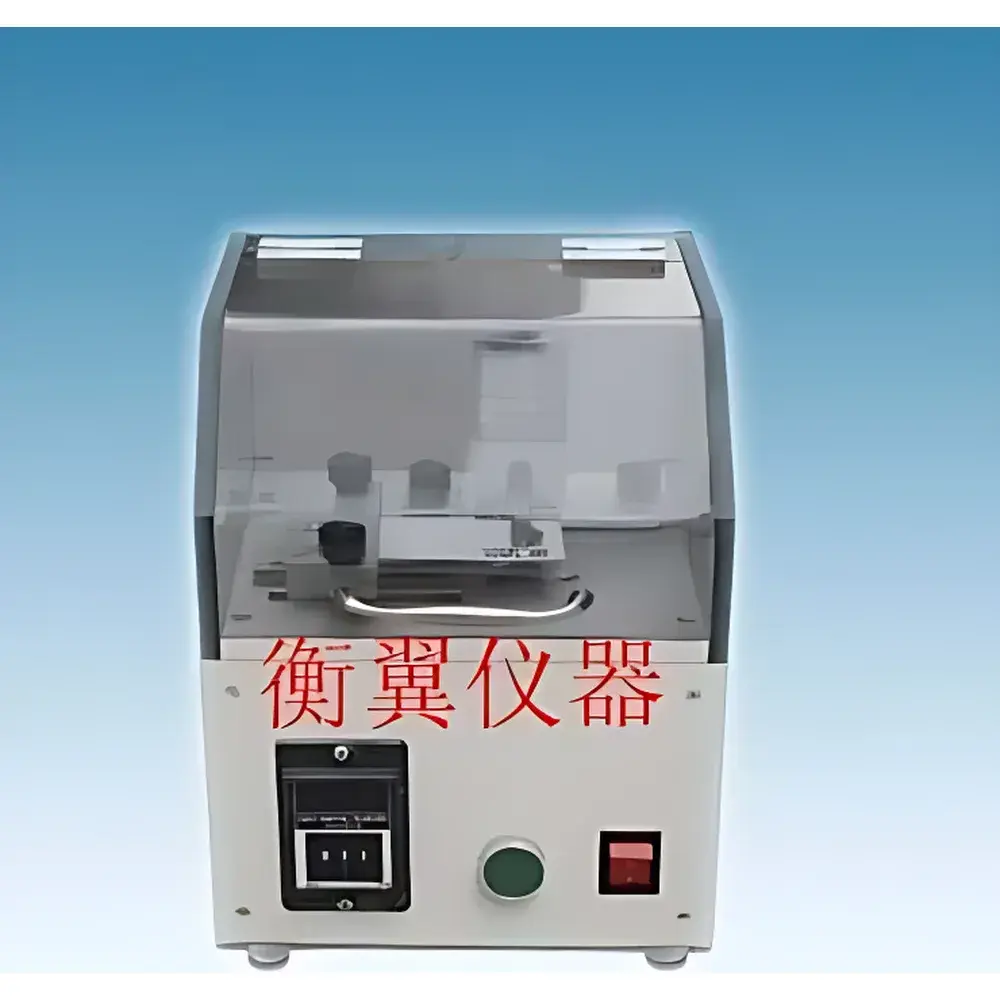
HY(SL)GG Smart Card Triple-Roller Pressure Tester by Hengyi Test
| Brand | Hengyi Test |
|---|---|
| Origin | Shanghai, China |
| Manufacturer Type | Direct Manufacturer |
| Region Classification | Domestic (China) |
| Model | HY(SL)GG |
| Pricing | Upon Request |
Overview
The HY(SL)GG Smart Card Triple-Roller Pressure Tester is an electromechanical test system engineered for standardized mechanical stress evaluation of contact-type smart cards—specifically designed to fulfill the requirements of the Mastercard Card Quality Management (CQM) program. It applies controlled, repetitive rolling compression across three precisely aligned rollers to simulate real-world handling stresses during card insertion, ejection, and frictional wear in terminals and readers. The device operates on a defined kinematic cycle: 100 total passes per test sequence—50 passes with the chip positioned ahead of the roller array and 50 passes with the chip trailing—executed at a nominal frequency of 0.5 Hz (30 cycles per minute). A calibrated downward force of 8 N is applied via gravity-driven loading; an optional 15 N weight is supplied to support CQM-recommended higher-stress validation protocols. Compliance with GB/T 17554.3–2006 (equivalent to ISO/IEC 7816-1:2014 Annex B for mechanical endurance) ensures traceable alignment with international smart card durability benchmarks.
Key Features
- Triple-roller architecture with 10 mm diameter precision-ground rollers, aligned to maintain consistent card trajectory and load distribution.
- Programmable cycle counter with auto-stop functionality—user-defined termination at any integer count (e.g., 100, 500, or 1000 cycles), supporting both pass/fail qualification and accelerated life testing.
- Dual-force configuration: standard 8 N load (default CQM-compliant setting) and optional 15 N load via interchangeable calibrated mass, enabling comparative stress analysis.
- Robust mechanical design: rigid aluminum frame with stainless-steel and electroplated components; all fasteners torqued and verified for long-term repeatability.
- Card positioning accuracy: fixed slot geometry ensures repeatable placement—measured distance from card trailing edge to center roller axis is maintained within 39–41 mm tolerance per test run.
- Integrated safety grounding and organized internal cabling conforming to IEC 61000-6-2 EMC immunity guidelines for laboratory environments.
- Compact footprint (260 × 230 × 280 mm) and lightweight chassis (10 kg), facilitating integration into QC labs, certification centers, and R&D workbenches.
Sample Compatibility & Compliance
The HY(SL)GG accommodates standard ISO/IEC 7810 ID-1 format smart cards (85.6 × 53.98 × 0.76 mm), including PVC, PET, and composite substrate variants. It is validated for use with embedded contact IC cards meeting ISO/IEC 7816-2 physical interface specifications. The tester satisfies mechanical endurance requirements outlined in GB/T 17554.3–2006 (identical in scope to ISO/IEC 7816-1:2014 Annex B), which defines roller-based stress protocols for chip module integrity verification. While not certified to UL or CE as a standalone electrical appliance, its construction adheres to GLP-aligned lab equipment principles—including calibration traceability, operator-accessible maintenance points, and documented mechanical repeatability (±0.5 N force deviation, ±1 mm positional tolerance).
Software & Data Management
This is a hardware-controlled, microprocessor-based electromechanical tester with no embedded operating system or network interface. All operation is managed via front-panel push-button controls and a digital LED counter. Cycle counts are stored non-volatilely and resettable to zero before each test. For audit readiness, users are advised to record test logs manually or integrate with external LIMS platforms via timestamped photo documentation or video capture of pre- and post-test card inspection. The device supports 21 CFR Part 11–compliant workflows when paired with validated electronic lab notebooks (ELNs) that enforce user authentication, electronic signatures, and audit trails for test initiation and result reporting.
Applications
- Pre-certification validation for Mastercard CQM compliance prior to formal submission to accredited labs.
- In-house quality control screening of smart card batches during final assembly and packaging stages.
- Failure mode analysis of chip delamination, solder joint fatigue, or antenna fracture under cyclic rolling shear stress.
- Comparative evaluation of adhesive bonding strength between chip modules and card substrates across material suppliers.
- Supporting root-cause investigations following field returns attributed to mechanical interface failure in POS terminals or ATMs.
- Research into substrate deformation thresholds and interfacial stress distribution using high-speed imaging synchronized with roller actuation.
FAQ
What standards does the HY(SL)GG comply with?
It is explicitly designed to meet GB/T 17554.3–2006, which mirrors ISO/IEC 7816-1:2014 Annex B for mechanical endurance testing of contact smart cards.
Can the test force be adjusted beyond 8 N and 15 N?
No—the system supports only two discrete gravitational loads: the built-in 8 N configuration and the optional 15 N mass provided with the unit. Custom weights are not supported due to mechanical stability and roller torque constraints.
Is calibration documentation included with shipment?
Yes—a factory calibration certificate verifying roller alignment, counter accuracy, and load application tolerance is supplied. Annual recalibration against NIST-traceable force and dimensional standards is recommended.
Does the tester include software or PC connectivity?
No—it is a stand-alone electromechanical instrument with no USB, Ethernet, or Bluetooth interfaces. Data logging requires manual entry or external documentation systems.
What maintenance is required for long-term reliability?
Monthly visual inspection of roller surface finish, lubrication of drive shaft bearings (using ISO VG 32 mineral oil), and verification of screw tightness on structural mounts are advised per the maintenance log sheet included in the operations manual.



